Languages
Monday, October 12, 2026



News and Views from the Global South
Conferences

Millions of Dollars for Climate Financing but Barely One Cent for Women
The statistics tell the story: in some parts of the world, four times as many women as men die during floods; in some instances women are 14 times more likely to die during natural disasters than men.
Curbing Tobacco Use – One Step Forward, Two Steps Back
The numbers are in, and there’s not much to celebrate: every year, about six million people die as a result of tobacco use, including 600,000 who succumb to the effects of second-hand smoke.
Pledges for Humanitarian Aid to Syria Fall Short of Target by Billions
When United Nations Secretary-General Ban Ki-moon stood before 78 potential donors at the Bayan Palace in Kuwait Tuesday, his appeal for funds had an ominous ring to it: the Syrian people, he remarked, "are victims of the worst humanitarian crisis of our time."
Cash-Strapped U.N. to Seek Funds for Syria at Pledging Conference in Kuwait
A cash-strapped United Nations, which is struggling to reach out to millions of Syrian refugees with food, medicine and shelter, is desperately in need of funds.
Pacific Islanders Say Climate Finance “Essential” for Paris Agreement
As Pacific Islanders contemplate the scale of devastation wrought by Cyclone Pam this month across four Pacific Island states, including Vanuatu, leaders in the region are calling with renewed urgency for global action on climate finance, which they say is vital for building climate resilience and arresting development losses.
CSW 59 Wraps up as Delegates Look Towards 2016
The Commission on the Status of Women, one of the biggest events on the calendar for United Nations headquarters in New York City, is over for another year.
In India, an Indoor Health Crisis
For years, Kehmli Devi, a middle-aged woman from the village of Chachadeth in India’s northern Himalayan state of Uttarakhand, has prepared her family’s meals on a wood-burning stove.Brazil Called upon to Block Genetically Engineered Eucalyptus Trees
Forest protection, increased biodiversity and wildlife conservation are just a few of the promises made by proponents of genetically engineered (GE) plants. But campaigners are not buying these promises.Tackling Ebola: Give Autonomy to Local African Communities, Says International Rescue Committee
Recommendations on how to eradicate Ebola and avoid future outbreaks were released in a report on Tuesday by the International Rescue Committee (IRC).
Women Leaders Call for Mainstreaming Gender Equality in Post-2015 Agenda
Women leaders from every continent, brought together by U.N. Women and the Chilean government, demanded that gender equality be a cross-cutting target in the post-2015 development agenda. Only that way, they say, can the enormous inequality gap that still affects women and children around the world be closed.
Everyone Benefits from More Women in Power
Women’s participation in decision-making is highly beneficial and their role in designing and applying public policies has a positive impact on people’s lives, women leaders and experts from around the world stressed at a high-level meeting in the capital of Chile.
Opinion: Goals for Gender Equality Are Not a ‘Wish List’ – They Are a ‘To Do List’
This weekend, at the invitation of President Michelle Bachelet and myself, women leaders from across the world are meeting in Santiago de Chile. We will applaud their achievements. We will remind ourselves of their contributions. And we will chart a way forward to correct the historical record. History has not been fair to women – but then, women usually didn’t write it.
Indigenous Peoples – Architects of the Post-2015 Development Agenda
“We do not inherit the Earth from our ancestors, we borrow it from our children” – an ancient Indian saying that encapsulates the essence of sustainability as seen by the world’s indigenous people.Press Looks at Future After “Charlie”
In the wake of last week’s attack on French satirical weekly Charlie Hebdo that left 12 people dead, a heated battle of opinion is being waged in France and several other countries on the issue of freedom of expression and the rights of both media and the public.U.N. Chief Leads the Way on the ‘Road to Dignity’
Addressing the 193 member states of the General Assembly on Thursday, United Nations Secretary-General Ban Ki-moon called for sweeping changes that would set the world on the path of sustainable development.
Lima Agrees Deal – but Leaves Major Issues for Paris
After a 25-hour extension, delegates from 195 countries reached agreement on a “bare minimum” of measures to combat climate change, and postponed big decisions on a new treaty until the 21st Conference of the Parties (COP 21), to be held in a year’s time in Paris.
Glaciers and Fruit Dying in Peru with no Response from COP20
Snow-capped mountains may become a thing of the past in Peru, which has 70 percent of the world’s tropical glaciers. And farmers in these ecosystems are having a hard time adapting to the higher temperatures, while the governments of 195 countries are wrapping up the climate change talks in Lima without addressing this situation facing the host country.
Climate Change Creates New Geography of Food
The magnitude of the climate changes brought about by global warming and the alterations in rainfall patterns are modifying the geography of food production in the tropics, warned participants at the climate summit in the Peruvian capital.
Pushing for Gender Equity at COP20
Despite international acknowledgement that women are disproportionately affected by climate change, the Lima climate negotiations have been slow to deliver progress on recognising their importance, while threats of pushback loom on the horizon.
Faiths United Against Nuclear Weapons
“Never was there a greater need than now for all the religions to combine, to pull their wisdom and to give the benefit of that combined, huge repository of wisdom to international law and to the world.”
Civil Society Support for Marshall Islands Against Nuclear Weapons
Ahead of the Dec. 8-9 Vienna Conference on the Humanitarian Impact of Nuclear Weapons, activists from all over the world came together in the Austrian capital to participate in a civil society forum organised by the International Campaign to Abolish Nuclear Weapons (ICAN) on Dec. 6 and 7.« Previous Page — Next Page »





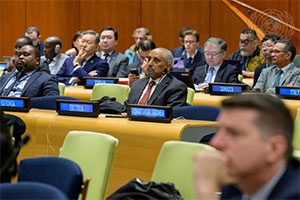 General Assembly Meets to Hear Briefing on UN80 Initiative. Credit: UN Photo/Manuel Elías
Global development conferences are continuing to produce critical frameworks for South-South cooperation and multilateral reform. In January of 2024, the 3rd Global South Nexus (GSN) International Conference was held in Odisha, India, with its theme being “Creating Responsible Professionals for Advancing SDGs: Inputs from Global North and South.” The 2025 UN SDG Report provided a midpoint assessment of the 2030 Agenda, with only 35% of targets on track and 18% having reversed. The 2025 UN Climate Change Conference (COP30) in Belém, Brazil, agreed to mobilize $1.3 trillion annually for climate action by 2035, operationalize the loss and damage fund, triple adaptation finance, and launched the Belém Mission to 1.5°C. In 2025, the Partnership for Economic Policy (PEP) convened its annual Policy Conference in Nairobi, Kenya, addressing the issue of “Financing and Inclusivity in Green Energy Transition in the Global South.” As the Global South advocates increasingly for a South-South framework alongside North-South cooperation, international conferences on sustainability aim to bridge economic and social divides between developed and developing countries in achieving the UN SDGs. Furthermore, to mark the UN’s 80th anniversary, the UN80 Initiative was launched to reshape how the UN system works so that every mandate, dollar, and decision creates greater impact for the global system.

The Week with IPS

NEXT STOP - SDGs
Tracking global progress towards a sustainable world
Tracking global progress towards a sustainable world
