Languages
Thursday, October 8, 2026



News and Views from the Global South
Conferences

IUCN Puts the Accent on Business
The outcome of the June Rio+20 UN conference on sustainable development was the undisputed inability of governments to come to an agreement on moving ahead to protect the planet. Three months later, the International Union for Conservation of Nature (IUCN) is proposing what can be done as a collective.Kyoto Protocol May End With the Year
As government negotiators from the world’s poorest countries ended a round of United Nations climate change talks in the Thai capital, they sounded a grave note about what appears imminent when they assemble in November in Doha – the reading of the last rites of the Kyoto Protocol.Getting Into the Business of Environment
Regulations that stand in the way of conservation programmes lower their likely success, experts warned at the World Conservation Congress of the International Union of Conservation of Nature (IUCN) in Jeju, South Korea.
Environment Congress Looks First at the Island It’s Meeting On
Before business could get under way, the controversy had to be dealt with. That appeared to be the strategy of the South Korean government just before the opening of the high profile International Union of Conservation of Nature (IUCN) World Conservation Congress here on Thursday.
Women Spend 40 Billion Hours Collecting Water
As the weeklong international conference on water concluded Friday, it was left to one of the keynote speakers from the United Nations to focus on a much neglected perspective on water and food security: the role of women.
PACIFIC ISLANDS: Marine Protected Areas Bolster Conservation Efforts
The world's smallest island nations wield more power than their sizes would suggest, with millions of square kilometres in their domains, said leaders of Pacific Island nations gathered at a special forum here in the Cook Islands.
Despite Possible Attacks, Gaza Plans Half-Billion-Dollar Desalination Plant
Last May the European Commission reported that scores of infrastructure projects in the Gaza Strip, financed mostly by the European Union, have been damaged or destroyed, wittingly or unwittingly, by Israeli military forces in the ongoing conflict in the Palestinian Occupied Territories.
Sweden to Fund Innovations in Water Sector
When the international community was struggling to ward off a potential decline in development aid in early 2000, it came up with a novel idea: a proposal for "new and innovative sources of financing", including a tax on airline tickets and a levy on foreign exchange transactions.
Could Water Strife Lead to ‘Mass Killings’ in the Future?
As the world faces possible water scarcities in the next two to three decades, the U.S. intelligence community has already portrayed a grim scenario for the foreseeable future: ethnic conflicts, regional tensions, political instability and even mass killings.OP-ED: Some Thoughts on the Nonaligned Movement Summit in Tehran
It must be considered pure fortuity for the Islamic Republic of Iran that the decision to hold the Nonaligned Movement (NAM) summit in Tehran was made three years ago in Sharm El-Sheikh, Egypt.
Q&A: Water and Food Security Are Inseparable
With the U.N. ominously warning of an impending food crisis following severe droughts in farmlands in the United States, Brazil, Russia and at least two rain-deprived states in India, the world will once again turn its attention to a finite natural resource: water.
Jeju Island Base Divides Korean, International Green Groups
As construction of a hotly contested naval base on South Korea’s Jeju Island advances, there’s a showdown underway.Where Are Canada’s Missing Native Women?
First Nations’ leaders are calling on the Canadian government to establish an independent commission of inquiry to investigate at least 582 missing and murdered indigenous women and girls - a wish which was not immediately granted by provincial premiers meeting last week.Caribbean Sees Progress on HIV/AIDS, Fears Funding Cuts
Ian McKnight, executive director of the Caribbean Vulnerable Communities Coalition (CVCC), used one word - “tokenistic” - to sum up his perspective on the 19th International AIDS Conference that ended here over the weekend.AIDS Meet Ends with Talk of Cure, But Realities of Scourge Persist
As the International AIDS Conference ended in Washington on Friday, organisers unveiled groundbreaking new research on the promise of early anti-retroviral (ARV) drug therapy.
Silenced by U.S., Sex Workers Speak from Kolkata
Bare-chested and beaming in the company of many like him, London-based male sex worker Thierry Schaffauser wipes the beads of sweat trickling down his face on a humid Kolkata evening, and slams U.S. President Barack Obama.
Protesters: Free Trade Deals, Drug Patents Derail AIDS Fight
As the nineteenth International AIDS Conference continued in Washington Tuesday, thousands of protesters marched on the White House with a set of demands to end the epidemic.
U.S. Aims for AIDS-Free Generation Amid Funding Cuts
As more than 20,000 health workers, scholars and activists from around the world gather here this week for a major biannual AIDS conference, observers are warning that U.S. government proposals to cut HIV/AIDS-related funding could undermine the significant potential to deal a decisive blow to the disease in the near future.
Family Planning Essential for Development
Improving family planning to avoid unwanted pregnancies in developing countries, as well as assuring girls’ access to education, and women’s participation in the economy, are essential components of a sound development policy, according to Western experts and African activists.Family Planning Summit Offers New Hope
The Summit on Family Planning that is taking place in London on Wednesday is a bid to get governments around the world to commit more resources to safeguarding women’s reproductive rights, according to the executive director of the United Nations Population Fund (UNFPA).
Coral Triangle Fights to Save Reefs from Extinction
The planet's richest region of coral and marine life, which feeds 130 million people, is in trouble.« Previous Page — Next Page »





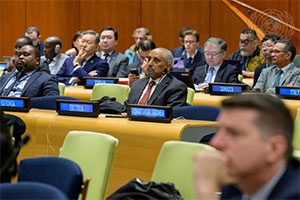 General Assembly Meets to Hear Briefing on UN80 Initiative. Credit: UN Photo/Manuel Elías
Global development conferences are continuing to produce critical frameworks for South-South cooperation and multilateral reform. In January of 2024, the 3rd Global South Nexus (GSN) International Conference was held in Odisha, India, with its theme being “Creating Responsible Professionals for Advancing SDGs: Inputs from Global North and South.” The 2025 UN SDG Report provided a midpoint assessment of the 2030 Agenda, with only 35% of targets on track and 18% having reversed. The 2025 UN Climate Change Conference (COP30) in Belém, Brazil, agreed to mobilize $1.3 trillion annually for climate action by 2035, operationalize the loss and damage fund, triple adaptation finance, and launched the Belém Mission to 1.5°C. In 2025, the Partnership for Economic Policy (PEP) convened its annual Policy Conference in Nairobi, Kenya, addressing the issue of “Financing and Inclusivity in Green Energy Transition in the Global South.” As the Global South advocates increasingly for a South-South framework alongside North-South cooperation, international conferences on sustainability aim to bridge economic and social divides between developed and developing countries in achieving the UN SDGs. Furthermore, to mark the UN’s 80th anniversary, the UN80 Initiative was launched to reshape how the UN system works so that every mandate, dollar, and decision creates greater impact for the global system.

The Week with IPS

NEXT STOP - SDGs
Tracking global progress towards a sustainable world
Tracking global progress towards a sustainable world
