Languages
Monday, October 19, 2026



News and Views from the Global South
Energy

The Invisible Women in Energy: Biomass Producers Who Deserve More Recognition
As the world looks to address issues of gender equity, development and climate change, the importance of increasing the participation of women in the energy sector is gaining attention. To date, this topic has generally been framed around the underrepresentation of women in the energy workforce.
Recipes with a Taste of Sustainable Development on the Coast of El Salvador
Salvadoran villager Maria Luz Rodriguez placed the cheese on top of the lasagna she was cooking outdoors, put the pan in her solar oven and glanced at the midday sun to be sure there was enough energy for cooking.
Indigenous Communities in Mexico Fight Energy Projects
Indigenous farmers on communally owned lands have blocked since 2016 a private solar farm in the southeastern Mexican state of Yucatan by means of legal action, due to the company’s failure to hold consultations with local native communities and the risk of environmental damage.
Energy Crisis: Tribal Behavior or Quality Decisions Based on Conscious Trade-Offs?
Crises, as the one we saw across the US and Mexico last week originated by Winter Storm Uri, provide ample material for reflection. This is particularly clear from a distant viewpoint and when benefitting from the fact of not being directly affected, as strong emotions and reactions that often bias our judgements are absent.
A Growing Shift in the Narrative about Climate Action
A keen awareness about the intersection of our ecosystem and the “accelerating destabilisation of the climate” is helping shift the narrative for climate action and can help us transition from being polluters to becoming protectors of the climate, said Marco Lambertini, Director General at the World Wide Fund for Nature.
Sustainable Energy Key to COVID-19 Recovery in Asia and the Pacific
The past year is one that few of us will forget. While the impacts of the COVID-19 pandemic have played out unevenly across Asia and the Pacific, the region has been spared many of the worst effects seen in other parts of the world. The pandemic has reminded us that a reliable and uninterrupted energy supply is critical to managing this crisis.
In Argentina’s Chaco Region, the Forest Is Also a Source of Electricity
The forest is the main resource in the Chaco, a vast plain shared by Argentina, Bolivia and Paraguay. And how to use it sustainably is the most difficult question. Two recently inaugurated power plants fired by forest biomass provide a possible answer, although they are not free of controversy.
El Aromo Solar Project Sets Precedent for Renewable Energy in Ecuador
In December 2020, the “El Aromo” solar energy project was approved in coastal Manabí province, Ecuador. Operated by the Spanish company Solarpack, the project is expected to transform national solar output. El Aromo will occupy 2.9km2 of land that was previously cleared to build a multi-billion dollar oil refinery, plans that have since been abandoned. While El Aromo holds symbolic significance, it remains uncertain whether the project will mark a significant step toward more environmentally sustainable energy development in Ecuador.
Belo Monte Dam: Electricity or Life in Brazil’s Amazon Rainforest
"We are no longer familiar with the Xingú River," whose waters govern "our way of life, our income, our food and our navigation," lamented Bel Juruna, a young indigenous leader from Brazil´s Amazon rainforest.
Latin American Electric Utilities COVID-accelerated Evolution
The COVID-19 pandemic has accelerated an evolution across Latin American electric utilities. The need for utilities to manage structural issues derived from increased deployment of Renewable Sources of Energy (RSE) such as wind and solar and Distributed Energy Resources (DER) has rapidly increased. Technology is unleashing major disruptions and challenges. In many ways, Latin America’s traditional electric utilities are in crisis.
Energy Efficiency for Developing Countries: Pivoting from Fewer Inputs to More Outputs
Energy efficiency (EE) is often marketed as a tool to save energy and money. The oft-repeated mantra is doing “more with less”, namely producing more goods with less energy. But, as set out in a recent World Bank report (which I co-authored), EE can do something that is often much more important for developing countries: it can produce the additional goods and services needed to raise standards of living.
Solar Power from Argentina’s Puna Highlands Reaches Entire Country
The unprecedented growth of renewable energies in Argentina over the last three years has borne its greatest fruit: the Cauchari solar park, with nearly one million photovoltaic panels and 300 MW of installed power, which was connected to the national power grid on Sept. 26.
Mexico Sticks to Natural Gas, Despite Socioenvironmental Impacts
In his community of small farmers and ranchers in northern Mexico, Aristeo Benavides has witnessed the damage caused by the natural gas industry, which has penetrated collectively owned landholdings, altering local communities' way of life and forms of production.
G20 Puts More into Fossil Than Green Energy in Covid-19 Recovery Packages
As the world’s leading economies direct trillions of dollars towards Covid-19 recovery packages, a significant proportion is going to fossil fuel industries without climate stipulations, according to the 2020 edition of the Climate Transparency Report – which has assessed the climate performance of G20 countries.
Green Recovery in Mexico – A Citizen’s Plea
The alarms warning against climate inaction have sounded for years. Almost a year into the hardest pandemic and maybe the worst economic recession my generation has seen, expert voices everywhere are claiming this to be the golden opportunity to do something to right our course and even find a silver lining in this unfortunate situation, by funding the economic recovery of COVID-19 with a green stimulus package.
Chile’s Energy Revolution Has an Achilles’ Heel
The Atacama Desert, a giant reservoir of solar power, is the battering ram of the transformation undertaken by Chile to decarbonise its energy mix, in a country with enormous potential in non-conventional renewable sources.
Distributed Generation Provides Hope of Energy for the Poor in Brazil
"Showing solidarity is consuming the energy generated in your own municipality" - this is the motto of a project of distributed electricity generation in one of Brazil's many poor neighbourhoods.
Capture of CO2 and Hydrogen as Part of Latin America’s Energy Future
While struggling to increase the generation and consumption of renewable energy, Latin America is beginning to see the rise of new technologies, such as the capture and storage of carbon and hydrogen from fossil fuels or wind and solar energy.
Community Hydropower Dam Lights Up Salvadoran Villages
 The people of Potrerillos, a village located in northeastern El Salvador, worked hard to achieve something that many doubted they could do: harness the waters of the Carolina River to install a community mini hydroelectric plant, which supplies them with cheap energy.
Energy Transition and Post-Covid Recovery, a Challenge for Latin America
The way forward for energy transition and its link to an economic recovery after the depression caused by the covid-19 pandemic is focusing attention in Latin America and Europe, according to the 2nd Madrid Energy Conference (MEC), which concluded this Friday 2.
Community Hydropower Dam Illuminates Life in Salvadoran Villages
Ermelinda Lobos's life has improved substantially since she and the rest of the people in her small village, hidden in the mountains of northeastern El Salvador, worked hard to build a mini hydroelectric plant and become self-sufficient in energy.« Previous Page — Next Page »





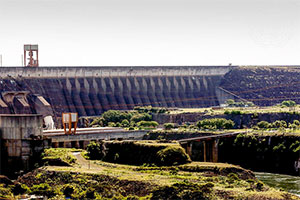 UN Power Plant, Paraguay. Credit: UN Photo/Evan Schneider
Energy has posed a great challenge for economies around the world. As global energy consumption skyrockets throughout the years, so does the need for sustainable solutions. The Sustainable Development Goals are essential in providing people with access to safe, affordable, and sustainable energy sources that minimize harm on the planet. Progress towards these goals opens the door for an advancement in modernization for communities on a global level and allows for a potential mitigation of tensions between nations.
The UN’s Summit of the Future in 2024 offered new initiatives that are being taken to achieve these goals, including a decreased reliance on fossil fuels, a switch to renewable energy sources, and improved climate financing.
IPS is well positioned to provide relevant, insightful, and compelling analysis of recent updates and measures being taken around the world to achieve a cleaner future.

The Week with IPS

NEXT STOP - SDGs
Tracking global progress towards a sustainable world
Tracking global progress towards a sustainable world
