Languages
Tuesday, October 20, 2026



News and Views from the Global South
Energy

Bioenergy, the Ugly Duckling of Mexico’s Energy Transition
Rosa Manzano carefully arranges pieces of wood in a big mud igloo that, seven days after it is full, will produce charcoal of high caloric content.
Walking the Talk on Climate Change after the Pandemic: Reorienting State-Owned Enterprises towards Sustainability
This year started with the news of the appearance of a new virus, COVID-19. The impact and severity of its effects in public health, mortality and the world economy are overwhelming. No public health system was prepared for this crisis, and yet governments are reacting deploying different policies to mitigate the crisis, and recover as fast as possible.
Mexico’s Plan to Upgrade Hydropower Plants Faces Hurdles
Water security and profitability are the Achilles heels of the plan to modernise 60 hydroelectric plants in Mexico, drawn up by the administration of President Andrés Manuel López Obrador.
Young People Bring Solar Energy to Schools in the Argentine Capital
"The idea came to a group of schoolmates and me in 2014, but we never thought it could become a reality," says Sebastián Ieraci, 23, as he points to a multitude of photovoltaic solar panels shining on the roof of the Antonio Devoto High School in the Argentine capital.
Giant Itaipú Dam and Bacteria Join Forces for Clean Energy and Environment
 "It used to be complicated, I would have lunch with the flies," recalls Pedro Colombari, laughing, on his 400-hectare farm where he fattens 5,000 pigs and raises 400 cattle outside of a small town in southern Brazil.
Tackling Climate Change and Preserving the Water Body: A Bangladeshi Perspective
For any riverine country, the state of the water body around big cities and conditions of major rivers hold a leadership position in the overall climate effects and how the water body is protected and preserved impacts the entire economy and living standards of that country. Bangladesh is renowned for the geomorphic features that include massive rivers flowing throughout the country. Within the border of Bangladesh lie the bottom reaches of the Himalayan Range water sources that flow into the Bay of Bengal totaling the number of rivers by a count of 700. The length of river bodies is about 24,140 km. There are predominantly four major river systems: the Brahmaputra-Jamuna, the Ganges-Padma, the Surma-Meghna, and the Chittagong Region river system. The Brahmaputra is the 22nd longest (2,850 km) and the Ganges is the 30th longest (2,510 km) river in the world. (1) The river system works as a backbone for agriculture, communication, drinking water source, energy source, fishing and as the principal arteries of commercial transportation in Bangladesh. During the annual monsoon period between June and October, the rivers flow about 140,000 cubic meters per second and during the dry period, the numbers come down to 7000 cubic meters per second.
Synergy with Hydropower Plants Boosts Biogas Production in Brazil
Fomenting biogas production among agricultural producers may seem at first glance to be a distraction from the purpose of Itaipu, the giant hydroelectric power plant shared by Brazil and Paraguay, but in fact it is part of their energy business strategy.
World Drains Away Valuable Energy, Nutrients & Water in Fast-Growing Wastewater Streams
Vast amounts of valuable energy, agricultural nutrients, and water could be recovered from the world’s fast-growing volume of municipal wastewater.
Oil-rich Gulf Turns to Renewable Energy
The increased frequency of climate-induced weather extremes and public opinion pressure are forcing even major fossil fuel exporting countries in West Asia to make a big push towards renewable energy.
Carbon Markets Can Provide a Crucial Part of the Solution to the Climate Crisis
One of the main discussions at the COP25 climate change talks was Article 6, which is designed to provide financial support to emerging economies and developing countries to help them reduce emissions by using global carbon markets. Carbon pricing is an essential piece of the puzzle to curb emissions. Without a value on carbon, there is less incentive to make positive changes, especially in the private sector. The most efficient way to carry this forward is to allow trading of carbon both nationally and internationally, which will ensure the lowest cost of mitigation for participants globally.
Lithium and Clean Energy in Argentina: Development or Mirage?
The intense white brightness of the salt flats interrupts the arid monotony of the Puna in northwest Argentina, resembling postcards from the moon. Beneath its surface are concealed the world's largest reserves of lithium, the key mineral in the transition to clean energy, the mining of which has triggered controversy.
Solar and Biogas, the Perfect Agroenergy Duo in Brazil
"They're the ideal duo," because the combination of solar and biogas sources makes it possible to provide electricity around the clock, one during the day and the other at night, says Anelio Thomazzoni, a pig farmer who has become a producer of clean energy in southwestern Brazil. 
Industrial Energy Efficiency is a Climate Solution
At a time when the world is battling unprecedented drought, bushfires, rising sea levels and water shortages, reducing energy use across industry is one powerful way to fight climate change in the immediate term.
Under Pressure. Can COP25 Deliver?
Mass public pressure backed by the weight of scientific reports is starting to bring governments to their senses as the annual UN climate summit kicks off in Madrid today.
Africa’s Civil Society Calls for Action as COP25 Kicks off in Madrid
During the 25th round of climate change negotiations starting today in Madrid, Spain, African civil society organisations will call on governments from both developing and developed nations to play their promised roles in combating climate change.
No Region is Immune from Rising Inequalities, Trade Tensions & Declining Growth Rates
We are facing tense and turbulent times around the globe. Rising inequality is a danger everywhere. Trade and technology tensions are building. Growth forecasts are being revised down. Unease and uncertainty are going up. This is a global phenomenon. No region is immune.
Going with the Wind: Transition to Clean Energy in Latin America & the Caribbean
The UN Climate Action Summit 2019, which took place in the days leading up to the 74th UN General Assembly, delivered new pathways and practical actions for governments and private sector to intensify climate action.
Solar Cookers Produce More Than Food for Mexican Women
The sun's rays are also used to cook food and thus replace the burning of firewood and gas, improve the health of local residents and fuel the energy transition towards the use of renewable sources - the objectives of an enterprise in the southern Mexican state of Oaxaca. 
Solar Energy Transforms Villages in Argentina’s Puna Highlands
"On moonless nights it was very difficult to walk around this town," says Celia Vilte, a teacher from San Francisco, a highlands village of just 54 people in the extreme northwest of Argentina whose centre is not a town square but 40 solar panels, which provide one hundred percent of its electricity.
Global Climate Change Investment Heavily Tilted Towards Mitigation and Low on Adaptation
Good news: the graph depicting climate investments has been steadily increasing. Climbing from the 2012 figure of $360 billion in climate investments across the world to close to $600 billion currently.
China Wants to Mainstream Environmental Protection
In the 2014 China-US joint announcement on climate change, China promised to peak its greenhouse gas (GHG) emissions around 2030. Later this commitment was cemented in the Paris Agreement signed in 2016.« Previous Page — Next Page »





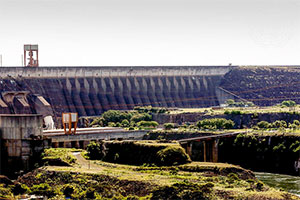 UN Power Plant, Paraguay. Credit: UN Photo/Evan Schneider
Energy has posed a great challenge for economies around the world. As global energy consumption skyrockets throughout the years, so does the need for sustainable solutions. The Sustainable Development Goals are essential in providing people with access to safe, affordable, and sustainable energy sources that minimize harm on the planet. Progress towards these goals opens the door for an advancement in modernization for communities on a global level and allows for a potential mitigation of tensions between nations.
The UN’s Summit of the Future in 2024 offered new initiatives that are being taken to achieve these goals, including a decreased reliance on fossil fuels, a switch to renewable energy sources, and improved climate financing.
IPS is well positioned to provide relevant, insightful, and compelling analysis of recent updates and measures being taken around the world to achieve a cleaner future.

The Week with IPS

NEXT STOP - SDGs
Tracking global progress towards a sustainable world
Tracking global progress towards a sustainable world
