Languages
Saturday, October 3, 2026



News and Views from the Global South
Energy

Venezuela’s Oil Industry Is Falling Apart
Corruption in the Venezuelan state oil industry, denounced by the government itself, and with former ministers and senior managers behind bars, is the latest evidence that, in the country with the largest oil reserves on the planet, the industry on which the economy depends is falling apart.
Long Maligned for Deforestation, Charcoal Emerges from the Shadows
“We have various financial obligations that push us to charcoal making. Top on the list is farming inputs and school fees,” explains Arclay Moonga, a charcoal producer and chairperson of the recently formed Choma District Charcoal Association in Southern Zambia.
Money Talks at One Planet Summit in Paris
As funding to combat climate change has lagged behind lofty words, the One Planet Summit in France this week invited governments and business leaders to put money on the table.
Central America Builds Interconnected Clean Energy Corridor
Countries in Central America are working to strengthen their regional electricity infrastructure to boost their exchange of electricity generated from renewable sources, which are cheaper and more environmentally friendly.
The Journey to Oslo
On December 10 in Oslo, the International Campaign to Abolish Nuclear Weapons (ICAN) was awarded the Nobel Peace Prize. ICAN started as a grassroots campaign in 2007. Its aim was to shift the paradigm of discussion about nuclear weapons from security and deterrence to the environmental and humanitarian effects of nuclear explosions. As the prize demonstrates, ICAN has succeeded brilliantly. But, as ICAN acknowledges, this is still only the beginning of the end of nuclear weapons.
Global Initiative to Relieve Pressure on Mountains
International Mountain Day and the Mountain Partnership’s 15th anniversary coincided on December 11, kicking off a three-day Mountain Partnership Global Meeting at the headquarters of the Food and Agriculture Organization of the United Nations (FAO) in Rome.
Are Rising Seas, Coastal Erosion & Powerful Storms a Wave of the Future for Small Island Nations?
The 44-member Alliance of Small Island States (AOSIS) represents some of the world’s most vulnerable island nations fighting a virtually losing battle against rising sea levels triggered by global warming and climate change.
Pacific Islands Struggling to Meet SDG7 Energy Targets
The four Pacific Island nations who are amongst the Least Developed Countries (LDCs) may be falling behind in meeting energy access targets because they are too busy devoting resources towards climate change.
Lobbying & Sponsorships at COP23 Corrupted Climate Talks
The world’s nations got together in Bonn, Germany, for the 23rd annual Conference of the Parties (COP) under the UN Framework Convention on Climate Change (UNFCCC), where nearly 200 countries and some 23, 000 delegates met to discuss and influence the negotiations over the rulebook of the Paris Agreement.
Desperate Need to Halt ‘World’s Largest Killer’ — Pollution
Now that the lights of the UN climate change summit’s meeting rooms have been turned off in Bonn, after a week of intense negotiations and some partial results, another major environmental event is now scheduled in Nairobi, this time to search for ways to halt the world’s major killer – pollution.
At Climate Summit, Two Global Energy Alliances Emerge
As the summit of governments known as COP23 reached its conclusion in Bonn, Germany this week, two clear alliances have emerged in the global energy landscape.
Coal Pollution Continues to Spread in Latin America
Despite growing global pressure to reduce the use of coal to generate electricity, several countries in Latin America and the Caribbean still have projects underway for expanding this polluting energy source.
The Mekong, Dammed to Die
In Laos, the lush forests are alive with the whines of drills that pierce the air. On the Mekong, a giant concrete wall rises slowly above the trees. The Don Sahong dam is a strong symbol, not only for a power-hungry Asia but also for what critics fear is a disaster in the making.
Economic Development vs. Climate Action: Rebutting Deniers and Wafflers
As negotiators meet in Bonn to put together a deal to implement the Paris Agreement, John Holdren, a professor of environmental policy at the John F. Kennedy School of Government, Harvard University, stressed that economic development and climate change mitigation and adaptation are not ‘either-or’ but must be pursued together.
Will Policymakers Listen to Climate Change Science This Time Around?
Climate change is altering the ecosystem of our oceans, a big carbon sink and prime source of protein from fish. This is old news.
An Urgent Need to Transform World’s Energy Systems
When we discuss global interconnection in relation to energy, we are at the centre of the two key words that express our global concerns - sustainability and inclusivity.
Cycles of Wealth in Brazil’s Amazon: Gold, Lumber, Cattle and Now, Energy
The burning down of the local forest, on Jun. 29, 1979, was the first step towards the creation of the city of Paranaita, in a municipality that is now trying to shed its reputation as a major deforester of Brazil’s Amazon rainforest and has named itself “the energy capital.”
The Future for Financing Africa’s Renewable Energy
Lack of energy access presents a formidable challenge to Africa and lack of access to financing has been singled out as the biggest reason why over 620 million people living on the continent are stuck in energy poverty.
Argentina’s Biodiesel Plagued by Commercial and Environmental Challenges
The Argentine biodiesel industry, which in the last 10 years has become one of the most powerful in the world, has an uncertain future, faced with protectionist measures in the United States and Europe and doubts in the international scenario about the environmental impact of these fuels based on agricultural products.
Dams Hurt Indigenous and Fishing Communities in Brazilian Amazon
The dirty water is killing more and more fish and ‘Taricaya’ yellow-spotted river turtles every day. In addition, the river is not following its usual cycle, and the water level rises or declines without warning, regardless of the season, complained three Munduruku indigenous law students in the south of Brazil’s Amazon rainforest.
The IMF and Climate Change: Three Things Christine Lagarde Can Do to Cement Her Legacy on Climate
The International Monetary Fund (IMF) and climate change do not often appear in the same headline together. Indeed, environmental issues have been, at most, peripheral to the Fund's core functions. But now economists inside and outside the IMF are beginning to understand that climate change has significant implications for national and regional economies, and so it's worth reconsidering the Fund's role in addressing the climate challenge.« Previous Page — Next Page »


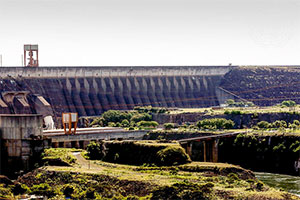 UN Power Plant, Paraguay. Credit: UN Photo/Evan Schneider
Energy has posed a great challenge for economies around the world. As global energy consumption skyrockets throughout the years, so does the need for sustainable solutions. The Sustainable Development Goals are essential in providing people with access to safe, affordable, and sustainable energy sources that minimize harm on the planet. Progress towards these goals opens the door for an advancement in modernization for communities on a global level and allows for a potential mitigation of tensions between nations.
The UN’s Summit of the Future in 2024 offered new initiatives that are being taken to achieve these goals, including a decreased reliance on fossil fuels, a switch to renewable energy sources, and improved climate financing.
IPS is well positioned to provide relevant, insightful, and compelling analysis of recent updates and measures being taken around the world to achieve a cleaner future.

The Week with IPS

NEXT STOP - SDGs
Tracking global progress towards a sustainable world
Tracking global progress towards a sustainable world
