Languages
Wednesday, October 14, 2026



News and Views from the Global South
Energy

Activists Criticise Offshore Drilling as Obama Prepares for Arctic Summit
A one-day summit taking place here on Aug. 31 hopes to bring Arctic nations together in support of climate action against a backdrop of criticism of offshore oil drilling in the region.
Opinion: How Will Wall Street Greet the Pope?
Millions in the New York City area are excited about Pope Francis’ visit on Sep. 25 to address the U.N. General Assembly as worldwide consensus grows on the need to shift global investments from fossil fuels to clean, efficient, renewable energy in the UN’s Sustainable Development Goals (SDGs) scheduled to replace the expiring Millennium Development Goals (MDGs).
Plant in Chile Opens South America’s Doors to Geothermal Energy
Chile, a land of volcanoes and geysers, has started building South America’s first geothermal plant, which would open a door to this kind of renewable energy in this country that depends largely on fossil fuels.
UAE Wins Hearts and Minds at World Exhibition in Milan
She only turned nine last June. But Mahra Mustafa has become a celebrity at the Expo Milan. She stars as Sara in ‘The Family Tree’, a short film on the UAE’s heritage being screened at the United Arab Emirates pavilion. Sara is in fact the face of young, dynamic and innovative Emirates.Iran Deal a ‘Net-Plus’ for Nuclear Non-Proliferation Worldwide
As the U.S. Congress prepares to vote next month on the landmark Joint Comprehensive Plan of Action (JCPOA), which was agreed on July 14 between the world’s leading powers and Iran, and has been approved by the U.N. Security Council, eminent nuclear non-proliferation experts are mobilising international support for its immediate implementation.
Presalt Oil Drives Technological Development in Brazil
The extraction of deepwater oil, the most abundant kind in Brazil, is costly but foments technological and industrial development, requiring increasingly complex production equipment and techniques.
World’s Nuclear Facilities Vulnerable to Cyber-Attacks
As hackers continue to rampage through closely-guarded information systems and databases with monotonous regularity, there is a tempting new target for cyber-attacks: the world’s nuclear facilities.
Zimbabwe’s Forest Carbon Programme Not All It Seems
The efficacy of attempts to sustainably manage forests and conserve and enhance forest carbon stocks in Zimbabwe is increasingly coming under scrutiny as new research warns that the politics of access and control over forests and their carbon is challenging conventional understanding.
Tiny Island Nation Pleads for Global Moratorium on New Coal Mines
The tiny island of Kiribati in the Central Pacific, with a population of about 103,000, has long been identified as one of the U.N. member states threatened with physical extinction due to sea-level rise triggered largely by climate change.
Latin America Has Enormous Untapped Potential for Green Infrastructure
Latin America is facing a two-pronged challenge: double power generation by 2050 while reducing greenhouse gas emissions. The only solution? Green energy.
Protests Greet Japan’s Relaunch of Nuke Power
Protesters rallied outside Japan's Sendai nuclear plant a day ahead of its planned opening and four years after the Fukushima disaster galvanised opposition to nuclear power in the country.
Caribbean Artists Raise Their Voices for Climate Justice
Award-winning St. Lucian poet and playwright Kendel Hippolyte thinks that Caribbean nationals should view the Earth as their mother.
Opinion: The Road to Paris and the Path to Renewable Energy
Renewable energy is now being seen by many people around the world as a cost-effective development solution both for developed and developing nations. Countries have slowly been realising that the use of coal and the huge amount of carbon emissions it generates harms the environment and impacts our daily activities.
Obama Takes Lead on Climate Change Ahead of U.N. Talks in Paris
This week, U.S. President Barack Obama formally unveiled the details of his Clean Power Plan (CPP), a comprehensive carbon-cutting strategy he described as “the biggest and most important step…ever taken to combat climate change” in a prior video address posted on Facebook.
No More Hiroshimas, No More Nagasakis, Vows U.N. Chief
Speaking at a commemoration of the 70th anniversary of the atomic bombings of Japan, Secretary-General Ban Ki-moon, a vociferous advocate of nuclear disarmament, echoed the rallying cry worldwide: “No more Hiroshimas, No more Nagasakis.”
Humanitarian Crisis Looming Over Venezuela, Says ICG
A Brussels-based think-tank has warned Venezuela of an impending humanitarian calamity in tandem with growing political instability.
U.N. Targets Trillions of Dollars to Implement Sustainable Development Agenda
After more than two years of intense negotiations, the U.N.’s 193 member states have unanimously agreed on a new Sustainable Development Agenda (SDA) with 17 goals -- including the elimination of extreme poverty and hunger -- to be reached by 2030.
Zimbabwe’s Climate Change Ambitions May be Too Tall
With the U.N. Climate Change conference later this year in Paris fast approaching, Zimbabwe's climate change commitments face the slow progress on an issue that continues to stalk other developing countries – climate finance.
Nigeria to Balance GHG Emission Cuts with Development Peculiarities
Nigeria seems in no haste to unveil its climate pledge with just four months to go before the U.N. Climate Conference scheduled for December in Paris.
Belo Monte Dam Marks a Before and After for Energy Projects in Brazil
Paulo de Oliveira drives a taxi in the northern Brazilian city of Altamira, but only when he is out of work in what he considers his true profession: operator of heavy vehicles like trucks, mixers or tractor loaders.
Kenyan Pastoralists Fighting Climate Change Through Food Forests
Sipian Lesan bends to attend to the Vangueria infausta or African medlar plant that he planted almost two years ago. He takes great care not to damage the soft, velvety, acorn-shaped buds of this hardy and drought-resistant plant. ”All over here it is dry,” says the 51-year-old Samburu semi-nomadic pastoralist.« Previous Page — Next Page »





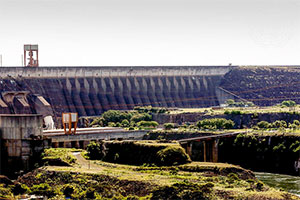 UN Power Plant, Paraguay. Credit: UN Photo/Evan Schneider
Energy has posed a great challenge for economies around the world. As global energy consumption skyrockets throughout the years, so does the need for sustainable solutions. The Sustainable Development Goals are essential in providing people with access to safe, affordable, and sustainable energy sources that minimize harm on the planet. Progress towards these goals opens the door for an advancement in modernization for communities on a global level and allows for a potential mitigation of tensions between nations.
The UN’s Summit of the Future in 2024 offered new initiatives that are being taken to achieve these goals, including a decreased reliance on fossil fuels, a switch to renewable energy sources, and improved climate financing.
IPS is well positioned to provide relevant, insightful, and compelling analysis of recent updates and measures being taken around the world to achieve a cleaner future.

The Week with IPS

NEXT STOP - SDGs
Tracking global progress towards a sustainable world
Tracking global progress towards a sustainable world
