Languages
Tuesday, October 13, 2026



News and Views from the Global South
Energy

Brazil’s Expanded Climate Targets Frustrate Environmentalists
Brazil’s greenhouse gas emissions reduction programme, hailed as bold, has nevertheless left environmentalists frustrated at its lack of ambition in key aspects.
Honduran Fishing Village Says Adios to Candles and Dirty Energy
A small fishing village on the Caribbean coast of Honduras has become an example to be followed in renewable energies, after replacing candles and dirty costly energy based on fossil fuels with hydropower from a mini-dam, while reforesting the river basin.
Mexican Government Depends More and More on Private Business Partners
The Mexican government has increasingly turned to public–private partnerships (PPPs) to build infrastructure in the energy industry and other areas. But critics say this system operates under a cloak of opacity and is plagued by the discretional use of funds.
The Rubicons That Have Been Crossed
In their attempts to sabotage Iran’s nuclear program, the United States and Israel have resorted over time to a number of unorthodox, illegal and in some cases criminal methods to achieve their aims. They have included the following:
Activists Say Fracking Fails to ‘Keep Pennsylvania Beautiful’
U.S. activist Vera Scroggins has been sued five times by the oil industry, and since October 2013 she has faced a restraining order banning her from any properties owned or leased by one of the biggest players in Pennsylvania’s natural gas rush, Cabot Oil & Gas Corporation.
Opinion: UN Committee adopts principles for sovereign debt restructuring
As a growing number of countries face the possibility of debt crises, the United Nations General Assembly has approved a set of nine basic principles for sovereign debt restructuring processes in an effort to provide for debt restructuring that is fair and economically sustainable.
Opinion: Another U.N. General Assembly Talk Fest Begins
UNGA 70 formally commenced on Sep. 15. In accordance with custom, it elected a new President, Denmark's Mogens Lykketoft, who has picked as the theme for his tenure as the President, "The UN at 70 - A New Commitment to Action".
Opinion: Iran and Nuclear Weapons, a Dangerous Delusion
Despite all the propaganda about the Iranian leaders’ rush to acquire nuclear weapons, ever since the start of the country’s nuclear programme, Iranian leaders have been adamant that they only wish to make peaceful use of the nuclear energy to which they are entitled as a member of the Non-Proliferation Treaty (NPT).
The Recent Stages of Iran’s Nuclear Programme
When negotiations between Iran and the European “Troika” broke down, the reformist government of Mohammad Khatami was discredited in the eyes of the Iranian electorate which had seen the futility of negotiating with the West.
Africa Sees U.N. Climate Conference as “Court Case” for the Continent
As the clock ticks towards the United Nations climate change conference (COP21) in Paris in December, African experts, policy-makers and civil society groups plan to come to the negotiation table prepared for a legal approach to avoid mistakes made during formulation of the Kyoto Protocol.
G20 Finance Ministers Committed to Sustainable Development
Finance ministers and central bank governors of the world’s 20 major economies, accounting for 66 percent of world population, have pledged to “promote an enabling global economic environment for developing countries as they pursue their sustainable development agendas”.
Opinion: The Early History of Iran’s Nuclear Programme
Iran has had a nuclear programme since 1959 when the United States gave a small reactor to Tehran University as part of the “Atoms for Peace” programme during Mohammad Reza Shah Pahlavi’s reign. When the Non-Proliferation Treaty (NPT) was introduced in 1968 and entered into force in 1970, Iran was one of the first signatories of that Treaty.
Opinion: Short-Term Goals are the Key to an Effective Climate Treaty
Less than 100 days before the U.N. climate change conference (COP21) in Paris in December, there are now only few who believe that the conference will not produce a treaty. But for most countries involved, this is rarely the question.
Q&A: “We Must Put Everything Aside and Just Focus on Water”
Globally, more than 748 million people do not have access to safe drinking water. That is more than double the population of the entire United States.
Crisis in Brazil Hampers Infrastructure under Construction
Besides suffering from macroeconomic imbalances, like a drop in GDP, a high inflation rate and a large public deficit, Brazil is experiencing heavy losses as many oil industry and logistical works grind to a halt.
Opinion: Iran and the Non-Proliferation Treaty
Iran’s nuclear programme has been the target of a great deal of misinformation, downright lies and above all myths. As a result, it is often difficult to unpick truth from falsehood.
Two Indigenous Solar Engineers Changed Their Village in Chile
Liliana and Luisa Terán, two indigenous women from northern Chile who travelled to India for training in installing solar panels, have not only changed their own future but that of Caspana, their remote village nestled in a stunning valley in the Atacama desert.
CORRECTION/Who Will Pay the Price for Australia’s Climate Change Policies?
Rowan Foley has spent many years as a ranger and park manager, caring for Uluru–Kata Tjuta National Park Aboriginal lands in the spiritual heart of Australia’s Red Centre in the Northern Territory. He has been observing the effects of soaring temperatures and extreme weather events on his people, residing in some of the hottest regions of the country.
Strong Words, But Little Action at Arctic Summit
After a one-day summit in the U.S. Arctic’s biggest city, leaders from the world’s northern countries acknowledged that climate change is seriously disrupting the Arctic ecosystem, yet left without committing themselves to serious action to fight the negative impacts of global warming.
Local Development, the Key to Legitimising Amazon Hydropower Dams
In the case of the Belo Monte hydroelectric dam in Brazil, the projects aimed at mitigating the social impacts have been delayed. But in other cases, infrastructure such as hospitals and water and sewage pipes could improve the image of the hydropower plants on Brazil’s Amazon rainforest rivers, turning them into a factor of effective local development.
Activists Criticise Offshore Drilling as Obama Prepares for Arctic Summit
A one-day summit taking place here on Aug. 31 hopes to bring Arctic nations together in support of climate action against a backdrop of criticism of offshore oil drilling in the region.« Previous Page — Next Page »





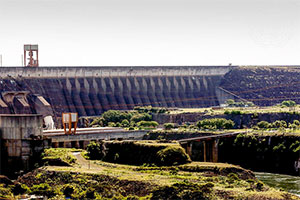 UN Power Plant, Paraguay. Credit: UN Photo/Evan Schneider
Energy has posed a great challenge for economies around the world. As global energy consumption skyrockets throughout the years, so does the need for sustainable solutions. The Sustainable Development Goals are essential in providing people with access to safe, affordable, and sustainable energy sources that minimize harm on the planet. Progress towards these goals opens the door for an advancement in modernization for communities on a global level and allows for a potential mitigation of tensions between nations.
The UN’s Summit of the Future in 2024 offered new initiatives that are being taken to achieve these goals, including a decreased reliance on fossil fuels, a switch to renewable energy sources, and improved climate financing.
IPS is well positioned to provide relevant, insightful, and compelling analysis of recent updates and measures being taken around the world to achieve a cleaner future.

The Week with IPS

NEXT STOP - SDGs
Tracking global progress towards a sustainable world
Tracking global progress towards a sustainable world
