
Monday, November 23, 2026



News and Views from the Global South
Environment

South Africa Moves Towards Low Carbon Footprint Travel
Counting on responsible travellers who increasingly seek environmentally friendly alternatives for their holidays, South Africa's tourism sector wants to conserve its biggest asset – nature – while fighting climate change at the same time.NEPAL: Protests Fail to Stop Climate Loans
Nepal will implement five projects with 110 million dollars sanctioned by the controversial Climate Investment Funds (CIFs), ignoring protestors who say this least developed country merits grants rather than climate loans.
Growing Calls for Water to be Prioritised
Efforts to establish water as an agenda item in its own right in climate change negotiations are gaining momentum in Durban, South Africa. Water experts say doing this will lead to a greater focus on developing policy, and attract more resources into the water sector through adaptation programmes.
TRADE: Small Steps towards Emission Reduction Deal
Emerging economies China, South Africa and Brazil have indicated their openness to legally-binding carbon emission reduction targets from 2020 during the United Nations climate change summit in Durban, South Africa.
CLIMATE CHANGE: Biofuels Are Not the Solution
Science tells us that we are heading for a climate crisis, yet it is within our means to change course.
Mountain magic turning tragic
 A mountainous country that boasts of eight of the 14 highest peaks in the world, including Mt Everest, Nepal is threatened by both deluge and drought with climate change shrinking its glaciers by 21 percent in 30 years. As rising temperature disturbs the balance of snow, ice and water in the Hindu Kush Himalayan region where it is located, millions of mountain people and 1.3 billion people living downstream in Asia's major river basins face the loss of livelihood, homes and lives due to flash floods and droughts.

“Fracking” for Shale Gas: Neither Clean nor Green
Hydraulic fracturing or "fracking" is being used to tap the last remaining natural gas deposits across large areas of the United States and western Canada, fueling continued dependence on hydrocarbons instead of a shift to genuinely clean energy sources to cool the planet.Shale Gas May Be a Mexican Mirage
In spite of mounting scientific evidence about its negative aspects, Mexico is getting ready to intensify exploration for shale gas, natural gas found trapped in shale, a sedimentary rock.
Q&A: Time for a New Agricultural Revolution
Negotiators at the 17th Conference of Parties owe it to the world's more than seven billion people to deliver a deal with a work plan for agriculture, a sector that is expected to be the worst affected by climate change.
Climate Change Killing Womens’ Livelihoods
Talata Nsor, a 54-year-old woman from Bolgatanga community in Northern Ghana, has been weaving the cultural Bolga baskets, which are named after her community, her entire life.
Biofuels Are Not the Solution
The fact that agrofuels have triggered a new scramble for Africa is no longer news. Millions of hectares are being grabbed with little concern for the poor who are bound to face displacement, says the chair of Friends of the Earth International, Nnimmo Bassey.Ecobreves – VENEZUELA: Overflowing Lake Valencia Poses Threat to Nearby Communities
The rising water level in Lake Valencia in northern Venezuela poses a threat to tens of thousands of families in the surrounding area due to the risks of water damage, road washouts, burst water pipes and spilled sewage.Ecobreves – HONDURAS: Sugar Producers Expand Generation of Clean Energy
Sugar producers in Honduras will invest over 35 million dollars to generate up to 300 MW of electricity from sugar cane bagasse.Ecobreves – BRAZIL: Air Pollution Causes Nervous System Damage
Excessive exposure to air pollution can harm the embryonic development of the nervous system, reveals a new study conducted by the University of São Paulo, Brazil.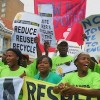
CLIMATE CHANGE: Marching for 100 Percent Change
Chanting loudly, thousands of demonstrators marched through the streets to the venue of the 17th United Nations Climate Change Conference to demand that their voices be heard for "immediate and drastic" carbon emission reductions to save the planet.
U.S. Inaction on Climate is “Criminal”, Activists Say
The United States' delegation at the 17th annual Conference of the Parties (COP) to the United Nations Framework Convention on Climate Change (UN FCC) in Durban, South Africa has come under heavy fire from civil society leaders and activists around the globe for standing in the way of real solutions to climate change.
NEPAL: Praying Against Climate Change
There are gasps from the audience as a series of shocking images flash across the screen: human hands eaten away by arsenic, the carcass of a cow so emaciated that it looks two-dimensional, a starved child with matchstick legs grasping at the udder of an animal for sustenance.
Giant puppets welcome delegates to Durban
The COP17 negotiations in Durban, South Africa, have been described as the most colourful UN event yet after giant puppets and musicians welcomed delegates to the International Conference Centre in the port city.

Waste pickers can play a role in climate change mitigation
Waste pickers can play a role in climate change mitigation. IPS Africa led a team of reporters that produced ten days of outstanding coverage of the climate change negotiations that took place in Durban, South Africa over the past weeks. During the last four days of the official negotiations a twelve-page printed TerraViva supplement was included daily as part of The New Age newspaper, distributed inside the conference hall to the delegates and to its usual readership across KwaZulu Natal province.

A Recipe for Carbon Farming
Civil society has warned of the danger of turning Africa's food-producing lands into "carbon farms" so that rich countries can avoid making cuts in their carbon emissions.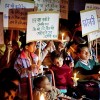
INDIA: Bhopal Victims Oppose Dow as Olympics Sponsor
India’s sport stars have joined the survivors of the 1984 gas leak tragedy in this city, capital of the central Madhya Pradesh state, to protest against a sponsorship deal between Dow Chemical and the organisers of the 2012 London Olympic Games.« Previous Page — Next Page »


Through our global network of local writers, we are continuing our award-winning coverage of global and local environmental challenges, with a focus on the people for whom the ecosphere matters in a direct way: rural dwellers who have little means to protect themselves against adverse conditions; communities that need to switch to sustainable development in order to survive; poor women and children, who are the most vulnerable in natural disasters. Sponsored by the United Nations Environment Program (UNEP), the United Nations Development Program (UNDP) and The World Bank (WB), IPS also maintains the award-winning Tierramérica, a specialised information service on environment and development.

The Week with IPS

Tracking global progress towards a sustainable world


