Languages
Thursday, October 22, 2026



News and Views from the Global South
Human Trafficking
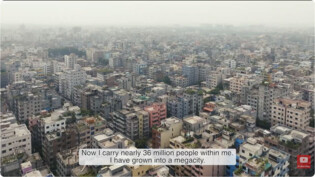
My Name is Dhaka
My Name is Dhaka is a one-minute experimental film portraying Dhaka as a living, breathing entity with a 400-year history. Through a reflective voice, the city recounts its transformations, crises, and resilience. It captures contrasts between pollution and celebration, hardship and hope, revealing a megacity shaped by climate change, migration, and human survival.
Maison des Talibés Confronts Abuse of ‘Talibé’ children in Senegal
When you walk through the streets of Senegal’s cities, you notice them almost immediately: young boys in worn clothes, clutching plastic cans or tin bowls, weaving between cars and pedestrians to ask for spare change or food. They are often barefoot, alone and hungry. These children are known as talibés.
Ending Child Marriage Needs a Culture of Accountability, Respect for the Rule of Law
Global leaders came together at the sidelines of this year’s UN General Assembly to commit to ending child marriage, calling on all world leaders to make concerted efforts to ensure accountability and enforce the laws that prohibit it.
Democracy under Attack: Why the World Needs a New UN Special Rapporteur
When tanks rolled through Myanmar’s streets in 2021, civil society groups worldwide sounded the alarm. When Viktor Orbán systematically dismantled Hungary’s free press, democracy activists demanded international action. And as authoritarianism returns to Tanzania ahead of elections, it’s once again civil society calling for democratic freedoms to be respected.
Regaining Progress on Birth Registration Is Critical to Child Protection
Registering the birth of a newborn, which is taken for granted in many countries, has profound lifelong repercussions for a child’s health, protection, and well-being. But after initially increasing this century, the global birth registration rate has declined in the past ten years, with some countries in the Pacific and Sub-Saharan Africa facing significant challenges. Embracing new registration technologies, increasing political will, and increasing parents’ understanding of its importance are paramount to reversing the trend.
Lawyer-Turned-Activist Bhuwan Ribhu Honored for Leading a Campaign to End Child Marriage
Bhuwan Ribhu didn’t plan to become a child rights activist. But when he saw how many children in India were being trafficked, abused, and forced into marriage, he knew he couldn’t stay silent.
The Gates to Paradise Are Closing
In 2020, a historic announcement emerged from the Global Trafficking in Persons Report, an annual assessment that evaluates human exploitation in 129 countries. For the first time, the world witnessed a 13% decrease in the number of victims. For those of us who fight against this heinous crime, it felt as if a door to paradise had opened—an Eden where no human being is for sale.
Violence Flows in Parts into Mexico from the United States
The case of a man arrested in Texas, in the south of the United States, for shipping arms parts to Mexico immediately caught the attention of authorities in both countries. But it was only one thread in a web that continues to become more and more tangled.
Kenya’s Unanswered Questions About Enforced Disappearances
As the world marked International Day of the Disappeared, Kenya grapples with a shadowy and persistent crisis—enforced disappearances. This harrowing violation of human rights has left countless families in anguish, searching for their loved ones while battling a wall of government denial and indifference.
Let the Dead Speak: Forgotten Workers
Immigration policies are among the most hotly debated topics in Europe. Xenophobia, combined with curbing immigration, have become the main reason to why ever-increasing large crowds of voters are supporting populist parties.
Abandoned Children Growing Problem in Northern Syria
Wael Al-Hassan was returning from work in the Syrian city of Harim when he heard the sound of a baby crying. He was returning from work on December 10, 2023. He stopped momentarily, turned on his mobile phone flashlight to investigate, and spotted a baby girl, around one month old, wrapped in a white blanket, lying by the roadside.
Written in Memory of Alexei Navalny and Osip Mandelstam
The devastation of Ukraine and Gaza might seem to be beyond belief. Let us thus turn to fairy tales to find descriptions of the stony indifference of warlords.
No God but Greed: Slavery and Indifference
At Statens Museum for Kunst in Copenhagen there is a great painting made in 1797 by the Danish Golden Age painter Jens Juel. It depicts one of Denmark’s richest merchants at the time – Niels Ryberg, his newlywed son Johan Christian, and the son’s bride, Engelke. Johan Christian makes a gesture as though to show off the family estate. There is a strong feeling of harmony between the people and the countryside in which they are placed. The picture reflects the new interest in nature that emerged all over Europe towards the end of the 18th century. It also demonstrates how Denmark’s new, rich bourgeois wished to carry themselves in the style of the aristocracy, a social class which dominance they were infringing. Ryberg and his son appear just as distinguished as the aristocrats that used to be portrayed by Jens Juel.
Trapped and Trafficked—Fishers Tell of Forced Labor Horror
“The thing is that when you come from an African country, they know that you’re basically trapped,” says Noel Adabblah. “You have the wrong documents; you can’t go home because you’ve already borrowed money there to get here, and you won’t risk losing what work you have, no matter how bad, because of that. They know all the tricks.”
Combating Corruption to Address the Triple Planetary Crises
The triple planetary crisis of climate crisis, biodiversity loss, and pollution is a threat to the well-being and survival of millions of people around the world. Corruption, in its many forms, worsens these multiple crises.
Forced Labor: Exposing Dark Web of Fisheries Labor Abuses
It is a terrifying life experience, cut off from the world and trapped in forced labour aboard fishing vessels, often in high seas or seas beyond the territorial waters of any state. The fishers are isolated under hazardous and horrific working conditions under limited regulatory oversight. More than 128,000 fishers were trapped in forced labour aboard fishing vessels in 2021 alone.
Venezuela’s Young Women Particularly Vulnerable to the Crisis
Hemmed in by poverty, with barely two days of school a week, and often at risk of unwanted pregnancy or the uncertain prospect of emigration, young women and adolescents are among the main victims of the ongoing crisis in Venezuela.
Human Trafficking: Women Lured by Promise of Jobs, Sold as Brides
It has been over a decade since 32-year-old Rafiqa (not her real name) was sold to a villager after being lured by the promise that she would be employed in the handicrafts industry of Indian-administered Kashmir.
A New Center In The Time of The Brave
In the years when Mexico did not have a general law against human trafficking, there existed an evil man known as "El Osito" (“The Little Bear”). His alias could mislead those who heard of his criminal record: he was a ruthless pimp, devoid of any trace of kindness in his body, who claimed to collect kidnapped women to exploit their bodies.
A Shipwreck in Greece Reminds Us of the Mess in Libya
A new catastrophe in the Mediterranean, this time off the coast of Greece. The number of drowned still to be determined — barely 100 survivors speak of more than 700 passengers on board— will be added to almost 30,000 lost at sea since 2014, according to the International Organization for Migrations.
Chile Steps Up Controls to Curb Immigration
The Chilean government tightened controls on the northern border to curtail the influx of migrants, especially Venezuelans, along a 1,030-km stretch of border with Bolivia and Peru.Next Page »





The Week with IPS

NEXT STOP - SDGs
Tracking global progress towards a sustainable world
Tracking global progress towards a sustainable world
