Languages
Friday, November 13, 2026



News and Views from the Global South
Humanitarian Emergencies

The First Global Event in the History of Humankind
The current pandemic is probably the first global event in the history of the human race. By ‘global’ I mean it has affected almost everybody, regardless of country of residence or social class.
Women’s Bodies, COVID-19 and Male Chauvinism
COVID-19 has in some nations been converted into a noxious, political issue. One of many worrying examples is the rhetoric of Brazil´s president. On 10 November, when Brazil´s COVID-19 death toll surpassed 162,000 victims – the numbers have continued to raise and are now 179,032 second only to USA´s 296,745 – Jair Bolsonaro minimized the effects of COVID-19 by stating: ”All of us are going to die one day. There is no point in escaping from that, in escaping from reality. We have to cease being a country of sissies.” Bolsonaro actually said maricas, which like sissies is slang for gay people. Both expressions originally indicated ”small girls” – marica is a diminutive of Maria and sissy of “kid sister”. Bolsonaro thus defined homosexuality as effeminacy by associating gay men with affectation and cowardice. By connecting disease, fear, and femininity the Brazilian president not only ignored the strength and courage women throughout history have demonstrated by enduring childbirths and caring for others, it also shows a strong disregard for gender equality and the rights of women and gay people.
Celebrating Vanuatu’s Path to Sustainable Development
The Pacific Island Developing State of Vanuatu has emerged as one of the region’s great success stories. Vanuatu has joined the ranks of Samoa and the Maldives as one of only six countries to graduate from being a least developed country, since the category was introduced by the United Nations in 1971.
If Your Civic Space is Closed, your Human Rights Dissolve
On Human Rights Day, civil society calls for the protection of civic space as a fundamental freedom, as more than 80% of the world’s population live in countries where civic space is closed, repressed or obstructed.
Human Rights Must Be at the Heart of the COVID-19 Recovery
On 10 December every year, we celebrate Human Rights Day, marking the anniversary of the adoption of the Universal Declaration of Human Rights. The Universal Declaration guarantees a spectrum of human rights that belong to each of us equally, and unite us as a global community and upholds our humanity.
Education Is a Fundamental Human Right and the Priority of the 21st Century
Education is not a privilege. It is a fundamental human right. Yet, education is undervalued even at the best of times. We often fail to connect the dots between the right to education and the realization of all human rights. As noted by the Nobel-winning economist Amartya Sen, we have failed to give ‘this massive potential in transforming human lives’ the attention it deserves.
What Indonesia’s Local Elections Mean for National Politics
In just over a day, on 9 December, Indonesia holds 270 simultaneous local elections for executive office. This involves nine of the republic’s 34 governors, 224 of 416 bupati (district chiefs) and 37 of 98 mayors. The polling was initially scheduled for 23 September but the independent KPU (General Elections Commission) put the date back to 9 December due to the Covid-19 pandemic.
La Niña Weather Phenomenon Could Endanger Colombia’s Food Security
After ten years without a strong La Niña weather phenomenon in Colombia, the climate pattern, coupled with the COVID-19 pandemic, could create a vacuum in food production and supply. Multilateral organizations, along with the Colombian government, are trying to implement measures to reduce malnutrition risk. Still, the population is already overwhelmed by a year of struggles that have deepened socio-economic differences.
Urgently Needed Deficit Financing No Excuse for More Fiscal Abuse
Fiscal and monetary measures needed to fight the economic downturn, largely due to COVID-19 policy responses, require more government accountability and discipline to minimise abuse. Such measures should ensure relief for the vulnerable, prevent recessions from becoming depressions, and restore progress.
Keeping Climate Ambition Alive: Challenges Remain but Signs of Progress Abound
For those of us in the international climate action community, 2020 isn’t ending the way we expected when we rang in the new year. Even before 2020 dawned, countries were hard at work planning for their first updated Nationally Determined Contributions (NDCs), in line with the Paris Agreement’s five-year NDC revision cycle. NDCs are official statements, prepared by countries themselves, outlining the commitments they are making to reduce national emissions and adapt to climate change’s impacts. They are at the heart of putting the Paris Agreement into practice and pursuing action on a global scale.
How to Reap the Benefits of Food as Medicine
COVID-19 has magnified global food insecurity and is driving unhealthy eating and worsening malnutrition, food experts say. They have called for deliberate global investment in food as medicine on the back of growing diet-related illnesses.
Pandemic, ‘Great Reset’ and Resistance
According to the Center for Systems Science at Johns Hopkins University, as of November 29th, there have been 62,150,421 COVID-19 cases, including 1,450,338 deaths.
Will the New Fiscal Crises Improve International Tax Cooperation?
COVID-19 recessions have hit most countries, requiring massive fiscal responses. While most developing countries struggled with mounting debt even before the pandemic, many developed countries also face unprecedented macroeconomic pressures despite earlier spending cuts due to ‘fiscal consolidation’ policies.
Women Empowerment During COVID-19 Through Remote Learning – the Fuzia Perspective
This year, the world commemorated the 25th anniversary of the Beijing Declaration and Platform for Action, instead of celebration; however, its progress has been impeded by the COVID-19.
Millions of New Poor Are on the Way – Who Cares?
The recent meeting of the G20 – scheduled to take place in Riyadh but held virtually due to the Coronavirus pandemic – has been an eloquent example of how the world is drifting, in a crisis of leadership.
Can Africa’s Third Industrial Development Decade Deliver?
Industrialization and development go hand in hand. There is hardly a country in the world that has developed without building a strong manufacturing base. But for Africa – sometimes referred to as the continent of the future – the fruits of industrialization have often seemed just out of reach.
Food as Prevention – Rising to Nutritional Challenges
The risks factors contributing to the dramatic rise in non-communicable diseases (NCDs) in recent decades have been known for a long time but the Covid-19 pandemic has brutally exposed our collective failure to deal with them.
CARE Offers Policies That Engender Success for Young People in Agribusiness
Often cited as Africa’s greatest asset, its youth are also among the most vulnerable and volatile. A large and growing population of talented young people has the potential to drive economic growth and well-being of societies across the continent but, as the African Development Bank warns, current conditions of severe unemployment are translating into poorer living conditions, higher flows of migration, and greater risks of conflict – in short, a social disaster in the making.
Does WFP Deserve the Nobel Peace Prize?
On 10 December, representatives for the World Food Programme (WFP) will in Norway receive the Nobel Peace Prize at the Oslo City Hall. This is taking place while the COVID-19 pandemic is causing lock-downs and suffering all over world, limiting agricultural production and disrupting supply chains.
Farmers Will (Again) Feed the World
Wealthier countries struggling to contain the widening COVID-19 pandemic amid protests over lockdowns and restrictions risk ignoring an even greater danger out there – a looming global food emergency.
Japan Should Lead Charge for Equitable Access to COVID-19 Vaccines
Japan should step up and play a role as a global facilitator for equitable access to COVID-19 vaccines, Dr Daisaku Higashi said at a recent Japan Parliamentarians Federation for Population (JPFP) study meeting.« Previous Page — Next Page »


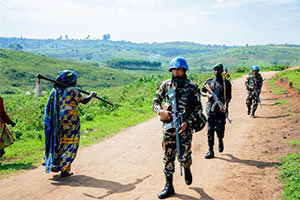 MONUSCO Peacekeepers and FARDC Soldiers Patrol Fataki Area. Credit: UN Photo/Jorkim Jotham Pituwa
Conflict, human rights violations, natural disasters, and famine have been at the forefront of concerns for humanitarian organizations. The escalation of humanitarian crises has led to over 239 million people in need of humanitarian assistance at the start of 2026, as estimated by OCHA’s Global Humanitarian Overview. The 2025 humanitarian appeal received only $12 billion, the lowest funding in over a decade, which has left 24 million fewer people reached in comparison to 2024. Conflict has remained the primary driver of crisis.
Humanitarian emergencies massively impact progress towards the Sustainable Development Goals (SDGs), adversely affecting economic development, inequality, education, planetary well-being, and poverty. Millions of people are faced with reduced access to essential services, including shelter, food, healthcare, and access to clean drinking water. UN Organizations such as UNHCR and the United Nations Children’s Fund (UNICEF) are committed to providing direct relief to affected communities when state governments cannot.
The United Nations 2024 Summit of the Future discussed measures that will be taken to reduce global inequality and promote peacekeeping efforts around the world. The recent UN Climate Change Conference (COP30) in Belém, Brazil, agreed to mobilize $1.3 trillion annually for climate action by 2035, operationalize the loss and damage fund, and triple adaptation finance. However, a fossil fuel transition commitment was not secured, despite climate change and the greenhouse effect being major contributors to humanitarian crises worldwide.
Countries across the world have also rallied to end humanitarian crises, as witnessed in conflicts such as Palestine and Ukraine. IPS is committed to providing relevant and in-depth reports of humanitarian emergencies around the world and their implications.

The Week with IPS

NEXT STOP - SDGs
Tracking global progress towards a sustainable world
Tracking global progress towards a sustainable world