
Tuesday, November 10, 2026



News and Views from the Global South
Indigenous Rights
Moana Nui Set to “Undress” APEC
This November, when the Asia-Pacific Economic Cooperation (APEC) forum holds its annual rotating summit in Honolulu, it will attract more than the attention of the world's media.
U.S.: Battle Escalates Against Genetically Modified Crops
Home to a fast-growing network of farmers' markets, cooperatives and organic farms, but also the breeding ground for mammoth for-profit corporations that now hold patents to over 50 percent of the world's seeds, the United States is weathering a battle between Big Agro and a ripening movement for food justice and security.BOLIVIA: General Strike Protests Crackdown on Native March
Bolivia's main trade union declared a 24-hour general strike Wednesday to protest Sunday's police crackdown on indigenous demonstrators who were protesting the construction of a road through a pristine rainforest preserve.
INDIA: Kashmiris Hail Hague Stay on Dam
A ruling by the International Court of Arbitration (ICA) at The Hague, staying construction of a dam across a river that flows into Pakistan, has brought cheer to the tribal people who live around the site.Despite Western Boycott, Racism Meet Gets Overwhelming Support
A "boycott" by more than a dozen Western nations, including the United States, Germany, Canada and Israel, failed to derail a high-level meeting on racism and xenophobia hosted by the 193-member General Assembly.
MEXICO: Peace Movement Meets Zapatistas
The Caravan for Peace with Justice and Dignity, headed by Mexican writer Javier Sicilia, travelled through southeastern Mexico and reached the heart of the territory controlled by the Zapatista National Liberation Army (EZLN), bringing a message of solidarity.
Global Gold Rush Brings Heightened Scrutiny
Bolstered by gold prices hovering above 1,800 dollars an ounce and a global economy slowly recovering, exploration activity for the precious metal in 2010 once again rebounded. Yet, with this surge comes the attendant scrutiny by activists, investors, and the media into the industry's human rights and environmental records abroad.MOROCCO: Demands for Autonomy Spread
Morocco's offer of autonomy to Western Sahara to stave off demands for full independence is boomeranging on the kingdom with other regions now demanding similar freedom.
MEXICO: Peace Caravan “Has Made Us Feel Stronger”
With a huge hug, Olga Reyes from Chihuahua, who has lost six family members in Mexico's wave of drug-related violence, greets Araceli Rodríguez from Mexico state, the mother of a young federal police officer who "disappeared" in Michoacán two years ago.INDIA: Landless Plan a Long March
The Gandhian movement Ekta Parishad plans to organise a march for land rights in October 2012 in India, aiming to gather around 100,000 indigenous people, dalits and poor peasants. Support is shaping up around the world, at events such as an international mobilisation conference in Geneva Sep. 12-13.GUATEMALA: The War Over Land
The violent eviction of 91 rural families in northern Guatemala was the latest incident in the ageold conflict over land in a country where the army is frequently called in to force peasant farmers off their land.MIDEAST: Not School Time Yet for Bedouin Girls
For mother of five Shimaa al-Aasam, providing her children with the opportunity to complete their education despite a severe lack of classrooms in their Bedouin community is of prime importance.
Q&A: Mighty Maya Cities Succumbed to Environmental Crisis
The latest archeological findings in the Mirador Basin of Guatemala lend further credence to the theory that the Maya civilisation that once flourished there was brought down by environmental causes such as deforestation.CANADA: Native Lands Ruling Opens Up New Questions
As Canada's aboriginal community celebrates last month's milestone legal ruling regarding clear-cutting in Ontario and the forestry sector mulls its future strategy, discussions are taking place about how to carry out an impact assessment evaluating damage incurred by decades of industry encroachment on traditional lands and forests.
BOLIVIA: Rainforest Road Will Have Environmental and Cultural Impacts
A richly biodiverse rainforest the size of 3,000 soccer fields in central Bolivia will be the first victim of the road planned to run through the Isiboro Sécure Indigenous Territory and National Park (TIPNIS), say environmental activists.
Q&A: “Civilians Should Not Suffer the Effects of the Armed Conflict” in Colombia
Indigenous people in the province of Cauca in southwest Colombia want their territory to be free of war, and are organising a protest march to demand that the police and military close down their bases and the guerrillas abandon their camps in the native reservations in the north of this mountainous province.CONGO: Poachers Feel the Long Arm of New Law
Authorities in the Republic of Congo are showing an encouraging new readiness to arrest and prosecute people trading in endangered species.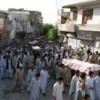
PAKISTAN: For Shia Hazaras, it’s Funeral After Funeral
Rukhsana Ahmed finds comfort visiting her husband Ahmed Ali Najfi’s grave. "I feel at peace there," says the 60-year-old widow, mother of four and member of the Shia Hazara community.
BOLIVIA: Morales Clashes with Native Protesters over Road through Tropical Park
The lack of regulations for consulting indigenous communities in Bolivia on initiatives that affect their territories is at the heart of a dispute over a road to facilitate traffic from Brazil, which would run through an enormous tropical national park self-governed by indigenous communities.Lenape Take On Ford
"We have been living here for thousands of years. Unfortunately, we are the original people of this land, but we get no respect," says Vivian Milligan, in a tone filled with sarcastic laughter.CONGO: Many Indigenous Women Still Give Birth in the Forest
Marguerite Kassa feared she would find herself alone in the small crowd of a dozen other pregnant women at the integrated health centre in Mossendjo, in the southwestern Republic of Congo. "I am six months pregnant already, but I hesitated to come here before now, because there is so much contempt for us," the thirty-year-old indigenous woman tells IPS. "Yet I was warmly welcomed."« Previous Page — Next Page »





The planet's roughly 350 million indigenous peoples took notable steps on the international stage in the last decade. They got the world's governments to agree to create a body to represent them at the United Nations, the Permanent Forum on Indigenous Issues, and to appoint a special rapporteur responsible for their human rights. In 2007 a Universal Declaration on the Rights of Indigenous Peoples was approved by the UN. Yet the living conditions of most "tribal", "aboriginal", "native" or "first" peoples remain precarious. IPS, with its network of contributors at the UN and linked to indigenous communities worldwide, is committed to tracking the world community's efforts to do justice to the rights and aspirations of these peoples, with a special current focus on Latin America's 40 million rural indigenous peoples.

The Week with IPS

Tracking global progress towards a sustainable world
