Languages
Thursday, November 12, 2026



News and Views from the Global South
Labour
BANGLADESH: Ship Breakers Defy Court Ruling on Toxic Vessels
The ship breaking companies of Bangladesh continue to import highly toxic foreign vessels despite a two-year-old ban, and are also defying a court order to ensure workers’ safety and implement environmentally sound practices, a group of lawyers says.
Q&A: “Women Have Yielded the Cooking Profession to Men”
"Women didn't want to be slaves any more, or work professionally at what they were trying to liberate themselves from," renowned Venezuelan chef Helena Ibarra told IPS, explaining why women have taken so long to compete in a workplace as symbolically feminine as the kitchen.MALAWI: Village Hands Join to Save Forest for Juice
Seventy kilometres outside Malawi's commercial capital, Blantyre, a profitable cooperative enterprise is providing villagers jobs and preserving forests.
SRI LANKA: A Life Lost in Protest Against Pension Bill
Even before 22-year-old Sri Lankan worker Roshen Chanaka was pronounced dead at the Colombo North Hospital on Jun. 1, a large contingent of military personnel had moved in to secure the building. And to the small undertaker’s premises to which his body was later brought, the soldiers followed.Critics Call Trade Pact Lose-Lose Deal for Colombian Labour
Two days ago, on Jun. 7, Ana Fabricia Cordoba was killed in the Santa Cruz neighbourhood of Medellin, Colombia. A community leader with the women's organisation Ruta de Pacifica de Mujeres working with displaced workers, Cordoba had been receiving death threats, which she reported to the police and national government.
Asylum-Seekers Find Refuge in a Street Paper
The reasons why people become street paper vendors are many and diverse. Some are homeless; others suffer mental or physical health problems, struggle with addiction or face unemployment. And some people do it because the magazines offer them the refuge they so desperately need.Urban Transformation for Interethnic Cities
Urban centres, marked by globalisation, migration and the intermingling of culturally and ethnically diverse communities were among the major topics of the International Conference on the Inter-ethnic City held in Rome last week on the eve of the celebrations of Italy’s national day.
PAKISTAN: Lonely for Women Who Succeed
As you climb the ladder at the workplace, from the mid-management level to the senior leadership positions, you find fewer and fewer women. Little wonder then that Naz Khan - chief finance officer at Engro Fertilizers, a subsidiary of one of Pakistan’s largest conglomerates, Engro Corporation - says it gets lonely at the top.DEVELOPMENT: Microfinance Craze Conceals Multiple Problems
The microfinance industry is expanding at breakneck pace, with more banks and private equity firms now entering the fray. Yet there is growing unease about the naive assumptions, and evangelical predictions, of its advocates.Human Rights Teachings Spread Ripples of Hope
In a new curriculum introduced last December, thousands of students in New York State are learning about modern-day human rights defenders, and that they too can make a positive difference in the world.ECUADOR: Gov’t Shuts Down Illegal Gold Mines
The Ecuadorian government sent in the army to shut down illegal gold mining operations in the jungles of the northwest province of Esmeraldas, where the highly polluting activity is associated with drug traffickers and protected by armed militias and hired killers.ARGENTINA: Power Still Overwhelmingly in Men’s Hands
In Argentina the overwhelming majority of decision-making posts in the most diverse areas are occupied by men, with the exception of the presidency, held by Cristina Fernández.
PAKISTAN: Women Lose Livelihood Centres to Militants
Housewife Shahida Jabeen was devastated when she heard the news that she could no longer take sewing and embroidery classes at the local training centre in her hometown in South Waziristan in north-west Pakistan.
AFRICA: ‘Bicycles Are For Good’
"Politicians may tell us that bicycles are a sign that we are not advancing," says Patrick Kayemba, managing director of the First African Bicycle Information Organization in Uganda, "but we ourselves have seen that cycling is a socio-economic tool. It works now - we don’t have to wait for someone to rescue us with better public transport, better this, or better that..."
Nascent Independent Unions Play Key Role in Arab Uprisings
In the Arab world, most trade unions are affiliated to governments, but independent labour organisations are starting to emerge.
BRAZIL: Amazon Dams Mean Progress for Some, Lost Livelihoods for Others
The Amazonian town of Mutum-Paraná, in the northern Brazilian state of Rondônia, is disappearing. Its last remaining buildings must be dismantled before it is flooded by the construction of the Jirau hydroelectric dam on the Madeira River.ZIMBABWE: Cross-Border Traders Don’t Trust Banks With Their Money
A newly available electronic banking service has received a lukewarm reception from cross-border traders in Zimbabwe’s second largest city Bulawayo, despite it alleviating the need to move around with large sums of cash.Hotel Maids Say Sexual Harassment Is Part of the Job
With the arrest of the once powerful head of the International Monetary Fund (IMF), Dominique Strauss-Kahn, following allegations that he tried to rape a maid in his 3,000-dollar- a-night penthouse suite at the Sofitel Hotel, a spotlight has been turned on the treatment of female cleaning staff, many of whom are immigrants who keep silent for fear of losing their jobs or being deported.
NIGERIA: Women Giving Each Other a Hand Up
In an open space near her home in Makoko, a crowded suburb of the sprawling city of Lagos, Latifat Agboola sits in the midst of bags of charcoal, attending to her customers. Some of them call her "the charcoal woman with the dirty job, but she sees herself as a businesswoman on the rise.
ZAMBIA: Making the Most of Limited Capital
Proponents of microfinance often portray it as the empowering extension of credit to vulnerable but diligently self-employed poor people - often women - who support each other to improve their livelihoods as well as repay their loans. The image is true, to some extent, but in many parts of Africa, microfinance institutions have somewhat sharper teeth.
ZAMBIA: Microfinance Beyond the Reach of the Poor
According to the World Bank, less than eight percent of Zambian adults have bank accounts. For the millions who make their living in the informal economy, this prevents them from earning interest on any savings they have or securing credit needed to expand small businesses beyond mere survival.« Previous Page — Next Page »





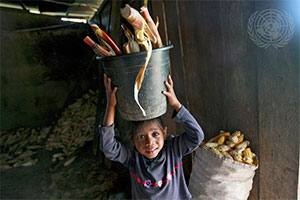 Timorese Girl with Fresh-Picked Corn. Credit: UN Photo/Martine Perret
A global common denominator is the need for a decent job. The economic realities of each country determine just how difficult it is to find one. Despite the labour movement's achievements, serious challenges persist: gender discrimination, child labour, worker migration, the digital divide and AI automation, evaporating pensions, unsafe workplaces, corporate pressure against union organising, negative impacts of trade agreements, and the precariousness of informal employment. The 2025 UN SDG Report identifies jobs and social protections as one of the six priority areas requiring urgent action, with progress either stalled or reversing in many developing nations.
In recent years, the fight to protect labour equality has taken on new dimensions with the rise of Environmental, Social and Governance standards. With the Social aspect aiming to promote equality and human rights, ESG principles have strengthened labour advocacy within corporate and governmental regulatory landscapes. In particular, ESG has become much more institutionalized in emerging economies such as Brazil and China. IPS follows the world’s workers as they confront these challenges - their setbacks and their successes.

The Week with IPS

NEXT STOP - SDGs
Tracking global progress towards a sustainable world
Tracking global progress towards a sustainable world
