Languages
Tuesday, October 27, 2026



News and Views from the Global South
Labour

Parliamentarians Tackle Youth Employment, SRHR in Post-COVID Asia and Pacific
With more than 600 million youth aged between 18 and 24 in the Asia and Pacific region, putting their issues front and center is crucial. Speakers at a recent forum, Youth Empowerment: Education, Employment and Sexual and Reproductive Health and Rights, held in Phnom Penh, Kingdom of Cambodia, agreed that policy development and implementation should be youth-centered.
International Women’s Day, 2023

From the earliest days of computing to the present age of virtual reality and artificial intelligence… …women have made untold contributions to the digital world in which we increasingly live.

Management Areas Protect Sustainable Artisanal Fishing of Molluscs and Kelp in Chile
Management areas in Chile for benthic organisims, which live on the bottom of the sea, are successfully combating the overexploitation of this food source thanks to the efforts of organized shellfish and seaweed harvesters and divers.
Welcome To the Vegetable Garden of Europe – ‘The Greenhouses of Death’
Chances are that the fruits and vegetables sold in European supermarkets have been picked and packed by a migrant worker in southern Spain. By the tens of thousands, they work there, in sweltering hot plastic greenhouses - often underpaid and without residence permit - in the vegetable garden of Europe. "Cheap vegetables, yes. But at what price?"
In Zimbabwe, Economic Crisis Pushes Underaged Girls to Sex Work
After other adolescent girls her age have gone to bed at around 10 pm, Kudzai commutes to a shopping centre near her home in Penhalonga, a mining area 25 kilometres outside the third largest Zimbabwean city of Mutare, to look for men to solicit sex.
Fear of Population Ageing
Fear of population ageing is all over the news media and in government offices of country capitals worldwide. Planet Earth is becoming “planet ageing”.
In Latin America’s Aging Population, 17 Percent Will Be Over 65 by 2050
Latin America and the Caribbean is no longer a young region and it will be one of the regions with the largest aging populations by 2050, which poses great challenges due to the social inequalities the countries face, but also opportunities to overcome them.
It’s Time to Move Away from Public-Private Partnerships & Build a Future That is Public
Last month, we joined more than 1000 representatives from all sectors of civil society who came together in Santiago de Chile to debate the future of – and threats to - public services the world over.
US Policies Slowing World Economy
Few policymakers ever claim credit for causing stagnation and recessions. Yet, they do so all the time, justifying their actions by some supposedly higher purpose.
We Want to Be Legal; We’re Not ‘Zama Zama’ Criminals Say South African Artisanal Miners
Mining towns across South Africa have become hostage to a booming but bloody illegal mining economy.
The Year of Inflation Exposes Dogma and Class Bias
Inflation worries topped Ipsos’s What Worries the World survey in 2022 overtaking COVID concerns. The return of inflation caught major central banks, e.g., the US Federal Reserve (Fed), Bank of England, European Central Bank “off guard”. The persistence of inflation also surprised the International Monetary Fund (IMF). The return of inflation and its persistence exposed the poverty of the economics profession, unable to agree on its causes and required policy responses. It also exposed the profession’s anti-working class biases.
Demography Doesn’t Care
Demography doesn’t care about such things as national strikes over pension retirement ages, public protests about contraception and abortion rights, sexual orientation, habits and preferences, political ideology and party affiliation, dress codes and head coverings, and religious identity, beliefs and practices.
More Austerity in 2023 Will Fuel Protests
This week world leaders meet in Davos to discuss cooperation to address multiple crises, from COVID-19 and escalating inflation to slowing economic growth, debt distress and climate shocks.
Deportees Start Businesses to Overcome Unemployment in El Salvador
While grilling several portions of chicken and pork, Salvadoran cook Oscar Sosa said he was proud that through his own efforts he had managed to set up a small food business after he was deported back to El Salvador from the United States.
Raising Retirement Age Coming Soon
Despite the objections, resistance and protests taking place in many countries around the world, raising the official retirement age to receive government provided pension benefits is coming soon.
India’s Extensive Railways Often Conduit for Child Trafficking
Deeepti Rani (13) lives with her mother in a dilapidated dwelling near a railway track in India’s southern state of Karnataka. The mother-daughter duo sells paperbacks on trains for a living.
AGRA Gets Make-Up, Not Make-Over
Despite its dismal record, the Gates Foundation-sponsored Alliance for a Green Revolution in Africa (AGRA) announced a new five-year strategy in September after rebranding itself by dropping ‘Green Revolution’ from its name.
The World Cup of Opportunity
The sun is shining, and the temperature sits at an idyllic 28 degrees Celsius. The Uber driver taking me to work is from Pakistan and devastated about the recent loss to England in the T20 Cricket World Cup final in Australia.
Balancing Diversity and Meritocracy
Countries worldwide, and as different as India, Indonesia, Iraq, Iran, Ireland, Israel and Italy, are struggling with the issue of how best to balance diversity and meritocracy across disparate ethnic, racial, caste, linguistic and religious subgroups in their populations.
Open Veins of Africa Bleeding Heavily
The ongoing plunder of Africa’s natural resources drained by capital flight is holding it back yet again. More African nations face protracted recessions amid mounting debt distress, rubbing salt into deep wounds from the past. With much less foreign exchange, tax revenue, and policy space to face external shocks, many African governments believe they have little choice but to spend less, or borrow more in foreign currencies.
A Looming Debt Crisis is Threatening Global Health Security. It is time to Drop the Debt
In this moment of profound challenge in international relations, it was understandable that the conclusion of the G20 meeting left leaders feeling relieved that the meeting took place without a breakdown. Leaders were justifiably proud too of important steps forward they made including the launch of the new pandemics fund.« Previous Page — Next Page »





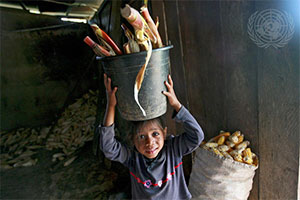 Timorese Girl with Fresh-Picked Corn. Credit: UN Photo/Martine Perret
A global common denominator is the need for a decent job. The economic realities of each country determine just how difficult it is to find one. Despite the labour movement's achievements, serious challenges persist: gender discrimination, child labour, worker migration, the digital divide and AI automation, evaporating pensions, unsafe workplaces, corporate pressure against union organising, negative impacts of trade agreements, and the precariousness of informal employment. The 2025 UN SDG Report identifies jobs and social protections as one of the six priority areas requiring urgent action, with progress either stalled or reversing in many developing nations.
In recent years, the fight to protect labour equality has taken on new dimensions with the rise of Environmental, Social and Governance standards. With the Social aspect aiming to promote equality and human rights, ESG principles have strengthened labour advocacy within corporate and governmental regulatory landscapes. In particular, ESG has become much more institutionalized in emerging economies such as Brazil and China. IPS follows the world’s workers as they confront these challenges - their setbacks and their successes.

The Week with IPS

NEXT STOP - SDGs
Tracking global progress towards a sustainable world
Tracking global progress towards a sustainable world
