Languages
Wednesday, September 16, 2026



News and Views from the Global South
Labour
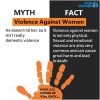
Am I Abused or Am I a Failure to Adjust? – A Migrant’s Story
Every year hundreds of immigrants leave their homes and trail to a land of dream and hope where they aspire to find peace, happiness and sometimes a little bit of safety compared to what they leave behind.
Blue Innovation in the Commonwealth
With 95 per cent of the ocean still unexplored by humans, we are only just beginning to understand its profound influence on life on earth, including its effect on global climate and ecosystems.
School Lunch Programmes for Progress
If well planned, coordinated and implemented, a government funded school feeding programme for all primary school children can be progressively transformative. Such a programme, involving government departments and agencies working together, can benefit schoolchildren, their families, farmers and public health, now and in the future.
Was China Manipulating Its Currency?
Many argue that China’s impressive growth for last four decades has been due to deliberate exchange rate undervaluation, promoting exports and discouraging imports. In August last year, the Trump administration accused China of engaging in currency manipulation.
In the Elusive Grip of an Abusive Partner: A Migrant’s Story
To live in a home with family, to have a safe environment, food and basic human necessities, are some of the essentials that most people expect to have without giving it all much thought. When a child is born, parents or caregivers are likely to provide these things. These expectations get renewed whenever someone gets married and moves to a new home, a different neighborhood, or a city. We can hardly find someone who will say that they were not expecting happiness and safety when stepping into a new relationship, or starting a new chapter of life. But these expectations of a better life turn disastrous for millions of people when they step into another country as a dependent.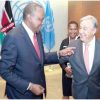
The United Nations Reforms-From Ideas to Actions
One of the highlight activities as the United Nations commemorates its 75th anniversary this year will be the launch of an “annual temperature check” on Sustainable Development Goals (SDGs), progress. With only ten years left to the final whistle for the Goals, this activity that will take place each September will provide a snapshot of what’s working, and where countries need more action.
2020: a Year Full of Danger
Let’s face what lies ahead with open eyes: 2020 is going to be a very tough year for the world, and developing countries in particular. The infant decade has already begun with the harbingers of climate disaster as thousands fled to beaches in Australia from raging bush fires, and the Middle East braced for more conflict after a U.S. air strike in Baghdad killed Iran’s top general.
2020 Is the Decade of Action & It Has to Be a Sprint
Happy New Year, Kenya. 2020 marks a decade of action towards the realization of the Sustainable Development Goals by 2030. Peace and development are inextricably linked, with each making the achievement of the other far more likely. This puts the conflict-prevention and development work of the UN at the heart of the agenda in East Africa, but in a multi-agency and programme environment, making meaningful progress is challenging.
A Tribute to Sir Fazle Hasan Abed (1936 – 2019)
“When I think about Bangladesh, I think about everybody. Not everybody is enjoying Rabindranath and the great literature and culture that Bangladesh has. But I think everybody has got the right to have this experience”, deeply felt by late Sir Fazle Hasan Abed, founder of BRAC (Building Resources Across Communities), a unique, integrated development organization that many have hailed as the most effective anti-poverty organization in the world; who passed away December 20, 2019at the age of 83.
More Women in Tech Will Lead to Peaceful Gender Equal World
It will take around 100 years for the world to reach gander parity according to the Global Gender Gap Report 2020 just published by World Economic Forum.
Q&A: Initiative Starts Mental Health Sessions for Bangladeshi Garment Workers
Nearly seven years ago, garment workers in Bangladesh were victims of one of the gravest man-made disasters in history -- a factory collapse that left more than 1,100 workers dead, and rendered thousands with injuries -- in many cases lifelong ones. For many of the workers from Rana Plaza, the trauma remains real even to this day.
Carbon Markets Can Provide a Crucial Part of the Solution to the Climate Crisis
One of the main discussions at the COP25 climate change talks was Article 6, which is designed to provide financial support to emerging economies and developing countries to help them reduce emissions by using global carbon markets. Carbon pricing is an essential piece of the puzzle to curb emissions. Without a value on carbon, there is less incentive to make positive changes, especially in the private sector. The most efficient way to carry this forward is to allow trading of carbon both nationally and internationally, which will ensure the lowest cost of mitigation for participants globally.
Taking Bangladesh to Zero-Leprosy, One New Case at a Time
Sandhya Mandal has never felt so vindicated. For the past four years, the 36-year-old community health worker from Meherpur – a rural district bordering India – has been traveling 50 km every day along dusty roads on an old motorbike, searching for leprosy patients who needed urgent treatment. But in her community, instead of compliments, neighbours and relatives raised questions about her work and her character. “They ask why I come home so late and what is this ‘work’ that I really do. Some even imply that I might be doing something like prostitution,” Mandal tells IPS.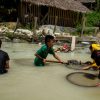
Building Momentum to Hold Companies to Account
Millions of adults and children around the world suffer abuses as workers who obtain raw materials, toil on farms, and make products for the global market. They are at the bottom of global supply chains, for everything from everyday goods like vegetables and seafood to luxury items like jewelry and designer clothing that end up on store shelves worldwide.
Accelerating SDG Progress in Asia – Pacific
“The 2030 Agenda is coming to life”, declared the Secretary General at the opening of the first SDG Summit, a quadrennial event for the follow up and review of the 2030 Agenda for Sustainable Development. As leaders from Asia – Pacific took the floor, they highlighted country progress of SDG implementation and reaffirmed commitment to achieve the 2030 Agenda. Statements reflected different approaches across the region. Yet all converged on one priority: accelerated actions and transformative pathways.
Why Is Growth Slowing in China?
China’s gross domestic product (GDP) grew by 14%. Since then, its growth rate has declined by more than half to 6.6% in 2018. The five-year moving average growth rate is at its lowest since reforms began in 1978, although annual growth briefly fell lower during 1989, the year of the Tian An Men incident.
Fostering Sustainable Urbanization and Rural-Urban Linkages
As urbanization continues apace, coupled with rapid population growth and rural to urban migration, the challenges for inclusive rural transformation continue, and the importance of fostering improved rural-urban linkages for better food systems becomes increasingly important.. According to the UN, by 2050 some 66% of the world’s population of 9 billion is expected to live in urban areas. Such rapid urbanization is increasingly shaping the rural space and rural livelihoods (through markets, demand for agricultural goods and labour, migration, and through the provision of services to rural areas). It is therefore critical for the increasing emphasis on urban development to take into account the importance of rural development.
Gains and Losses of Irregular Migration
While opening a newspaper or watching a TV program we are every day made aware of the plights of irregular migrants. Some recent examples among many – on 24 October, 39 Chinese nationals were found dead in a lorry trailer in Essex. They had apparently frozen to death within a refrigerator container with temperatures as low as -25C (-13F). This while tragedies occur almost daily on the Mediterranean Sea. On 26 November, a rescue vessel found a boat almost completely sunken. It had three dead bodies aboard. Fifty-five migrants were saved. Three of them were in a critical condition, and one died after reaching Melilla in Spain, where the migrants were brought in. Three children were among the survivors, though a further ten individuals were reported missing. Nowadays, such news items pass by almost imperceptibly. Every day, thousands of unfortunate human beings are trafficked all over the world to suffer underpaid, hazardous work, or prostitution.
Fostering Jobs, Entrepreneurship, and Capacity Development for African Youth: The Time for Disruption Is Now!
“There is no greater asset to Africa than its youth,” a statement that has been repeatedly proclaimed, but the continent still has a long way to go. Despite robust economic growth over the past two decades, a 1 percent increase in growth between 2000–14 was associated with only 0.41 percent growth in employment. This figure suggests that employment stood at less than 1.8 percent a year, far below the nearly 3 percent annual growth in the labor force. If this trend continues, 100 million people will join the multitudes of the unemployed in Africa by 2030.African Development Bank launches digital tool to help African youth learn to code
The African Development Bank and technology firm Microsoft today launched the ‘Coding for Employment’ digital training platform, an online tool to provide digital skills to African youth, wherever they are across the continent.
Catalysing Change for Gender Equality
Great strides have been taken to empower women and girls in the Asia-Pacific region since the Fourth World Conference on Women in Beijing adopted an ambitious global agenda to achieve gender equality twenty-five years ago. Gender parity has been achieved in primary education. Maternal mortality has been halved. Today, the region’s governments are committed to overcoming the persistent challenges of discrimination, gender-based violence and women’s unequal access to resources and decision-making.« Previous Page — Next Page »


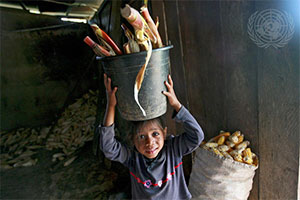 Timorese Girl with Fresh-Picked Corn. Credit: UN Photo/Martine Perret
A global common denominator is the need for a decent job. The economic realities of each country determine just how difficult it is to find one. Despite the labour movement's achievements, serious challenges persist: gender discrimination, child labour, worker migration, the digital divide and AI automation, evaporating pensions, unsafe workplaces, corporate pressure against union organising, negative impacts of trade agreements, and the precariousness of informal employment. The 2025 UN SDG Report identifies jobs and social protections as one of the six priority areas requiring urgent action, with progress either stalled or reversing in many developing nations.
In recent years, the fight to protect labour equality has taken on new dimensions with the rise of Environmental, Social and Governance standards. With the Social aspect aiming to promote equality and human rights, ESG principles have strengthened labour advocacy within corporate and governmental regulatory landscapes. In particular, ESG has become much more institutionalized in emerging economies such as Brazil and China. IPS follows the world’s workers as they confront these challenges - their setbacks and their successes.

The Week with IPS

NEXT STOP - SDGs
Tracking global progress towards a sustainable world
Tracking global progress towards a sustainable world
