Languages
Monday, October 19, 2026



News and Views from the Global South
Labour

Farmers Hold Keys to Ending Poverty, Hunger, FAO Says
With recent data showing that 793 million people still go to bed hungry, ending hunger and poverty in 15 years is the next development challenge that world leaders have set for themselves.
Seeking a New Farming Revolution
As the World Farmers' Organization meets for its annual conference in Zambia to promote policies that strengthen this critical sector, IPS looks at how farmers across the globe are tackling the interconnected challenges of climate change, market fluctuations, water and land management, and energy access.
In sight but out of mind
This year Bangladesh exceeded all expectations, achieving a GDP rate of over 7 percent. With higher growth, the issue of labour rights is also gaining prominence in our national discourse, with more and more emphasis being given on workplace safety and wellbeing. Those amongst us who are educated are becoming more and more aware of our rights in our workplace, as we unhesitatingly demand for better pay, better facilities, a better life, really. And why shouldn't we? This is our right as promised by our Constitution and by our state. But there still remains a large portion of our workforce, over 80 percent to be precise, who are not warranted recognition by any of our state apparatuses. When we talk proudly of progress and development, we tend to take for granted that only those who fall under a formalised structure deserve acknowledgement and thereby can demand their rights under the law. We choose to ignore more than half of Bangladesh's population who, despite their indispensible contribution, are regarded as expendable, replaceable, and thus, undeserving of formal rights or protection.
When Only Men Make the News
On the onset, it seems women are everywhere in the media. You switch on the TV, there is inevitably an attractive woman luring you into buying a product. On the radio, there is the 'young new thing' vivaciously flirting with her male co-host while shuffling through songs; and in print, the entertainment pages would simply not sell without a titillating image of a female celebrity and a scoop on her latest rendezvous. But take a closer look, beyond the objectified and stereotypical images of women, being manufactured and mass consumed ad nauseam, and where are the women, really? Take a look at the news media, for instance. Where are the women in the newsrooms, in the bylines on the front and back pages, in the column spaces of our opinion pages, in the talk shows, not simply as hosts, but as commentators on so-called hard issues such as politics and foreign affairs? Where are the women in our news (discounting the PM and her alter-ego), except as wailing victims of violence, natural disasters and such and as muses of our male photographers during cultural festivals?
Maquilas Help Drive Industrialisation in Paraguay
“There were cases of people who stopped coming to work after receiving their first wages and then came back a few days later to ask if there was more work,” because they were used to casual work in the informal economy, said Ivonne Ginard.
Not So Smart Idea
As Bhubaneswar experiences scorching heat of 43.2 degrees Celsius in early April, 5 degrees above normal, 44-year-old Prasanti Behera barely sleeps at night. Two summers ago, a fire charred 50 homes in her slum and burnt in seconds US$600 she had painstakingly saved over two years for her daughter’s marriage.
Land Tenure Still a Challenge for Women in Latin America
Rural women in Latin America continue to face serious obstacles to land tenure, which leave them vulnerable, despite their growing importance in food production and food security.Streamlining opportunities to migrate
In Bangladesh, remittances from people living and working abroad added up to nearly Tk. 1.2 trillion last year—more than four times the nearly Tk. 250 billion that foreign aid agencies spent in the country.
The List of Shame
He stood there at the reception, with a sling bag filled with documents. He worked for a courier company. He was 10 years old. He was handsome. And he had the brightest eyes I had ever seen before.Dhaka’s Risky Streets with Kids Driving Buses, Human Hauliers
In any country, one has to be an adult to qualify as a driver. But in Bangladesh, one does not have to obey that law to become a driver – and that literally means it is “allowed”.
Outsourcing Jobs, Insourcing Labour & Increasing Profits
For decades “outsourcing” jobs from wealthy developed countries to low-wage developing countries has been a major strategy of many corporations, industries and businesses to increase profits by reducing labor costs and operating expenses.
Clean Clothes – Fashion Free of Slave Labour in Argentina
In Argentina, there are now 20 brand names that guarantee that their garments are produced by workers in decent working conditions, thanks to the Clean Clothes network, aimed at eradicating slave labour in the garment industry, which illegally employs some 30,000 people in sweatshops around the country.
Increasing Women’s Access to Skills and Jobs
"My daughter and I were a burden on my parents,” says 20-year-old Moushumi Akter Mou from Mirpur. Married off at the age of 14, Mou could not complete her schooling. After her daughter was born, her husband remarried, leaving her feeling vulnerable and hopeless. “I felt that if I had a job, my life might be worthwhile.”
Mexico’s Chinampas – Wetlands Turned into Gardens – Fight Extinction
David Jiménez grows two kinds of lettuce and other fresh produce on his “chinampa” or artificial island just under one hectare in size in San Gregorio Atlapulco, on the south side of Mexico City.
A Question of Honour for a Nigerian Migrant
“In 2005 I left my home town in Eastern Nigeria by boat, landing in Athens, Greece along with my fellow companions - members of a football team. I decided to push my luck and moved to Italy in search of what I believed to be better opportunities to start a new life and get a decent job. Unfortunately, this may have just been an illusion.”
El Salvador Pension Reform Could Take Women into Account
El Salvador is debating reforms of the country’s privatised pension system, which could introduce changes so that it will no longer discriminate against women.
Gulf migration at an inflexion point
The steep fall in global oil prices has hit Gulf economies severely. Saudi Arabia, United Arab Emirates (UAE), Qatar, Bahrain are expected to run huge budget deficits as shrinking revenues from selling cheaper oil cannot fund their mounting expenditures. As they tighten their belts, the brunt of adjustment will be felt by migrants, who constitute the bulk of the labour force. Reforms include cutting fuel, power, water, education subsidies and a value-added tax (VAT). This will affect migrants and reports indicate family members are returning home.Rise of Middle Class Undermined in East Europe & Central Asia
The UN’s post-2015 development agenda, which was adopted by world leaders at a summit meeting last September, includes a highly ambitious goal: the eradication of extreme poverty by the year 2030. The decline in poverty, as reflected in the UN’s Millennium Development Goals (MDGs) which ended last December, had one positive fallout: the rise of a new middle class graduating largely from the ranks of the poor.
The New Normal in Fata
A military operation by Pakistan’s army has been proving fatal for Taliban militants who held sway over vast swathes of the Federally Administered Tribal Areas (Fata) for over a decade. They crossed over the border from Afghanistan and took refuge in Fata after their government was toppled by US-led forces towards the end of 2001. After a few years, when they got a toe-hold in the region, they extended their wings to all seven districts of Fata. Not any more.
Kidneys Going Cheap in Poor Estate Community
One and half years ago, Johnson, a 20- something youth, hailing from Sri Lanka’s tea plantations, received an unusual request. The caller, someone Johnson knew casually, made an offer for his kidney. “It was for a half a million rupees (around US $3,500),” he said.
Family Planning in India is Still Deeply Sexist
The tragic death of 12 women after a state-run mass sterilisation campaign in the central Indian state of Chhattisgarh went horribly wrong in 2014 made global headlines. The episode saw about 80 women "herded like cattle" into makeshift camps without being properly examined before the laparoscopic tubectomies that snuffed out their lives. In another incident in 2013, police in the eastern Indian state of Bihar arrested three men after they performed a botched sterilisation surgery without anaesthesia on 53 women over two hours in a field.« Previous Page — Next Page »





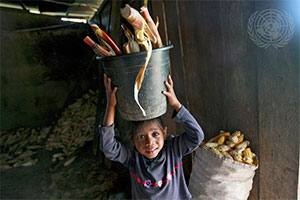 Timorese Girl with Fresh-Picked Corn. Credit: UN Photo/Martine Perret
A global common denominator is the need for a decent job. The economic realities of each country determine just how difficult it is to find one. Despite the labour movement's achievements, serious challenges persist: gender discrimination, child labour, worker migration, the digital divide and AI automation, evaporating pensions, unsafe workplaces, corporate pressure against union organising, negative impacts of trade agreements, and the precariousness of informal employment. The 2025 UN SDG Report identifies jobs and social protections as one of the six priority areas requiring urgent action, with progress either stalled or reversing in many developing nations.
In recent years, the fight to protect labour equality has taken on new dimensions with the rise of Environmental, Social and Governance standards. With the Social aspect aiming to promote equality and human rights, ESG principles have strengthened labour advocacy within corporate and governmental regulatory landscapes. In particular, ESG has become much more institutionalized in emerging economies such as Brazil and China. IPS follows the world’s workers as they confront these challenges - their setbacks and their successes.

The Week with IPS

NEXT STOP - SDGs
Tracking global progress towards a sustainable world
Tracking global progress towards a sustainable world
