Languages
Monday, October 19, 2026



News and Views from the Global South
Labour

Western Nations, Blaming Cash Crunch, Pull out of UNIDO
The 134-member Group of 77, the largest single coalition of developing countries, has expressed serious concern over the “unprecedented” withdrawal of nine member states from the Vienna-based UN Industrial Development Organization (UNIDO).
Leaving Saudi Arabia
The Eastern Province of Saudi Arabia is not one pilgrims or foreign tourists normally visit. Set against the Persian Gulf, it is the heart of the kingdom’s oil industry. Unsurprisingly, it is also home to most of its migrant workers whose labour populates this sector.
Bougainville Women Turn Around Lives of ‘Lost Generation’
Finding a sense of identity and purpose, as well as employment are some of the challenges facing youths in post-conflict Bougainville, an autonomous region in eastern Papua New Guinea in the southwest Pacific Islands.
The Art of Covering Up in Somaliland
Amid the hustle and bustle of downtown Hargeisa, Somaliland’s sun-blasted capital, women in various traditional Islamic modes of dress barter, argue and joke with men—much of it particularly volubly. Somaliland women are far from submissive and docile.
New Protocol Aims to Cut Trillion-Dollar Food Waste Bill
Four years ago, 27-year-old Tsering Dorji of western Bhutan’s Satsam village took to organic vegetable farming. Since then, thanks to composted manure and organic pesticide, the soil health of his farm has improved, and the yield has increased manifold.
No More Dumping of Milk in Laikipia
Daniel Mithamo, 28, grew up knowing that dairy farming is about producing milk in large quantities. You sell a few litres, consume some with your family, and dump the rest for lack of cold storage and decent roads to access markets.
The Idiocy of Things Requires an “Information Habeas Corpus”!
Today we are saturated with media hype about the joys of information and communication technology (ICT). We will all be connected, all the time, by the Idiocy of Things (IoT )devices and our social media, all converging in the cloud. Our lives will be monitored by smart sensors in homes with smart refrigerators, toasters, TVs, doorbells, alarm systems, garages, cars and electricity meters. We are bombarded with ads showing us how all these smart devices will improve our lives and health, bringing ever greater convenience. Driverless cars will be safer, allowing us to read, monitor our kids or enjoy the scenery. All this ICT and automation is already a multi-billion dollar industry and its producers are salivating over its growth and profits. Individual privacy rights and security concerns seem to be an afterthought.
A Jarring Anomaly of Society
It is easy to miss stories about child domestic workers being tortured and killed. Easy because stories of children being killed have become eerily regular. It is May 28 and there is the report of 14-year-old Konika Rani being hacked to death by a drug addict with three of her classmates also grievously injured by him. There is also the horror of having to read about a six-year-old being left critically wounded after being raped by her neighbour. Next to this is the news of 11-year-old Hasina Akhter dying in hospital from the fatal wounds inflicted on her, presumably by her employers.The Price of Non-Governmental Growth
It is well known that since the 1980s, Bangladesh has made astonishing progress on a wide variety of development indicators such as reducing the prevalence of extreme hunger and poverty, increasing primary education enrolment rates, and reducing child and maternal mortality. This progress has been mirrored by an impressive record of sustained GDP growth, spanning decades. In contrast to these successes, the quality of our democratic institutions has languished to the point where they now threaten to undermine all these hard-won gains. This article argues that the provision of public goods and services by non-governmental organisations (NGOs) has not only contributed to these successes, but also to this failure.
Latest Population Projection of 25 Million Poses Serious Challenges
The most recent population projections expect the Island’s population to reach 25 million by 2042 and 25.8 million by 2062. It is expected to stabilise around the mid 2060s at 25-26 million. This is a significant departure from earlier projections that expected population stability much earlier at around 23-24 million in the 2030s and to decline thereafter.
New International Accord to Tackle Illegal Fishing
A new international accord to tackle illegal and under-reported fishing will come into force on June 5.
Traditional Mexican Recipes Fight the Good Fight
In a clay pot, Araceli Márquez mixes tiny Mexican freshwater fish known as charales with herbs and a sauce made of chili peppers, green tomatoes and prickly pear cactus fruit, preparing a dish called mixmole.
Prickly Pears Drive Local Development in Northern Argentina
Family farmers in the northern Argentine province of Chaco are gaining a new appreciation of the common prickly pear cactus, which is now driving a new kind of local development.
Bangladesh’s Urban Slums Swell with Climate Migrants
Abdul Aziz, 35, arrived in the capital Dhaka in 2006 after losing all his belongings to the mighty Meghna River. Once, he and his family had lived happily in the village of Dokkhin Rajapur in Bhola, a coastal district of Bangladesh. Aziz had a beautiful house and large amount of arable land.
Refugees Bring Economic Benefits to Cities
Refugees are now more likely to live in cities than in refugee camps, bringing with them planning challenges but also opportunities for economic growth.
Bees and Silkworms Spin Gold for Ethiopia’s Rural Youth
Beekeeping and silkworm farming have long been critical cogs of Ethiopian life, providing food, jobs and much needed income.
Deadly Algal Bloom Triggers Social Uprising in Southern Chile
A ban on harvesting shellfish in Chiloé due to a severe red tide outbreak sparked a social uprising that has partially isolated thousands of local residents of the southern Chilean archipelago and revived criticism of an export model that condemns small-scale fishing communities to poverty and marginalisation.
Climate Change Leaves Kashmir’s Economy High and Dry
Trudging barefoot on his two-acre piece of land, 57-year-old Mukhtar Ahmad has little hope of growing any crops this year due to the sudden dry spell that has struck Kashmir’s winter.
WFO Calls for Farmer-Centred Sustainable Development
Over 600 delegates representing at least 570 million farms scattered around the world gathered in Zambia from May 4-7 under the umbrella of the World Farmers' Organisation (WFO) to discuss climate change, land tenure, innovations and capacity building as four pillars on which to build agricultural development.May Day Hijacked by Politicians
Workers of the world – or at least in Sri Lanka – ‘Divide’. The rallying call of the International Workers, from the barricades as they romantically say, for workers of the world to ‘Unite’ is now a thing of the past. The interests of the working class have been submerged by the interests of the political class.
Farmers Can Weather Climate Change – With Financing
Merian Kalala, a farmer in Solwezi, capital of the North-Western Province of Zambia, knows firsthand that climate change is posing massive problems for agricultural productivity.« Previous Page — Next Page »





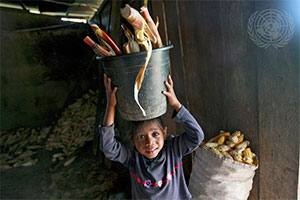 Timorese Girl with Fresh-Picked Corn. Credit: UN Photo/Martine Perret
A global common denominator is the need for a decent job. The economic realities of each country determine just how difficult it is to find one. Despite the labour movement's achievements, serious challenges persist: gender discrimination, child labour, worker migration, the digital divide and AI automation, evaporating pensions, unsafe workplaces, corporate pressure against union organising, negative impacts of trade agreements, and the precariousness of informal employment. The 2025 UN SDG Report identifies jobs and social protections as one of the six priority areas requiring urgent action, with progress either stalled or reversing in many developing nations.
In recent years, the fight to protect labour equality has taken on new dimensions with the rise of Environmental, Social and Governance standards. With the Social aspect aiming to promote equality and human rights, ESG principles have strengthened labour advocacy within corporate and governmental regulatory landscapes. In particular, ESG has become much more institutionalized in emerging economies such as Brazil and China. IPS follows the world’s workers as they confront these challenges - their setbacks and their successes.

The Week with IPS

NEXT STOP - SDGs
Tracking global progress towards a sustainable world
Tracking global progress towards a sustainable world
