Languages
Tuesday, November 10, 2026



News and Views from the Global South
Migration & Refugees

Macron Defends Globalist Approach at UN General Assembly
French President Emmanuel Macron delivered a sombre speech at the United Nations General Assembly yesterday, denouncing Myanmar’s “ethnic cleansing,” and calling for better protection of refugees in the world.
Aung San Suu Kyi: A Leader in Denial?
After finally breaking silence with a much anticipated address on the ongoing crisis in Rakhine State, Myanmar’s de facto leader Aung San Suu Kyi has disappointed the world as she refuses to acknowledge the plight of her country’s Rohingya community.
Cox’s Bazar Health Facilities Struggle to Cope as New Arrivals Pass 415,000: IOM Scales Up Mobile Teams, Support to Government Clinics
IOM, the UN Migration Agency is working with Government and aid agency partners to rapidly ramp up fixed and mobile health services in Bangladesh’s Cox’s Bazar district to help some 415,000 people who have fled violence in Myanmar’s North Rakhine State over the past three weeks.
“We are a World in Pieces”
I am here in a spirit of gratitude and humility for the trust you have placed in me to serve the world’s peoples. “We the peoples”, and our United Nations, face grave challenges. Our world is in trouble. People are hurting and angry. They see insecurity rising, inequality growing, conflict spreading and climate changing.
Out of Africa: Understanding Economic Refugees
Not a single month has passed without dreadful disasters triggering desperate migrants to seek refuge in Europe. According to the International Organization for Migration (IOM), at least 2,247 people have died or are missing after trying to enter Europe via Spain, Italy or Greece in the first half of this year. Last year, 5,096 deaths were recorded.
Ending Modern Slavery
Two centuries ago, right here in this city soon to emerge as the world’s center of commerce, a coalition of clergy, government officials, business leaders and rescued victims rose to fight the scourge of human slavery.
Rohingya: A Trail of Misfortune
Forsaken and driven out by their home country Myanmar, tens of thousands of Rohingyas are struggling to survive in Bangladesh’s border districts amid scarcities of food, clean water and medical care, mostly for children and elderly people.
World Hunger on the Rise Again
Exacerbated by climate-related shocks, increasing conflicts have been a key driver of severe food crisis and recently re-emerged famines, a major United Nations joint report has just revealed.
Why Aung San Suu Kyi Chooses Silence
On 23rd August, just days before thousands of Rohingyas began fleeing their homes from Rakhine State, Aung San Suu Kyi’s recently appointed Rakhine Advisory Commission, established in 2016, submitted its final report. The engaging of an independent Commission, tasked with recommending newer ways of improving the lives of Rohingya Muslims, Myanmar’s most deeply persecuted minority group, carried some weight of diplomacy.
Secretary-General Talks Myanmar, Trump Ahead of General Assembly
In an environment full of major threats, countries must work together towards peace and stability, the Secretary-General said ahead of the General Assembly.
Civilians ‘Direct Targets’ as Conflict Spreads in Central African Republic
Rape, torture, pillage, murder and forced displacement by the Union for Peace in Central Africa (UPC) rebel forces are the new horrifying realities faced by communities in Basse-Kotto, Central African Republic, according to the prominent London-based human rights group Amnesty International.
Dear Nobel Laureate, 19 September is 144 hours too late
Dear Nobel Laureate Aung San Suu Kyi, We learned today that you will address the Rohingya issue via television in Myanmar on 19 September - over 144 hours from now.

Myanmar Rohingya Face “Textbook Example of Ethnic Cleansing”
As hundreds of thousands of Rohingya Muslims flee violence in Myanmar’s Rakhine State, thousands that remain in the country face mass atrocities at a scale never seen before.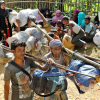
Dear Nobel Laureate Aung San Suu Kyi,
When you were finally able to accept your Nobel Peace Prize, you spoke eloquently of the ultimate aim of a world in which “every corner is a true sanctuary where the inhabitants will have the freedom and the capacity to live in peace.”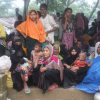
Refugee Camps “bursting at the seams” in Bangladesh
A dramatic increase in the number of refugees fleeing Myanmar is placing a huge strain on already very limited resources in Bangladesh, the UN refugee agency (UNHCR) said.
Ethiopia’s Internally Displaced Overlooked Amid Refugee Crises
Grasping its limp leg, a woman drags the carcass of one of her few remaining black-headed sheep away from her family’s domed shelter fashioned out of sticks and fabric that stands alone amid the desiccated scrubland a few kilometers from the town of Dolo Odo in the southeast of Ethiopia near the border with Somalia.
What Charities and Relief organizations do to alleviate poverty in the Arab region
Extreme poverty remains one of the world’s biggest challenges. According to the United Nations, 767 million people live in extreme poverty around the world. Although world society has managed to lift nearly 1 billion people out of extreme poverty – in 1999 it was estimated that 1.7 billion were affected by extreme poverty – the unprecedented rise of conflict and of violence in the Arab region has worsened the socioeconomic situation of vulnerable population segments in many countries. On 22 February 2017, the Under-Secretary-General for Humanitarian Affairs and Emergency Relief Coordinator of the United Nations –Stephen O’Brien – stated to the United Nations Security Council that 67% of the population in Syria is living under conditions considered as extreme poverty. In another Arab country affected by war and conflict – Yemen – the World Bank estimates that poverty affects 62% of the population, whereas the World Bank’s estimates this number to be at approximately 22% for Iraq or even as high as 40% in territories controlled by DAESH. Inevitably, conflict and violence have worsened the situation in the Arab region.
Latin America Calls for Free Movement of Persons in Global Compact on Migration
Latin America and the Caribbean called for the free movement of persons to be included in the Global Compact on Migration, which will be negotiated within the United Nations in 2018, in the first meeting held by any of the world’s regions to decide on the position to be adopted on the future agreement.
More Than 18,000 Rohingya Flee as Violence Renews
A surge in deadly violence in Myanmar has forced over 18,000 Rohingya Muslims to flee in less than one week, a migration agency said.
To Be a Nigerian Migrant in Italy
Bako* (24), a Nigerian migrant, stares at newcomers at an old, local Roman bar. Extremely polite, he asks for money. If you offer to buy him some food instead, he immediately accepts.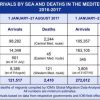
No Migrant Deaths at Sea in Last 20 Days as Mediterranean Arrivals Reach 121,517 for 2017
Since 9 August, IOM, the UN Migration Agency, has not received any reports of migrant deaths in the Mediterranean. The total count for Mediterranean Sea fatalities has remained at 2,410 for 20 days. Just 19 deaths have been recorded in the region so far in all of August by IOM, a sharp drop from the 689 recorded in August 2015 and 62 last year.« Previous Page — Next Page »





Human migration is a matter of global concern. Flows of migrants and refugees influence and change the social, economic and political dynamics of their destinations -- and the places they have left behind. IPS covers crucial issues such as migrant and refugee rights, irregular or undocumented migration, human trafficking, remittances, displaced persons and forced labour. And the positive: in many cases migration creates a new dialogue among civilisations. Migrants themselves become the building blocks of bridges connecting different cultures.

The Week with IPS

NEXT STOP - SDGs
Tracking global progress towards a sustainable world
Tracking global progress towards a sustainable world
