Languages
Wednesday, November 11, 2026



News and Views from the Global South
Natural Resources

Coral Reef Tourism in Danger as Reefs Struggle to Adapt to Warming
A recent UN Educational, Scientific and Cultural Organization (UNESCO) report on world heritage sites in danger from climate change received widespread media attention after the Australian government requested the removal of a chapter on the Great Barrier Reef.
Q&A: Crisis and Climate Change Driving Unprecedented Migration
Climate change is now adding new layers of complexity to the nexus between migration and the environment.
Golden Rice: The Malnutrition Fighting Crop
Over the past two decades, Bangladesh has remarkably managed to feed an increasing population better - the UN's Food and Agricultural Organization estimates that in 1993, the average Bangladeshi had access to just 2,000 calories per day, whereas today that number has increased to 2,450 calories per day. To a large extent, this success comes on the back of ever-higher rice production - rice makes up 70 percent of the average daily calorie intake.Climbing the Knowledge Ladder
After the Paris Agreement on climate change endorsed by every participating country last December at the 21st Conference of Parties (COP21) of the United Nations Convention in Climate Change (UNFCCC), all the participants , including both developing as well as developed countries, have to put in place a clear strategy to not only reduce emissions of greenhouse gases through mitigation actions, but also to adapt to the adverse impacts of human-induced climate change.
World Oceans Day – A Death Sea Called Mediterranean
While the United Nations identifies 17 major regional seas in its planning, the Mediterranean is perhaps the most dramatic case as it has gone from being the so-called cradle of civilization to be a cemetery for thousands of asylum-seekers and migrants. And it is most probably also the most polluted water basin the whole world. See this report.
Mega Dams Remain Controversial Source of Energy
Although mega dams can have devastating impacts on ecosystems and indigenous communities, many of the world’s poorest countries still see them as a way to fill gaping holes in their energy supplies.Wildlife Trafficking Needs to Be a Policy Priority in Asia Pacific Before It Is Too Late
This year’s World Environment Day on June 5 puts the spotlight on the illegal trade in wildlife. The problem has particular significance in Asia, which is the destination for most of the ivory taken from 20,000 to 25,000 elephants and the horns of more than 1,200 rhinos killed in Africa every year. Demand in the region is driven by fast growing middle and upper classes with an appetite for exotic pets, décor, food and fashion.
Battered by Storms, Sri Lanka Rethinks Food Security
The picture could be straight out of a tourist postcard – a sleepy green mountain with misty clouds floating above the canopy – if not for one fatal flaw: the ugly gash running right through the middle.
It’s Time to Tell Livestock’s Untold Secret
As nations attempt to usher in a new era of global development, seeking to satisfy both the Paris climate agreement and Sustainable Development Goals, there is one natural resource that has remained untapped.
Achieving Universal Access to Energy; Africa Caught Between a Rock and a Hard Place
“It is unacceptable that 138 years after Thomas Edison developed the light bulb, hundreds of millions of people cannot have access to electricity to simply light up the bulb in Africa,” says Africa Development Bank (AfDB) Group President, Akinwumi Adesina, mourning the gloomy statistics showing that over 645 million people in Africa lack access to electricity, while over 700 million are without clean energy for cooking.
New International Accord to Tackle Illegal Fishing
A new international accord to tackle illegal and under-reported fishing will come into force on June 5.
Malawi’s Drought Leaves Millions High and Dry
It’s Saturday, market day at the popular Bvumbwe market in Thyolo district. About 40 kilometers away in Chiradzulu district, a vegetable vendor and mother of five, Esnart Nthawa, 35, has woken up at three a.m. to prepare for the journey to the market.
A Disaster-in-Waiting
In a recent interview with BBC, India's minister of water resources Uma Bharti unveiled her government's massive plan to divert major rivers including the Ganges and Brahmaputra. According to the Guardian, the project is just waiting for a rubber stamp from the environment ministry of India. While we do not want to be alarmists, it is hard to ignore the fact that, if implemented, the project will rob Bangladesh, a riverine country, of her very lifelines.
Water Woes Put a Damper on Myanmar’s Surging Economy
The central plains of Myanmar, bordered by mountains on the west and east, include the only semi-arid region in South East Asia – the Dry Zone, home to some 10 million people. This 13 percent of Myanmar’s territory sums up the challenges that the country faces with respect to water security: an uneven geographical and seasonal distribution of this natural resource, the increasing unpredictability of rain patterns due to climate change, and a lack of water management strategies to cope with extreme weather conditions.
Bangladeshi Shrimp Farmers See Big Money in Small Fry
Frozen tiger shrimp exports from Bangladesh, mainly to the United States and the European Union, have grown substantially over the years and the demand keeps increasing.
Water Security Critical for World Fastest-Growing Economy
Lack of water management and limited access to data risk hindering Myanmar’s economic growth, making water security a top priority of the new government.
Water: An Entry Point for SDG Implementation in Myanmar
All people, economies, and ecosystems depend on water. Yet water is often taken for granted, overused, abused, and poorly managed. The way we use and manage water leaves a considerable part of the global population without access, and threatens the integrity of ecosystems that are vital for a healthy planet and people.
Natural Capital Investment Key to Africa’s Development
Plugging Africa’s funding gaps to accelerate social and economic development requires a fresh approach to using its natural capital, environment experts said on Monday.
Why Mainstreaming Biodiversity Is the Call for the Day
We have become familiar with the term biodiversity today due to the Convention of Biological Diversity [CBD] that was accepted by the UN Council on December 29, 1993, after which many nations, including Bangladesh, started becoming its signatories. As biodiversity is the foundation of life and is essential for the services provided by ecosystems, this year's theme of the International Biodiversity Day is “Mainstreaming Biodiversity; Sustaining People and their Livelihoods.”
Myanmar Seeks to Break Vicious Circle of Flood and Drought
It has been two weeks now since the village of Htita, with its few bamboo houses hemmed in by parched, cracked earth and dried-out ponds, has enjoyed the novelty of its first ever water well.
Indigenous Peoples Inclusion at United Nations Incomplete
The United Nations Indigenous Forum is one of the UN's most culturally diverse bodies yet its inclusion within the overall UN system remains limited.« Previous Page — Next Page »





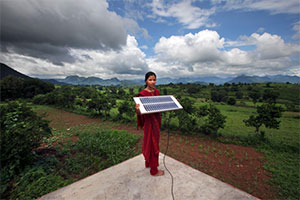 Bringing clean energy to rural India. Credit: Abbie Trayler-Smith / Panos Pictures / Department for International Development
Large reserves of oil, gas and minerals in developing countries generate opulent revenues. They could be used to stimulate economic growth and reduce poverty, but often result in environmental destruction and conflict, benefiting large companies and corrupt governments. Furthermore, competition over natural resources often manifests through geopolitical conflict. For example, before the US-Iraq war, Iraq’s domestic oil industry was nationalized. With US aggression came weakened Iraqi institutions and foreign intervention, thus eventually leading to the privatization of Iraqi oil, leaving the industry now largely dominated by Western companies. As another example, China’s rising investments within the lithium sector in South America are increasing the US-China rivalry across the Western Hemisphere. Notably, Bolivia has the largest reserves of lithium in the world, and the nation’s state-owned lithium extraction firm recently signed a contract with China’s CBC Consortium, while rejecting the entry of Western firms into the nation. In Bolivia’s case, rising Chinese investment in the nation’s lithium sector also raises concerns about environmental sustainability and the sociopolitical rights of Indigenous communities. More broadly, Sub-Saharan Africa holds nearly 30% of global reserves of critical minerals required for low-carbon technologies. Despite this, the region attracts less than 10% of global exploration investment, depicting a critical barrier to both the clean energy transitions and Sub-Saharan Africa’s economic development. Furthermore, resource wealth continues to fuel conflict like Sudan’s civil war, which has led to 9.1 million internally displaced people and is intensely connected to competition over gold, water, and agricultural land. IPS covers news about major oil, gas, and mining projects, their effects on the environment and local communities, and the ideas and actions of the interest groups involved.

The Week with IPS

NEXT STOP - SDGs
Tracking global progress towards a sustainable world
Tracking global progress towards a sustainable world
