Languages
Wednesday, October 21, 2026



News and Views from the Global South
Natural Resources

Big Nature-Based Finance Turnaround Needed to Restore, Protect Ecosystems
The world is pouring trillions of dollars each year into activities that destroy nature while investing only a fraction of that amount in protecting and restoring the ecosystems on which economies depend, according to a new United Nations report released on January 22.
World Living Beyond Its Means: Warns UN’s Global Water Bankruptcy Report
The world has entered what United Nations researchers now describe as an era of Global Water Bankruptcy, a condition where humanity has irreversibly overspent the planet’s water resources, leaving ecosystems, economies, and communities unable to recover to previous levels.
Experts Urge Rapid Adaptation as India Braces for ‘Stronger’ Cyclones, Quakes
Despite early warnings reportedly reaching communities before the cyclones (Ditwah and Senyar) struck coastal regions in Sri Lanka and Southeast Asia late in November 2025, over 1,500 people lost their lives and hundreds went missing even as millions were impacted by these disasters, which caused massive destruction. Scientists say that these disasters reflect a changing climate system, which is making cyclones more hazardous than what we considered “typical” in the past.
Living with nature, the climate lesson from Brazil’s caatinga
“The work of collecting seeds saved me from depression,” caused by her daughter's suicide at the age of 29, said Maria do Desterro Soares, 64, who lives in the poor rural community of Jatobá in northeastern Brazil.
In Kenya, Smallholder Farmers Push Back Against Corporate Control of Agriculture
For the past two years, Samuel Ndungu, a smallholder farmer, has been growing organic food and supplying it to the local market in Githunguri, just outside Nairobi.
Rescued from Fire: the World in 2025
Our traditional “year-ender” usually kicks off with a grim litany of world disasters and crises over the past 12 months, highlights IPS partners and contributors and culminates in a more positive-sounding finale. This time I’d like to begin on a more personal note intended also as a metaphor.
Kenyan Court Restores Seed Freedom: Landmark Ruling Boost for Food Security and Sovereignty
For years, smallholder farmers across Kenya have been engaged in a legal battle with the government over a law that criminalizes the practice of saving, sharing and exchanging indigenous seeds.
How Community Radio Is Powering Tanzania’s Climate Resilience
At dawn in the mangrove-choked Rufiji estuary, paddles from wooden canoes slice through still waters as a soft voice drifts across the tide.
Businesses Impact Nature on Which They Depend — IPBES Report Finds
Nature is a double-edged sword for global business. A groundbreaking report will reveal how businesses profit from exploiting natural resources while simultaneously impacting biodiversity.
Fresh Lens For Nuanced Multifaceted Climate Solutions Needed
“I see more philanthropic support aligning with systems thinking, linking climate stability, biodiversity protection, Indigenous leadership, and community resilience,” says Michael Northrop, Program Director at the Rockefeller Brothers Fund.
Why the UN Environment Assembly is Essential to a Safer, More Resilient Planet
As geopolitical challenges and tensions escalate globally, one thing is clear: fragmented politics will not fix a fractured planet. This is why the United Nations Environment Assembly (UNEA) – the world’s highest decision-making body on the environment – is so critical to address our shared and emerging environmental threats.
Africa’s Critical Minerals Poised to Power Global Green Energy Transition
Although Africa holds more than 30 per cent of the world’s critical green minerals—including cobalt, lithium, manganese, and rare earth elements vital for building batteries, wind turbines and solar panels— this has not translated into prosperity for the continent.
Continued Inaction Despite G20 Report on Worsening Inequality
Although inequality among countries still accounts for a far greater share of income inequality worldwide than national-level inequalities, discussions of inequality continue to focus on the latter.
Beyond Buzzwords: COP30’s Opportunity to Deliver on Sustainable Food Systems
The language of agricultural sustainability changes like the seasons—from “climate-smart” to “regenerative,” “agroecological,” and “nature-positive.” Each term reflects good intentions, but the growing list risks duplication, confusion and delays.
Cold or Heat, A Disputed Roadmap to Leave Fossil Fuels Behind in COP30
The heat in the Hangar Convention Center of the Amazonia, in the northeastern Brazilian city of Belém, has reached the negotiation rooms of the climate summit. Over the past 72 hours, one of the most delicate and significant discussions of this climate meeting has been taking place: the path to progressively abandon the production and use of coal, gas, and oil.
Rising Heat, Rising Risk: Regional Policy Actions
The year 2024 was the hottest on record globally. In Asia and the Pacific, Bangladesh was the worst-hit country, with about 33 million people affected by lower crop yields that destabilized food systems, along with extensive school closures and many cases of heatstroke and related diseases. Children, the elderly and outdoor low-wage earners in poor and densely populated urban areas suffered the most, as they generally had less access to cooling systems or to water supplies and adequate healthcare. India, too, was badly affected, with around 700 heat-related deaths mostly in informal settlements.
Hollow Promises or Hope?
COP30 Brazil – Moment of Truth for the Planet
COP30 Brazil, though shadowed by the absence of many world leaders, remains a pivotal milestone in the global fight against climate change, tasked with building on the Paris Agreement’s momentum. Yet the glaring lack of commitment, coupled with withdrawals from the accord, casts a grim shadow over the future. The planet continues to warm, and scientists warn that current targets may not prevent a catastrophic temperature spike. While the summit’s focus on implementation not just new promises—is a welcome shift, it’s clear: words alone won’t cool the Earth.

Indigenous Knowledge Holders Want to Be Acknowledged
Generational lived experiences are key to confronting and living with a changing climate, say Indigenous knowledge holders and activists at the UN Climate Conference (COP30). As the first COP to be held in the Amazon region, in Belém, representatives of Indigenous communities reiterated the importance of generationally transferred knowledge and skills to adapt to and mitigate the threats posed by climate change.
A Tale of Two Cities – Belém, Nairobi and Why Global Tax Justice Must be at Center of Climate Crisis Response
The climate crisis is getting worse and requires fundamental changes to societies, economies, and our global financial architecture in response. While extreme economic inequality is on the rise – the world's billionaires now hold more wealth in the world than every country except the U.S. and China – the impacts of climate change are also unequally felt, with the poor in the Global South and North most at risk.
The Top Climate Leaders Are Now in The Global South
When world leaders now gather in Belém, Brazil for the UN climate conference, expectations will be modest. Few believe the meeting will produce any breakthroughs. The United States is retreating from climate engagement. Europe is distracted. The UN is struggling to keep relevant in the 21st century.
COP30: The Age of Irrationality in Climate Policy
I have been working on climate policy since the late 1990s. I was in the room when Europe’s early carbon market discussions were shaping the architecture that would eventually underpin the Kyoto Protocol.« Previous Page — Next Page »





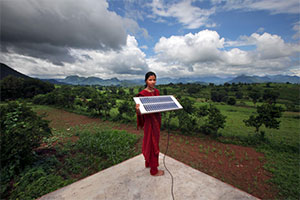 Bringing clean energy to rural India. Credit: Abbie Trayler-Smith / Panos Pictures / Department for International Development
Large reserves of oil, gas and minerals in developing countries generate opulent revenues. They could be used to stimulate economic growth and reduce poverty, but often result in environmental destruction and conflict, benefiting large companies and corrupt governments. Furthermore, competition over natural resources often manifests through geopolitical conflict. For example, before the US-Iraq war, Iraq’s domestic oil industry was nationalized. With US aggression came weakened Iraqi institutions and foreign intervention, thus eventually leading to the privatization of Iraqi oil, leaving the industry now largely dominated by Western companies. As another example, China’s rising investments within the lithium sector in South America are increasing the US-China rivalry across the Western Hemisphere. Notably, Bolivia has the largest reserves of lithium in the world, and the nation’s state-owned lithium extraction firm recently signed a contract with China’s CBC Consortium, while rejecting the entry of Western firms into the nation. In Bolivia’s case, rising Chinese investment in the nation’s lithium sector also raises concerns about environmental sustainability and the sociopolitical rights of Indigenous communities. More broadly, Sub-Saharan Africa holds nearly 30% of global reserves of critical minerals required for low-carbon technologies. Despite this, the region attracts less than 10% of global exploration investment, depicting a critical barrier to both the clean energy transitions and Sub-Saharan Africa’s economic development. Furthermore, resource wealth continues to fuel conflict like Sudan’s civil war, which has led to 9.1 million internally displaced people and is intensely connected to competition over gold, water, and agricultural land. IPS covers news about major oil, gas, and mining projects, their effects on the environment and local communities, and the ideas and actions of the interest groups involved.

The Week with IPS

NEXT STOP - SDGs
Tracking global progress towards a sustainable world
Tracking global progress towards a sustainable world
