Languages
Wednesday, November 18, 2026



News and Views from the Global South
Poverty & SDGs

Clean Energy Sources Manage to Cut Electricity Bill in Chile
A 75 percent drop in electricity rates, thanks to a quadrupled clean generation capacity, is one of the legacies to be left in Chile by the administration of Michelle Bachelet, who steps down on Mar. 11.
Policy Support Gap for “Climate-Smart” Agriculture
Conditioned that ploughing is the sure way to produce crops, Zimbabwean farmer Handrixious Zvomarima surprised himself by trying a different method. He planted cowpea seeds directly without tilling the land. It worked.
How Low-Income Bangladeshis Use Loans
Bangladeshis have a long tradition of borrowing from family, neighbors and other informal sources. Microfinance institutions (MFIs) have proliferated over the past three decades and offer a more formal loan service that has been taken up with enthusiasm, and today some 25 million Bangladeshis borrow from MFIs.
2017 Was a Year of Record-Breaking Climate Events
Parts of the United States are experiencing blizzard and record low temperatures, with sharks freezing in the Atlantic and cold-snapped iguanas falling from trees in Florida.
‘Red Alert’ 2018 – Global Unity, Media & Humanitarian Action
“Unity is the path. Our future depends on it,” said UN Secretary-General Antonio Guterres, as he issued an unequivocal global ‘Red Alert’ in his New Year message on December 31, 2017.
Disasters Bring Upheaval to Sri Lanka’s Rural Economy
Last year was an annus horribilis for 52-year-old Newton Gunathileka. A paddy smallholder from Sri Lanka’s northwestern Puttalam District, 2017 saw Gunathileka abandon his two acres of paddy for the first time in over three and half decades, leaving his family almost destitute.
Marooned in Bangladesh, Rohingya Face Uncertain Future
Hundreds of thousands of Rohingya refugee women from Myanmar are currently living in the cramped camps along Bangladesh Myanmar border. Victims of sexual and physical violence in the Rakhine state, women have been disproportionately affected by this crisis and these women’s perils are far from over in the host country as they continue to face multifaceted challenges.
Religion: Between ‘Power’ and ‘Force’
In 1994, Dr. David R. Hawkins wrote a book positing the difference between power and force (Power vs. Force: The Hidden Determinants of Human Behavior - the latest revised version came out in 2014).
Nowhere to Hide from Climate Change
The water is nibbling away the beaches of Fiji. Not even the dead are allowed peace of mind. The graveyard of Togoru - a village on the largest island of Fiji - has been submerged. The waves are sloshing softly against the tilted tombstones covered with barnacles. The names have become illegible, erased by the sea.
Central America Weakens Forest Shield Against Future Droughts
Jazziel Baca lives in the municipality of Esquías, in western Honduras, one of the areas hardest hit by the southern pine beetle (Dendroctonus frontalis), which damaged almost 500,000 hectares of forest in that Central American country between 2013 and 2015.
US Faces Collective Defiance at UN Over Jerusalem
When the UN General Assembly condemned the United States for its decision to recognize Jerusalem as the capital of Israel, the vote was described as a “collective defiance” of the international community against public threats against the United Nations and its member states by a politically unpredictable and predictably wavering US President.
Central America Hashes Out Agenda for Sustainable Use of Water
The countries of Central America are striving to define a plan to promote the sustainable use of water, a crucial need in a region that is already suffering the impacts of climate change.
“Only Our Youth Can Save the Planet” – Kumi Naidoo
"Today’s youth should think of new solutions for old problems like climate change and social injustice." That's the strong message of the South African activist Kumi Naidoo. The former executive director of Greenpeace says young people need to be more innovative and visionary, "because the solutions of my generation have failed."
Rise of Teenage Pregnancy Deters Development Goals
A few years ago, someone shared a video with me that deeply impacted me. It was called "The Girl Effect". In three minutes, the video demonstrates the fate of millions of girls and teenagers around the world.
Production Diversity, Diet Diversity and Nutrition in Sub -Saharan Africa
Lack of diet diversity is viewed as the major cause of micronutrient malnutrition in Sub-Saharan Africa. Imbalanced diets resulting from consumption of mainly high carbohydrate based-diets also contribute to productivity losses and reduced educational attainment and income. Consequently, micronutrient malnutrition is currently the most critical for food and nutritional security problem as most diets are often deficient in essential vitamins and minerals. In Tanzania, for example, most rural and urban households consume mainly staples as their main food, which are high in carbohydrates, but low in micronutrients and vitamins. Staple food items increase energy availability but do not improve nutritional outcomes if not consumed together with micro-nutrient rich foods.
Key Facts You Should Know About Global Migration Trends
The UN International Organization for Migration --IOM’s Global Migration Trends Factsheet presents a snapshot of the major migration trends worldwide for the year 2015 based on statistics from a variety of sources.
Long Maligned for Deforestation, Charcoal Emerges from the Shadows
“We have various financial obligations that push us to charcoal making. Top on the list is farming inputs and school fees,” explains Arclay Moonga, a charcoal producer and chairperson of the recently formed Choma District Charcoal Association in Southern Zambia.
Water, Water Everywhere, Costs More Than You Might Think
Without reliable access to water, human beings cannot survive. Yet 3 out of 10 people do not have a safely managed water supply, and 6 out of 10 lack safely managed sanitation. Over 2 billion people drank water that was fecally contaminated in 2015, and the World Bank estimates that the annual cost of poor sanitation is in excess of $260 billion annually.
No Health Protection for Migrant-Women Healthcare Givers
While the media may be attracted by images of migrants drowning or sold as slaves, another flagrant but lesser-known drama is that of care workers, who are overwhelmingly women, often migrants, and who make a very large contribution to global public health, but are exposed to great health risks themselves with little or no protection, let alone basic labour rights.
Helping Nepal by Working Abroad
Only a few millimeters of corrugated metal keeps us apart from the advancing dusk.
Rohingyas: Lurching from Crisis to Crisis
Ferdous Begum was cleaning her child after he had defecated in the open, using leaves she collected from a nearby tree at Bangladesh’s Teknaf Nature Park. The settlement is packed with Rohingya refugees who fled military persecution in Myanmar since August.« Previous Page — Next Page »


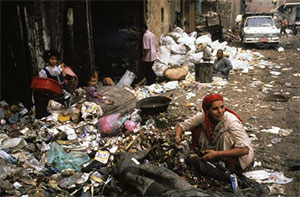 Romani people in Cairo, Egypt, forage through trash. Credit: UN Photo/Armineh Johannes
In 2015, the United Nations adopted the Sustainable Development Goals (SDGs) in an effort to promote “peace and prosperity for people and the planet.” To achieve that goal, it is essential to provide equal opportunities and access to basic services to all people. The 2025 UN SDG Report found that 35% of the 169 SDG targets are on track or making moderate progress, while 18% have reversed compared to the 2025 baseline. One in ten people still live in extreme poverty, one in eleven experience food insecurity, and over 1.1 billion people live in slums without access to clean water and sanitation. It is imperative to acknowledge the societal, technological, economic, and political issues that sustain poverty in countries around the world. Eradicating poverty will require significant frameworks in policy and governance on a national and international scale to ensure that all people will have equal access to basic services and economic opportunities by 2030. Furthermore, a dramatic reduction of United States foreign aid in 2025, including the termination of 83% of USAID programmes, threatens to erode years of fragile development gains.
Throughout the world, violent conflict and natural disasters also contribute to extreme poverty. The complete destruction of infrastructure and blockage of aid has significantly impoverished Palestine since October 7th. The destructive impact of Hurricane Maria in Puerto Rico left $91 billion in damage. An inadequate US government response also revealed significant and enduring questions within the issue of mitigating poverty: how do we rebuild infrastructure after its destruction? How do we restimulate economic development and bring in financial aid after disasters? Similar questions have been raised in the realm of regional cooperation, as devastating floods have wrecked hundreds of thousands of homes across multiple Southeast Asian nations in the past few years. Furthermore, the COVID-19 pandemic has greatly exacerbated the global poverty crisis, particularly in developing countries, setting back the United Nations goal of eradicating poverty by 2030.
IPS is committed to providing comprehensive features that focus on the persisting environmental, sociopolitical, and systemic issues that sustain poverty, and the steps taken worldwide towards poverty eradication.

The Week with IPS

NEXT STOP - SDGs
Tracking global progress towards a sustainable world
Tracking global progress towards a sustainable world

