Languages
Wednesday, November 18, 2026



News and Views from the Global South
Poverty & SDGs

Pollution or How the ‘Take-Make-Dispose’ Economic Model Does Kill
The prevailing “Take-Make-Dispose” linear economic model consisting of voracious depletion of natural resources in both production and consumption patterns has proved to be one of the world’s main killers due to the huge pollution it causes for air, land and soil, marine and freshwater.
Deliberate Famine Should Be a War Crime, UN Expert Says
The deliberate starvation of civilians could amount to a war crime and should be prosecuted, said an independent UN human rights expert.
Open or Closed Borders, or Something in Between?
Recent elections around the world have clearly shown growing public support for candidates and political parties advocating the deportation of migrants and stricter restrictions on immigration, including halting it altogether. At the same time, opposition, challenges and resistance to deportations and immigration restrictions have become more widespread, visible and vocal.
Latin America Heads to Climate Summit with Uneven Progress
Difficult to measure and unequal in their scope are the advances that the countries of Latin America will have to show, regarding their voluntary commitments to greenhouse gas emissions, during the climate summit to be hosted by Bonn, Germany in November.
Rules and Regulations. We Need them to Protect Minimum Standards in Education
Two years have already passed since the global education goal, SDG 4, was set by governments. But the vision of that goal has not yet fully trickled down to the country level. We need to know who is responsible for achieving this goal.
The United Nations Is Needed More than Ever Before to Promote Peace and Justice Worldwide
In commemoration of the 2017 United Nations Day, the Chairman of the Geneva Centre for Human Rights Advancement and Global Dialogue H. E. Dr. Hanif Hassan Ali Al Qassim called for enhancing the role of the United Nations to address issues related to the promotion of peace and security as a platform for collaboration and the advancement of human rights.
Role of the Fashion Industry in UN’s Sustainable Development Goals
Fashion is not a sector that exists in a vacuum. In fact, the fashion industry is not unlike any other key economic drivers; it is a key component of a global economy and certainly an important sector to consider when thinking about the UN’s 17 Sustainable Development Goals (SDGs).
Innovation for Climate-Smart Agriculture Key to Ending Hunger in Kenya
Some parts of Kenya are reeling from the effects of probably the worst drought in the last 20 years. With nearly 3.4 million people food insecure, Kenya’s food security prognosis looks gloomy, with climate change and natural resource depletion set to pose even greater risks in the long term.
World Campaign to Clean Torrents of Plastic Dumped in the Oceans
With 30 countries from Kenya to Indonesia and from Canada to Brazil now involved in the world campaign to beat pollution by countering the torrents of plastic trash that are degrading oceans and endangering the life they sustain, the UN has strengthened its massive efforts to clean up the seas, which are the Earth’s main buffer against climate change.
Can Index Insurance Make African Farmers Climate-resilient?
Index insurance is being promoted as a solution to protect climate affected smallholder farmers in Africa. This type of micro insurance is slowly gaining ground as a way of compensating farmers for lost crops and livestock due to climate change.
Mexican Immigrants Help Sustain Two Economies – and Are Discarded
They work for years to bolster the economies of two countries. For one, the United States, they provide labour and taxes; for the other, Mexico, they send remittances that support tens of thousands of families and communities. Then they are deported, and neither government takes into account their special needs.
The Future for Financing Africa’s Renewable Energy
Lack of energy access presents a formidable challenge to Africa and lack of access to financing has been singled out as the biggest reason why over 620 million people living on the continent are stuck in energy poverty.
Zimbabwe’s Diaspora Could Help Revive Ailing Economy
At the dawn of the millennium, Sheila Mponda, 60, waved goodbye to her four children, who were leaving Zimbabwe for the United Kingdom in search of greener pastures. Mponda had just lost her husband and had been a housewife all her life.
To Eliminate Poverty, Better Understanding Needed
As the United Nations’ Second Decade for the Eradication of Poverty (2008-2017) comes to an end, more self-congratulation is likely. Claims of victory in the war against poverty will be backed by recently released poverty estimates from the World Bank, entrusted by the UN system to monitor poverty.
What Do You Really Eat When You Order a Steak, Fish or Chicken Filet?
The world is running out of antibiotics to combat the growing threat of antimicrobial resistance, the UN World Health Organization (WHO) warned while announcing the World Antibiotic Awareness Week on 13-19 November.
Ending Poverty in Next 13 years Means Boosting Resilience Now
This month the world marks two key International Days: for the Eradication of Poverty on 17 October and for Disaster Reduction, four days earlier. It is no coincidence that they are profoundly connected.
Women: Major Drivers & Beneficiaries of Poverty Eradication
This year marks the 25th anniversary of the declaration of 17 October as the International Day for the Eradication of Poverty by the United Nations General Assembly. Under the theme “Answering the Call of October 17 to end poverty: A path toward peaceful and inclusive societies,” this year’s commemoration reminds us of the importance of equality, dignity, solidarity and equal voice in the fight to end poverty everywhere.
New Villages Bloom in the Shadow of a Mountain’s Wrath
Repeated volcanic eruptions of Mount Sinabung since 2010 have displaced thousands of people, leaving villages around the mountain deserted, with volcanic ash, lava and mud covering the soil, trees and empty houses.
Peace and stability must be restored in the Middle East and North Africa so as to alleviate poverty
On the occasion of the 2017 International Day for the Eradication of Poverty, the Chairman of the Geneva Centre for Human Rights Advancement and Global Dialogue H. E. Dr. Hanif Hassan Ali Al Qassim observed that the unprecedented rise of violence and insecurity in the Arab region combined, breed poverty and societal decline.
Driven to Extremes–How Poverty Fuels Extremism, and How to Help Africa’s Youth
Poverty is a blight, and one that disproportionately affects sub-Saharan Africa. It is a vast and complex issue whose tentacles reach into many areas, including climate change, sustainable development and–crucially–global security. The link between poverty and violent extremism is compelling, and means that if we want to address extremism, we must fight inequality too.
The Road Out of Poverty Depends on Feeding Our Children Nutritious Food First
One drizzly morning in some lush green tea plantations in Rwanda, I was on my way to visit a local community, to assess nutrition indicators among women and children. We stopped in a green blanket of tea fields and spoke to one young tea picker, I’ll call her Mary, who had a baby strapped to her back.« Previous Page — Next Page »


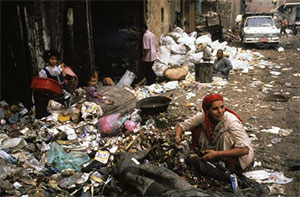 Romani people in Cairo, Egypt, forage through trash. Credit: UN Photo/Armineh Johannes
In 2015, the United Nations adopted the Sustainable Development Goals (SDGs) in an effort to promote “peace and prosperity for people and the planet.” To achieve that goal, it is essential to provide equal opportunities and access to basic services to all people. The 2025 UN SDG Report found that 35% of the 169 SDG targets are on track or making moderate progress, while 18% have reversed compared to the 2025 baseline. One in ten people still live in extreme poverty, one in eleven experience food insecurity, and over 1.1 billion people live in slums without access to clean water and sanitation. It is imperative to acknowledge the societal, technological, economic, and political issues that sustain poverty in countries around the world. Eradicating poverty will require significant frameworks in policy and governance on a national and international scale to ensure that all people will have equal access to basic services and economic opportunities by 2030. Furthermore, a dramatic reduction of United States foreign aid in 2025, including the termination of 83% of USAID programmes, threatens to erode years of fragile development gains.
Throughout the world, violent conflict and natural disasters also contribute to extreme poverty. The complete destruction of infrastructure and blockage of aid has significantly impoverished Palestine since October 7th. The destructive impact of Hurricane Maria in Puerto Rico left $91 billion in damage. An inadequate US government response also revealed significant and enduring questions within the issue of mitigating poverty: how do we rebuild infrastructure after its destruction? How do we restimulate economic development and bring in financial aid after disasters? Similar questions have been raised in the realm of regional cooperation, as devastating floods have wrecked hundreds of thousands of homes across multiple Southeast Asian nations in the past few years. Furthermore, the COVID-19 pandemic has greatly exacerbated the global poverty crisis, particularly in developing countries, setting back the United Nations goal of eradicating poverty by 2030.
IPS is committed to providing comprehensive features that focus on the persisting environmental, sociopolitical, and systemic issues that sustain poverty, and the steps taken worldwide towards poverty eradication.

The Week with IPS

NEXT STOP - SDGs
Tracking global progress towards a sustainable world
Tracking global progress towards a sustainable world

