Languages
Friday, November 20, 2026



News and Views from the Global South
Trade & Investment

The Government of Kenya and United Nations Partnership to Achieve Universal Health Care Inspires Many in Silicon Valley and the Stanford, U.C. Berkeley Communities
Recently, some of us from the Stanford University and U.C. Berkeley community had the privilege of hosting Siddharth Chatterjee, the United Nations Resident Coordinator for Kenya and his team at the Silicon Valley, where he spoke at the 2018 African Diaspora Investment Symposium. The Kenya team also met with academics, Directors of Centers and students as well as some of brilliant technology leaders in Silicon Valley at Facebook and Google.
Japan-led Pacific Rim Countries Desperate to Embrace Trump
The grandiose sounding Comprehensive and Progressive Agreement for Trans-Pacific Partnership (CPTPP) will be signed in Santiago de Chile today, 8 March. Instead of doing something to advance the condition of women on International Women’s Day, trade representatives from 11 Pacific rim countries will sign the CPTPP, which some critics argue will further set back the progress of humanity, including women who hold up ‘half the sky’.
The New CPTPP Trade Pact is Much Like the Old TPP
The new agreement that eleven countries are signing on 8 March in Chile in place of the Trans Pacific Partnership Agreement (TPP) is like old wine in a new bottle --- without the United States but retaining most of its controversial elements.
Inclusive Green Growth Must Shape Thailand’s Future, Says GGGI Chief
Energy efficiency in industries presents a unique opportunity for Thailand’s environmental and economic policies as regional trends push towards more inclusive and sustainable green cities for the country and its neighbors, says the Director-General of the Global Green Growth Institute (GGGI) Dr. Frank Rijsberman.
Model Trade Deal Con
In early 2016, the Trans-Pacific Partnership (TPP) Agreement -- involving twelve countries on the Pacific Ocean rim, including the USA -- was signed in New Zealand. Right after his inauguration in January 2017, newly elected US President Donald Trump withdrew from the TPP, effectively killing the agreement as its terms require the participation of both the US and Japan.What’s Limiting Our Potential?
Whenever there is a discussion about trade, investments, exports and economic growth, quite often much focus is placed upon infrastructure as the core challenge of our export growth. But is it the only hurdle?
Village Savings: Helping Small Farmers Weather Climate Shocks
In the past, Lameck Sibukale only knew savings in the form of rearing chickens, goats and more importantly, cattle—a long cherished cultural heritage of the Tonga-speaking people of southern Zambia.
Intellectual Property Regime Undermines Equity, Progress
Over the last few decades, people in the developing world have been rejecting the intellectual property (IP) regime as it has been increasingly imposed on them following the establishment of the World Trade Organization (WTO) including its trade-related intellectual property rights (TRIPs) regime. IP rights (IPRs) have been further enforced through ostensible free trade agreements (FTAs) and investment treaties among two (bilateral) or more (plurilateral) partners.
Stock Market Turmoil May Expose Flaws in Global Finance
Was last week’s global stock market sell-off only a “correction” or does it signify a new period of financial instability, caused by major flaws in the world financial system?
Bangladesh’s Garment Industry Boom Leaving Workers Behind
Although Bangladesh has made remarkable recent strides like building green factories and meeting stringent safety standards, garment workers here are still paid one of the lowest minimum wages in the world.
Look to India
It’s really time the Philippines pays serious attention to how India solves Third World problems in a practical and inexpensive but ingenious Third World way. And follow suit.
Renewed Partnership to End Hunger in Africa by 2025
After a period of prolonged decline, world hunger is on the rise. Africa has the highest rates of hunger in the world, and they are increasing. Agricultural and livestock productivity in Africa is under threat. This is largely due to conflict and climate change.
Wealth Concentration Continues to Increase
As the ‘masters of the universe’ gather for their annual retreat at Davos, the World Economic Forum (WEF) has just published its Inclusive Development Index (IDI) for the second time.
PPPs Likely to Undermine Public Health Commitments
The United Nations Agenda 2030 for the Sustainable Development Goals (SDGs) is being touted in financial circles as offering huge investment opportunities requiring trillions of dollars. In 67 low- and middle-income countries, achieving SDG 3 — healthy lives and well-being for all, at all ages — is estimated to require new investments increasing over time, from an initial $134 billion annually to $371 billion yearly by 2030, according to recent estimates by the World Health Organization (WHO) reported in The Lancet.
Expansion of Soy Resurrects Key Railway Line in Brazil
The railroad can contribute to the economy, making transportation cheaper, but it is unlikely to foment equitable development in and of itself, apart from facing complex construction obstacles in countries like Brazil.
Argentina Pursues the Lithium Dream
The government of Mauricio Macri dreams of Argentina becoming the world leader in lithium production. But it does not seem so clear that this aspiration, underpinned by the interest of multinational corporations, would also drive the development of local communities.
Digital Infrastructure
Millennials are the natives of the digital infrastructure. They have the privilege of having been born in a time when everything is within reach through the click of a button. Having worked in Dubai in the 1970s, I learned that there are three kinds of infrastructure: progressive, hard, and soft. Progressive infrastructure refers to the international airports and the seaports. The hard infrastructure are the roads, highways and the like. Lastly, the soft infrastructure refers to the ease of doing business. Back in the day, the Sheikh of Dubai would mention, what is good for business is good for Dubai. Later, I added two more; these are sustainable and institutional infrastructure. Even if you have the best plans in the world, without the right institutions to implement these, these plans would not come to fruition. Lastly, infrastructure should be sustainable in order to last for generations. With the advancement of technology, this is the Age of Digital Infrastructure.
The Data Revolution Should Not Leave Women and Girls Behind
If there is one political principle that has been constant throughout the history of human civilization it is the fact that land is power. This is something that is particularly true, and often painfully so, for women who farm in Africa.
Tourism Should Be Regulated, Before It Is Too Late…
This year, we will have 3 million tourists each day wandering the world. This massive phenomenon is without precedent in human history and is happening (as usual), with only one consideration in mind: money. We should pause and take a look at its social, cultural and environmental impact and take remedial measures, because they are becoming seriously negative if things are left as they are.
Uncertainty Surrounds Renegotiation of NAFTA and Its Consequences for Mexico
The first few months of 2018 will be key to defining the future of the North American Free Trade Agreement (NAFTA), whose renegotiation due to the insistence of U.S. President Donald Trump has Mexico on edge because of the potential economic and social consequences.
Trade Multilateralism Set Back yet Again
As feared, the Eleventh Ministerial Conference (MC11) of the World Trade Organization (WTO) in Buenos Aires, Argentina, on 10-13 December 2017, ended in failure. It failed to even produce the customary ministerial declaration reiterating the centrality of the global trading system and the importance of trade as a driver of development.« Previous Page — Next Page »


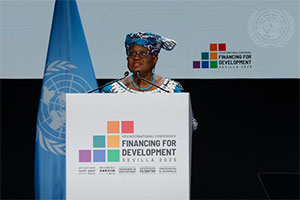 Opening of 4th International Conference on Financing for Development. Credit: UN Photo/Mariscal
International trade and investment are crucial elements of the world economy. While they can be powerful stimulators of development, they can also lead to global imbalances and dynamics of exploitation. In 2025, international trade entered a period of immense disruption, driven in part by a new wave of United States tariffs that reshaped global supply chains and investment flows. The increase in the US tariff rate, the highest since the 1930s, has forced bilateral renegotiations with global trading partners. Furthermore, the debt crisis in developing nations has accelerated while Official Development Assistance (ODA) has substantially dropped 7.3% in 2024.
In the 21st century, advancements in economic diversification in formerly colonized nations have propelled them into more central roles in the global economy. For example, both China and Mexico were able to develop their manufacturing sector and channel this development into booming export flows, thus advancing into the position of emerging economies. Foreign investment also plays an essential role in providing capital for developing countries, although they are oftentimes accompanied by social and environmental exploitation. For example, rising Chinese investments in natural resources in Latin America have often been met with tension as these investment projects fail to properly mitigate environmental risks and protect workers’ rights. In a more multifaceted vein, Sino-African relations have led to infrastructure development in Sub-Saharan Africa while also heightening the region’s economic dependency on China. IPS reports on global news in trade and investment, while shining a light on the nuanced nature of these endeavors.

The Week with IPS

NEXT STOP - SDGs
Tracking global progress towards a sustainable world
Tracking global progress towards a sustainable world
