Languages
Tuesday, October 20, 2026



News and Views from the Global South
Trade & Investment

Uncertain Future for “Diabolic” Free Trade Pacts Between EU and Africa
In the run-up to the fifth EU-Africa summit in Côte d'Ivoire, the future of the Economic Partnership Agreements (EPAs) between Europe and its former colonies looks bleaker than ever. While most of Europe’s trade partners around the world keep refusing to sign the deals, the African Union’s Commissioner for Trade will most likely announce a moratorium on all EPAs.
Foreign Investment Expands in Cuba…Despite Everything
“Maybe many of us thought that this project was a dream six years ago, but not anymore. The geography has completely changed, because of everything that has been built and the investments that have been approved," said Nathaly Suárez, director of Construction Management at the Mariel Special Development Zone (ZEDM).
Coping with Foreign Direct Investment
Foreign direct investment (FDI) is increasingly touted as the elixir for economic growth. While not against FDI, the mid-2015 Addis Ababa Action Agenda (AAAA) for financing development also cautioned that it “is concentrated in a few sectors in many developing countries and often bypasses countries most in need, and international capital flows are often short-term oriented”.
Beyond Piketty: on income inequality
Have demonetisation and the GST aggravated income inequality? With the Gujarat State elections barely a few weeks away, the debate on the Indian economy has become increasingly polarised. While the official view of demonetisation unleashed in November 2016 elevates it to a moral and ethical imperative, the chaos caused by the goods and services tax (GST) launched on July 1, 2017, is dismissed as a short-run transitional hiccup. Both policies, it is asserted, are guaranteed to yield long-term benefits, unmindful of large-scale hardships, loss of livelihoods, closure of small and medium enterprises and slowdown of agriculture. Critics of course reject these claims lock, stock and barrel. Lack of robust evidence is as much a problem for the official proponents of these policies as it is for the critics. Hence the debate continues unabated with frequent hostile overtones.
Finance Following Growth
Economists of all persuasions recognize the critical role of finance in economic growth. The financial sector’s stability and depth are widely considered important in this connection.
Emerging Markets at Risk Again
Emerging market governments often draw lessons from previous financial crises – or at least claim to do so – to prevent their recurrence. However, such preventive measures are typically designed to address the causes of the last crisis, not the next one. Hence, some measures adopted may inadvertently become new sources of instability and crisis.
Mounting Illicit Financial Outflows from South
Although quite selective, targeted, edited and carefully managed, last year’s Panama Papers highlighted some problems associated with illicit financial flows, such as tax evasion and avoidance. The latest Global Financial Integrity (GFI) report shows that illicit financial outflows (IFFs) from developing countries, already at alarming levels, continue to grow rapidly.
Why 1997 Asian Crisis Lessons Lost
Various different, and sometimes contradictory lessons have been drawn from the 1997-1998 East Asian crises. Rapid or V-shaped recoveries and renewed growth in most developing countries in the new century also served to postpone the urgency of far-reaching reforms. The crises’ complex ideological, political and policy implications have also made it difficult to draw lessons from the crises.
To Eliminate Poverty, Better Understanding Needed
As the United Nations’ Second Decade for the Eradication of Poverty (2008-2017) comes to an end, more self-congratulation is likely. Claims of victory in the war against poverty will be backed by recently released poverty estimates from the World Bank, entrusted by the UN system to monitor poverty.
Women: Major Drivers & Beneficiaries of Poverty Eradication
This year marks the 25th anniversary of the declaration of 17 October as the International Day for the Eradication of Poverty by the United Nations General Assembly. Under the theme “Answering the Call of October 17 to end poverty: A path toward peaceful and inclusive societies,” this year’s commemoration reminds us of the importance of equality, dignity, solidarity and equal voice in the fight to end poverty everywhere.
International Day of Rural Women
On this International Day of Rural Women, the world celebrates women and girls in rural areas and the critical role they play in enhancing agricultural and rural development, improving food security and eradicating rural poverty.
Can the Kenyan Lion Kick High Enough to Be the South Korean Tiger of Africa?
In 1953 South Korea emerged from the ravages of a debilitating war, yet the total gross domestic product in nominal terms has surged 31,000 fold since 1953.
Hunger in Africa, Land of Plenty
Globally, 108 million people faced food crises in 2016, compared to about 80 million in 2015 – an increase of 35%, according to the 2017 Global Report on Food Crises. Another 123 million people were ‘stressed’, contributing to around 230 million such food insecure people in 2016, of whom 72% were in Africa.
World Bank Must Stop Encouraging Harmful Tax Competition
One of the 11 areas that the World Bank’s Doing Business (DB) report includes in ranking a country’s business environment is paying taxes. The background study for DB 2017, Paying Taxes 2016 claims that its emphasis is “on efficient tax compliance and straightforward tax regimes”.
Ghana Aims to Regain Top Spot in Cocoa Production
Ghana is home to the world’s favourite cocoa beans. They’re bigger in size, have a higher butter content and superior flavour – all qualities which make Ghana’s cocoa the world standard against which all cocoa is measured.
Greater Cooperation To Strengthen Taxation
Since the 1950s, there has been a popular dance called the ‘limbo rock’, with the winner leaning back as much as possible to get under the bar. Many of today’s financial centres are involved in a similar game to attract customers by offering low tax rates and banking secrecy.
Making an Economic Case for Climate Action
Having faced a year of record temperatures and devastating hurricanes, the United States stands more to lose if it doesn't take steps to reduce the risk and impact of climate change, according to a new report.
More Public Spending, Not Tax Cuts, for Sustainable, Inclusive Growth
The Trump administration’s promise to increase infrastructure spending should break the straightjacket the Republicans imposed on the Obama administration after capturing the US Congress in 2010. However, in proportionate terms, it falls far short of Roosevelt’s New Deal effort to revive the US economy in the 1930s.
Global Companies Give Africa a Second Look
When travelling abroad for work and looking for accommodation, Joe Eyango, a Cameroonian living in the US, considers two factors: convenient transportation from the airport and around the city and reliable Internet access. He is a university professor and wants to be able to jet in, hit the ground running, make his presentation and zoom off to another destination in a day or two.
Even in School, More Than Half of All Children Aren’t Learning, Says UNESCO
Six out of ten children in the world are not achieving basic proficiency in reading and mathematics, a new report by the United Nations Educational, Scientific and Cultural Organization (UNESCO) shows.
Africa Moves Towards Third Industrial Development Decade
Since the turn of the century, much of Africa has achieved impressive economic growth. Sixteen African countries were among the world’s top 30 fastest growing nations. Last year, the 10 fastest growing African economies posted GDP growth rates exceeding 5 per cent.« Previous Page — Next Page »





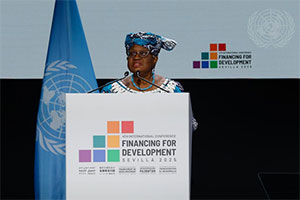 Opening of 4th International Conference on Financing for Development. Credit: UN Photo/Mariscal
International trade and investment are crucial elements of the world economy. While they can be powerful stimulators of development, they can also lead to global imbalances and dynamics of exploitation. In 2025, international trade entered a period of immense disruption, driven in part by a new wave of United States tariffs that reshaped global supply chains and investment flows. The increase in the US tariff rate, the highest since the 1930s, has forced bilateral renegotiations with global trading partners. Furthermore, the debt crisis in developing nations has accelerated while Official Development Assistance (ODA) has substantially dropped 7.3% in 2024.
In the 21st century, advancements in economic diversification in formerly colonized nations have propelled them into more central roles in the global economy. For example, both China and Mexico were able to develop their manufacturing sector and channel this development into booming export flows, thus advancing into the position of emerging economies. Foreign investment also plays an essential role in providing capital for developing countries, although they are oftentimes accompanied by social and environmental exploitation. For example, rising Chinese investments in natural resources in Latin America have often been met with tension as these investment projects fail to properly mitigate environmental risks and protect workers’ rights. In a more multifaceted vein, Sino-African relations have led to infrastructure development in Sub-Saharan Africa while also heightening the region’s economic dependency on China. IPS reports on global news in trade and investment, while shining a light on the nuanced nature of these endeavors.

The Week with IPS

NEXT STOP - SDGs
Tracking global progress towards a sustainable world
Tracking global progress towards a sustainable world
