Languages
Monday, September 7, 2026



News and Views from the Global South
Trade & Investment

Taiwanese Activists Push for Citizen-Based Constitution
“The clock is ticking.” Those were the words of Taiwan Democracy Watch Director Yeh Chueh-an on Feb. 4, as scores of civil society organisations in the capital, Taipei, began a countdown for a citizen-based rewriting of Taiwan’s constitution aimed at safeguarding human rights and social equity.Asia to Drive Strong Growth in Global Tourism
Global tourism, which stood at a mere 25 million international travelers in 1950 has, over the past decades, experienced such phenomenal growth and diversification that today it has become one of the fastest growing economic sectors in the world.
From Bullets to Ballots: The Face of Sri Lanka’s Former War Zone
 In four months’ time, Sri Lanka will mark the sixth anniversary of the end of its bloody civil conflict. Ever since government armed forces declared victory over the Liberation Tigers of Tamil Eelam (LTTE) on May 19, 2009, the country has savored peace after a generation of war.

Where the Right to Information and Good Governance Go Hand in Hand
On Jan. 8, 2009, the Sri Lankan media suffered a debilitating attack.
Row Erupts over Jamaica’s Bid to Slow Beach Erosion
A plan that government says will slow the rate of erosion on Jamaica’s world-famous Negril beach is being opposed by the people whose livelihoods it is meant to protect.
Ending Hunger in Africa
While Africa’s economies are among the world’s fastest growing economies, hundreds of millions of Africans are living on or below the poverty line of 1.25 dollars a day, a principal factor in causing widespread hunger.
People’s Tribunal Hopes Verdict on Mining Abuses Gains Traction
A recent case study on Canadian mining abuses in Latin America has woven one more thread of justice into the tapestry of international law.
Good Harvest Fails to Dent Rising Hunger in Zimbabwe
With agriculture as one of the drivers of economic growth, Zimbabwe needs to invest in the livelihoods of smallholder farmers who keep the country fed, experts say.
U.S.-India Partnership a Step Forward for Low-Carbon Growth
India garnered international attention this week for its climate action.
OPINION: The Corporate Takeover of Ukrainian Agriculture
At the same time as the United States, Canada and the European Union announced a set of new sanctions against Russia in mid-December last year, Ukraine received 350 million dollars in U.S. military aid, coming on top of a one billion dollar aid package approved by the U.S. Congress in March 2014.
Not Without Our Daughters: Lambada Women Fight Infanticide and Child Trafficking
At 11 years of age, Banawat Gangotri already has four years of work experience as a farm labourer. The child, a member of the nomadic Lambada community from the village of Bugga Thanda in India’s southern Telangana state, plucked cotton and chillies from nine a.m. until 5 p.m. for about a dollar daily.
Aboriginal Businesses Stimulate Positive Change in Australia
Roy Roger Gibson, an indigenous Kuku Yalanji elder, would watch thousands of tourists and vehicles trampling his pristine land while working on the sugarcane fields in Far North Queensland. His people were suffering and their culture was being eroded. The native wildlife was disappearing. He dreamt of turning this around.
After Nine Years of Foot-Dragging, U.N. Ready for Talks on High Seas Treaty
After four days of intense negotiations - preceded by nine years of dilly-dallying - the United Nations has agreed to convene an intergovernmental conference aimed at drafting a legally binding treaty to conserve marine life and govern the mostly lawless high seas beyond national jurisdiction.
OPINION: Greece Gives EU the Chance to Rediscover Its Social Responsibility
The European Union should not be afraid of the leftist opposition party Syriza winning the Greek election, but see it as a chance to rediscover its founding principle - the social dimension that created it and without which it cannot survive.
OPINION: Banks, Inequality and Citizens
Every day we receive striking data on major issues which should create tumult and action, but life goes on as if those data had nothing to do with people’s lives.
The Bahamas’ New Motto: “Sand, Surf and Solar”
When it comes to tourism in the 15-member Caribbean Community (CARICOM), The Bahamas -- 700 islands sprinkled over 100,000 square miles of ocean starting just 50 miles off Florida -- is a heavyweight.
OPINION-CUBA/US: Catching a Glimpse of the Possible Future
All Cubans, on either side of the Florida Straits, but in places like Spain, France or Greenland – where there must be a couple of Cubans - as well felt it was a historic moment that included each and every one of us, when U.S. President Barack Obama announced on Dec. 17 the normalisation of relations after half a century of hostility.
From Bullets to Ballots: The Face of Sri Lanka’s Former War Zone
In four months’ time, Sri Lanka will mark the sixth anniversary of the end of its bloody civil conflict. Ever since government armed forces declared victory over the Liberation Tigers of Tamil Eelam (LTTE) on May 19, 2009, the country has savored peace after a generation of war.
CORRECTION/Sustainable Energy Starts With the Sun
It began with an experiment to install photovoltaic cells over an irrigation canal that forms part of the Sardar Sarovar canal network – a massive hydel power project across the River Narmada that irrigates some 1.8 million hectares of arable land in the western Indian state of Gujarat.
OPINION: A New Era of Hemispheric Cooperation Is Possible
Two decades after the first Summit of the Americas, a lot has changed in the continent and it has been for the good. Today, a renewed hemispheric dialogue without exclusions is possible.
Aid Freeze Over Energy Controversy a Blow to Tanzanian Economy
As foreign donors drag their feet on injecting badly needed cash into the government’s coffers, local analysts are increasingly worried that this will affect implementation of key development projects that require donor funding.« Previous Page — Next Page »


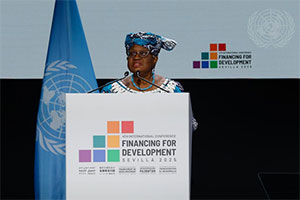 Opening of 4th International Conference on Financing for Development. Credit: UN Photo/Mariscal
International trade and investment are crucial elements of the world economy. While they can be powerful stimulators of development, they can also lead to global imbalances and dynamics of exploitation. In 2025, international trade entered a period of immense disruption, driven in part by a new wave of United States tariffs that reshaped global supply chains and investment flows. The increase in the US tariff rate, the highest since the 1930s, has forced bilateral renegotiations with global trading partners. Furthermore, the debt crisis in developing nations has accelerated while Official Development Assistance (ODA) has substantially dropped 7.3% in 2024.
In the 21st century, advancements in economic diversification in formerly colonized nations have propelled them into more central roles in the global economy. For example, both China and Mexico were able to develop their manufacturing sector and channel this development into booming export flows, thus advancing into the position of emerging economies. Foreign investment also plays an essential role in providing capital for developing countries, although they are oftentimes accompanied by social and environmental exploitation. For example, rising Chinese investments in natural resources in Latin America have often been met with tension as these investment projects fail to properly mitigate environmental risks and protect workers’ rights. In a more multifaceted vein, Sino-African relations have led to infrastructure development in Sub-Saharan Africa while also heightening the region’s economic dependency on China. IPS reports on global news in trade and investment, while shining a light on the nuanced nature of these endeavors.

The Week with IPS

NEXT STOP - SDGs
Tracking global progress towards a sustainable world
Tracking global progress towards a sustainable world
