Languages
Monday, September 7, 2026



News and Views from the Global South
Trade & Investment

Opinion: Reforming Mental Health in India
India is not only poised for greatness, some say it is already on its way. The events that have shaped the nation's dialogue over the past month showcase an India with a bold vision – to transform industry, to close the gap on inequality and ultimately, to redefine its place as a leader among the world.Prominent Lawyer Defending the Poor Gunned Down in Mozambique
As billions pour into Mozambique from foreign investors scooping up fields of coal and natural gas, the signs of newfound wealth are impossible to miss.
Opinion: Let’s Grant Women Land Rights and Power Our Future
Women are not only the world’s primary food producers. They are hardworking and innovative and, they invest far more of their earnings in their families than men. But most lack the single most important asset for accessing investment resources – land rights.
Opinion: Greece and the Germanisation of Europe
At last, on Tuesday Feb. 24, the Eurogroup (of eurozone finance ministers) approved the Greek government’s commitment to a programme of reforms in return for extending the country’s bailout deal.Namibian President Wins $5 Million African Leadership Prize
Outgoing Namibian President Hifikepunye Pohamba was Monday named winner of the Ibrahim Prize for Achievement in African Leadership, believed to be the most lucrative individual award in the world.

Tobacco Workers in Cuba Dubious About Opening of U.S. Market
“We have to wait and see,” “There isn’t a lot of talk about it,” are the responses from tobacco workers in this rural area in western Cuba when asked about the prospect of an opening of the U.S. market to Cuban cigars.
A New Forensic Weapon to Track Illegal Ivory Trade
The wildlife trade monitoring network, TRAFFIC, is deploying a new forensic weapon - DNA testing - to track illegal ivory products responsible for the slaughter of hundreds of endangered elephants in Asia and Africa.
Big Trouble in the Air in India
Like many others of her age, 15-year-old Aastha Sharma, a Class 10 student at a private school in India’s capital, New Delhi, loves being outdoors, going for walks with her friends and enjoying an occasional ice-cream. But the young girl can't indulge in any of these activities.
Tackling Corruption at its Root in Papua New Guinea
Corruption, the single largest obstacle to socioeconomic development worldwide, has had a grave impact on the southwest Pacific Island nation of Papua New Guinea. While mineral resource wealth drove high gross domestic product (GDP) growth of eight percent in 2012, the country is today ranked 157th out of 187 countries in terms of human development.
Argentina Moves Towards Marriage of Convenience with China
The government of Argentina is building a marriage of convenience with China, which some see as uneven and others see as an indispensable alliance for a new level of insertion in the global economy.
Analysis: Economic Growth Is Not Enough
Recent new data show a worrying picture of Latin America and the Caribbean. Income poverty reduction has stagnated and the number of poor has risen — for the first time in a decade — according to recent figures from the Economic Commission for Latin America and the Caribbean.
Everything You Wanted to Know About Climate Change
So much information about climate change now abounds that it is hard to differentiate fact from fiction. Scientific reports appear alongside conspiracy theories, data is interspersed with drastic predictions about the future, and everywhere one turns, the bad news just seems to be getting worse.
OPINION: Developing Economies Increasingly Vulnerable in Unstable Global Financial System
After a series of crises with severe economic and social consequences in the 1990s and early 2000s, emerging and developing economies have become even more closely integrated into what is widely recognised as an inherently unstable international financial system.
Millennium Development Goals: A Mixed Report Card for India
Despite being one of the world's fastest expanding economies, projected to clock seven-percent GDP growth in 2017, India – a nation of 1.2 billion – is trailing behind on many vital social development indices while also hosting one-fourth of the world's poor.
Keeping Food Security on the Table at U.N. Climate Talks
Food security has become a key issue of the U.N. climate negotiations this week in Geneva as a number of countries and observers raised concerns that recent advances in Lima are in jeopardy.
Women Pick Up the Slack as Fishing Declines on India’s Southern Coasts
Geeta Selvaraj and a few other women take turns to prepare meals with just one large gas cooker in a tiny shop.
Money Pipeline Flowing Between U.S. Congress and Big Oil
With battle lines sharpening over the stalled Keystone XL pipeline, a new analysis details the intense industry lobbying of both houses of the U.S. Congress since 2013 – to the tune of 58.8 million dollars by five refinery companies alone.
Diabetes Epidemic Threatens Development Gains in Pacific Islands
The rapid rise of non-communicable diseases (NCDs) in the Pacific Islands, which now cause 75 percent of all deaths, is one of the greatest impediments to post-2015 development, health ministers in the region claim.
In the Shadow of Displacement, Forest Tribes Look to Sustainable Farming
Laxman, a 10-year-old Koya tribal boy, looks admiringly at a fenced-in vegetable patch behind his home in southern India’s Andhra Pradesh state. Velvety-green and laden with vegetables, the half-acre patch is where Laxman’s family gets their daily quota of nutritious food.
OPINION: People Power, the Solution to Climate Inaction
Nothing is more important to farmers like me than the weather. It affects the growth and quality of our crops and livestock, and has a major impact on global food supply.
OPINION: China – The Future, After 4,000 Years of History
A theory serves comprehension, prediction and identification of conditions for change. Seven such historical-cultural pointers will be indicated for China – using the West in general, and the United States in particular, for comparison.« Previous Page — Next Page »


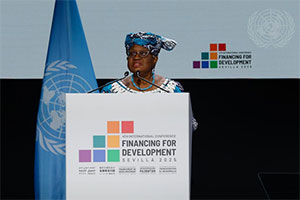 Opening of 4th International Conference on Financing for Development. Credit: UN Photo/Mariscal
International trade and investment are crucial elements of the world economy. While they can be powerful stimulators of development, they can also lead to global imbalances and dynamics of exploitation. In 2025, international trade entered a period of immense disruption, driven in part by a new wave of United States tariffs that reshaped global supply chains and investment flows. The increase in the US tariff rate, the highest since the 1930s, has forced bilateral renegotiations with global trading partners. Furthermore, the debt crisis in developing nations has accelerated while Official Development Assistance (ODA) has substantially dropped 7.3% in 2024.
In the 21st century, advancements in economic diversification in formerly colonized nations have propelled them into more central roles in the global economy. For example, both China and Mexico were able to develop their manufacturing sector and channel this development into booming export flows, thus advancing into the position of emerging economies. Foreign investment also plays an essential role in providing capital for developing countries, although they are oftentimes accompanied by social and environmental exploitation. For example, rising Chinese investments in natural resources in Latin America have often been met with tension as these investment projects fail to properly mitigate environmental risks and protect workers’ rights. In a more multifaceted vein, Sino-African relations have led to infrastructure development in Sub-Saharan Africa while also heightening the region’s economic dependency on China. IPS reports on global news in trade and investment, while shining a light on the nuanced nature of these endeavors.

The Week with IPS

NEXT STOP - SDGs
Tracking global progress towards a sustainable world
Tracking global progress towards a sustainable world
