Languages
Sunday, September 6, 2026



News and Views from the Global South
Trade & Investment

High-Tech to the Rescue of Southern Africa’s Smallholder Farmers
Agriculture is the major employer and a backbone of the economies of Southern Africa.
Development and Taxes, a Vital Piece of the Post-2015 Puzzle
Public funds are vitally important to achieving the Sustainable Development Goals (SDGs), making corporate tax avoidance trends a pressing issue for post-2015 Financing for Development discussions.
World’s Richest One Percent Undermine Fight Against Economic Inequalities
The growing economic inequalities between rich and poor – and the lopsided concentration of wealth and power in the hands of the world’s one percent - are undermining international efforts to fight global poverty, environmental degradation and social injustice, according to a civil society alliance.
Banana Workers’ Strike Highlights Abuses by Corporations in Costa Rica
A strike that has brought activity to a halt since January on three major banana plantations on Costa Rica’s southern Caribbean coast, along the border with Panama, has highlighted the abuses in a sector in the hands of transnational corporations and has forced the governments of both countries to intervene.
Why Investors Should Think Twice before Investing in Coal in India – Part 1
India’s Government under Narendra Modi is in overdrive mode to please businesses and investments in the country. The much aggrandised ‘Make in India’ campaign launched in September 2014 is a clarion call for spurring investments into manufacturing and services in India and all eyes have turned to the power sector which is expected to undergo dramatic shifts.
Women Turn Drought into a Lesson on Sustainability
When a group of women in the remote village of Sadhuraks in Pakistan’s Thar Desert, some 800 km from the port city of Karachi, were asked if they would want to be born a woman in their next life, the answer from each was a resounding ‘no’.
Caribbean Community Climate-Smarting Fisheries, But Slowly
Caribbean nations have begun work on a plan to ‘climate smart’ the region's fisheries as part of overall efforts to secure food supplies.
Indonesia’s Palm Oil Industry in Need of a Makeover
Over the past three decades, 50 percent of the 544,150 square kilometres that comprise Kalimantan, the Indonesian portion of the island of Borneo, has been taken over by the palm oil industry.
Middle East Conflicts Give Hefty Boost to Arms Merchants
The ongoing conflicts in Syria, Iraq, Libya and Yemen have helped spiral arms sales upwards to the Middle East, according to a study released Monday by the Stockholm International Peace Research Institute (SIPRI).
Opinion: Climate Change Continues, Impervious to Official Declarations
It is now clear that we are not going to reach the goal of controlling climate change.
Canada’s Waste Still Rotting in a Philippine Port
Filipino Catholic priest and activist Reverend Father Robert Reyes, dubbed by media as the “running priest”, joined a protest of environmental and public health activists last week by running along the streets of the Makati Business District, the Philippines’ financial capital, to urge the government to immediately re-export the 50 Canadian containers filled with hazardous wastes that have been in the Port of Manila for 600 days now.
Sendai Conference to Move From Managing Disasters to Risk Prevention
As the world inched towards a crucial United Nations Conference in Sendai, Japan, Margareta Wahlström, head of the U.N. Office for Disaster Risk Reduction (UNISDR), assured that there was “general agreement” on the need to “move from managing disasters to managing disaster risk”.
Feeding a Warmer, Riskier World
Artificial meat. Indoor aquaculture. Vertical farms. Irrigation drones. Once the realm of science fiction, these things are now fact. Food production is going high tech – at least, in some places.
Opinion: The ‘Acapulco Paradox’ – Two Parallel Worlds Each Going Their Own Way
The world is clearly splitting into two parallel worlds, with each going their own way, in what we could call the ‘Acapulco paradox’.
The Dilemma of Soy in Argentina
Industrial soy production continues to expand in Argentina, pushing small farmers out of the countryside and replacing other crops and cattle. It presents a challenge in a country where 70 percent of the food consumed comes from family farms, but which also needs the foreign exchange brought in by what has been dubbed “green gold”.
Coal: Burning Up Australia’s Future
With less than a year to go before the United Nation’s annual climate change meeting scheduled to take place in Paris in November 2015, citizens and civil society groups are pushing their elected leaders to take stock of national commitments to lower carbon emissions in a bid to cap runaway global warming.
Renewable Energies in Latin America Weather Low Oil Prices
Traditionally, falling oil prices have discouraged development of renewable energy sources, but clean energy is making steady progress in Latin America, according to regional experts.
In India, an Indoor Health Crisis
For years, Kehmli Devi, a middle-aged woman from the village of Chachadeth in India’s northern Himalayan state of Uttarakhand, has prepared her family’s meals on a wood-burning stove.Brazil Called upon to Block Genetically Engineered Eucalyptus Trees
Forest protection, increased biodiversity and wildlife conservation are just a few of the promises made by proponents of genetically engineered (GE) plants. But campaigners are not buying these promises.
Opinion: Reforming Mental Health in India
India is not only poised for greatness, some say it is already on its way. The events that have shaped the nation's dialogue over the past month showcase an India with a bold vision – to transform industry, to close the gap on inequality and ultimately, to redefine its place as a leader among the world.Prominent Lawyer Defending the Poor Gunned Down in Mozambique
As billions pour into Mozambique from foreign investors scooping up fields of coal and natural gas, the signs of newfound wealth are impossible to miss.« Previous Page — Next Page »


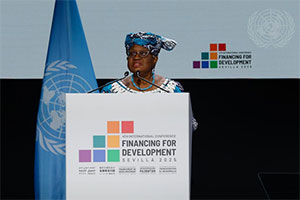 Opening of 4th International Conference on Financing for Development. Credit: UN Photo/Mariscal
International trade and investment are crucial elements of the world economy. While they can be powerful stimulators of development, they can also lead to global imbalances and dynamics of exploitation. In 2025, international trade entered a period of immense disruption, driven in part by a new wave of United States tariffs that reshaped global supply chains and investment flows. The increase in the US tariff rate, the highest since the 1930s, has forced bilateral renegotiations with global trading partners. Furthermore, the debt crisis in developing nations has accelerated while Official Development Assistance (ODA) has substantially dropped 7.3% in 2024.
In the 21st century, advancements in economic diversification in formerly colonized nations have propelled them into more central roles in the global economy. For example, both China and Mexico were able to develop their manufacturing sector and channel this development into booming export flows, thus advancing into the position of emerging economies. Foreign investment also plays an essential role in providing capital for developing countries, although they are oftentimes accompanied by social and environmental exploitation. For example, rising Chinese investments in natural resources in Latin America have often been met with tension as these investment projects fail to properly mitigate environmental risks and protect workers’ rights. In a more multifaceted vein, Sino-African relations have led to infrastructure development in Sub-Saharan Africa while also heightening the region’s economic dependency on China. IPS reports on global news in trade and investment, while shining a light on the nuanced nature of these endeavors.

The Week with IPS

NEXT STOP - SDGs
Tracking global progress towards a sustainable world
Tracking global progress towards a sustainable world
