Languages
Friday, November 27, 2026



News and Views from the Global South
Latin America & the Caribbean
CULTURE-CHILE: Free Book Selections for 400,000 Families
The Chilean government has begun distributing carefully selected packages of books to thousands of low-income families. But the programme aimed at promoting reading is not without its detractors, who question the extent of its real impact.NICARAGUA: Asylum for Survivors of Attack on FARC Camp
The Nicaraguan government of Daniel Ortega granted asylum to two young Colombian women who survived a Mar. 1 bombing raid by the armed forces of their country on a FARC guerrilla camp in Ecuador.
COLOMBIA: Extradition of Paramilitary Chiefs – a Blow to Truth
Fourteen former paramilitary chiefs were quietly extradited from Colombia to the United States before dawn on Tuesday on drug trafficking charges, in a move that drew criticism from human rights experts.RIGHTS-EL SALVADOR: Exhuming Memory
One of the men comes across a plastic thread and stops digging. He starts to carefully remove the dirt until unearthing a piece of material that he hands to an elderly woman, who is silently observing the exhumation of the remains of victims of El Salvador’s 12-year civil war.POLITICS-BOLIVIA: Morales Bets All or Nothing
If both Bolivian President Evo Morales and his vice president are voted out of office in a recall referendum that is to be held, they would be replaced - according to the constitution, and until new elections are held - by conservative businessman and Senator Óscar Ortiz from the eastern province of Santa Cruz.PERU: All-Out War on Remnant of ‘Shining Path’ Guerrillas
The armed forces have launched a major offensive against the most combative remaining column of Sendero Luminoso (the Maoist Shining Path guerrillas) which is operating in the jungle valleys of the Ene and Apurimac rivers in southeastern Peru, where most of the country’s coca leaf and cocaine is produced.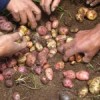
PERU: Highlands Families Work to Save Their Birthright – the Potato
A plate of parboiled potatoes of various sizes, shapes and colours welcomes the visitor to Huama, a town in the southern Peruvian Andes, at an altitude of 4,500 metres.COLOMBIA: Therapeutic Abortion – A Right in Name Only?
A woman in Pasto, the capital of the western Colombian province of Nariño, found out that the baby she was expecting was severely deformed. But when she went to the provincial university hospital for an abortion, the chief obstetrician gynaecologist told her that "If your son is born deformed, take him to a circus."RIGHTS-JAMAICA: Spat Escalates Over Anti-Gay Lyrics
Under pressure from gay rights groups and a sponsorship boycott of live dancehall shows by local beer giant Red Stripe, some Jamaican dancehall stars are offering free performances to events at which no Red Stripe products are sold or consumed.ENVIRONMENT-BRAZIL: Controversy Over Indigenous Land and Biofuels
The legal status of an indigenous territory in the far north of Brazil, and biofuels, are two hot potatoes at the Third National Conference on the Environment being held in the capital city, which is focusing on climate change.
COLOMBIA: "Mark Him on the Ballot – The One Wearing Glasses"
"With Uribe, we thought: this is the guy who is going to change the country," the 41-year-old fisherwoman told IPS.ARGENTINA: Food Inflation Hits People Close to Poverty Line
Poverty is once again growing in Argentina, reversing the downward trend recorded since 2003, as a result of price inflation mainly affecting basic food products, analysts say. But the government’s only response, according to its critics, has been to stop reporting poverty statistics.MEXICO: Pemex Oozes Corruption
Funds belonging to the Mexican state oil monopoly, Pemex, have paid in recent years for liposuction treatment for the wife of the company’s chief executive, a presidential candidate’s campaign, contracts with firms facing legal action, and the whims of trade union leaders who are not required to account for their expenses.DEATH PENALTY: Another Mexican on His Way to the Scaffold in US
The Mexican government’s aggressive strategy to prevent the execution of Mexican citizens in the United States has so far failed to bear fruit, despite a landmark international court ruling.HONDURAS: Prosecutors on Hunger Strike against Corruption
Prosecutors in Honduras are on hunger strike to demand the dismissal of the attorney general and his deputy, for failure to investigate cases of corruption. Tension mounted when the president of Congress warned of possible intentions to break with the "constitutional order."SOUTH AMERICA: Leaders Warn of Autonomy Attempts in Venezuela, Ecuador
Presidents Hugo Chávez of Venezuela and Rafael Correa of Ecuador warned of possible "contagion" in their countries by the autonomy movement in the eastern Bolivian province of Santa Cruz.
PARAGUAY: Torture Victim Still Fears Colorado Party ‘Mafia’
The Colorado Party has become a "criminal mafia" during its 61 years in government in Paraguay, and it will continue to be a force to be reckoned with in spite of its defeat in last month’s elections, says Anuncio Martí, a Paraguayan citizen living in exile in Brazil.BOLIVIA: Referendum Gives Major Boost to Autonomy Movement
The overwhelming vote in favour of autonomy in Bolivia’s richest province has strengthened the challenge to the reforms being ushered in by the government of Evo Morales.ECUADOR: New Constitution Addresses Demand for ‘Plurinational’ State
Ecuador’s new constitution, which a constituent assembly expects to finish drafting by mid-June, establishes a united "plurinational" state, recognising equality along with ethnic diversity, as agreed between the government and indigenous organisations.
BOLIVIA: Violent Pro-Autonomy Election Day in Santa Cruz
At least eight people were injured in clashes between backers of the autonomy referendum held Sunday in the eastern Bolivian province of Santa Cruz and supporters of the government of Evo Morales from the country’s western highlands.BOLIVIA: Santa Cruz Autonomy Statute Violates Constitution
Voters in the Bolivian province of Santa Cruz, which is in the vanguard of an "autonomy" movement involving six of the country’s nine regions, will decide Sunday on a statute that runs counter to the constitution.« Previous Page — Next Page »


The Week with IPS

NEXT STOP - SDGs
Tracking global progress towards a sustainable world

