Languages
Monday, November 9, 2026



News and Views from the Global South
Politics
Egypt Sounds Alarm on Economy
Egyptian officials are warning that the country, just emerging from a popular uprising that ousted the regime of former President Hosni Mubarak, could be facing a major economic crisis with lagging international aid and foreign investment.Paradoxes of Iranian Society Spur on Heroic Women
Haleh Sahabi is the latest Iranian woman to die in political violence.US-PAKISTAN: Mend Aid Programme, Don’t End It, Says Study
Amid a spate of calls by U.S. lawmakers to slash aid to Pakistan in the aftermath of Osama bin Laden's death, an influential think tank is calling for greater patience, precision, transparency and humility in implementing Washington's 1.5-billion-dollar-a-year development aid programme.BRAZIL: Activists Call for Stronger Action against Violence in Amazon
Organisations of small farmers and human rights groups are disappointed with the measures announced by the Brazilian government to address the problem of violence in the Amazon jungle region, after four environmental activists were murdered in less than a week.U.S. Veto Could Derail Palestine as New U.N. Member State
If the General Assembly is called upon to recognise Palestine as a new sovereign nation state, the resolution is expected to garner the required two-thirds majority among the 192 members in the world body, come September.EGYPT: Popular Opposition Mounts to Camp David Deal
Throughout ousted president Hosni Mubarak's 30-year rule, the 1979 Camp David agreement served to keep the peace between historical foes Egypt and Israel. But since Mubarak's February departure, popular calls for the treaty's abrogation have grown louder.
TAIWAN: No Indictment Over Wrongful Execution
Taiwan prosecutors certified that Air Force private Chiang Kuo-ching had been wrongfully executed in August 1997 for the rape-murder of a five-year-old-girl at an air force headquarters compound in Taipei, but failed to indict any of the nine military officers responsible for extracting his "confession" through torture.Libya Dominates EU-Africa Talks
Facing unrest in the north and a struggle against poverty elsewhere, leaders of the African Union and their European counterparts are working as "equal partners" to spread democracy and economic opportunity across the African continent.Syria’s Opposition Dismisses Amnesty Gesture
Syrian opposition members have rejected an amnesty offer by President Bashar al-Assad as a token concession in order to contain a crisis that has called the legitimacy of the current leadership into question.OP-ED: A Tale of Two Raids
They were both responsible for thousands of civilian deaths in causes they believed were righteous. They both occupied top spots on the World's Most Wanted list. They were both the subject of raids that were years in the making and required extensive intelligence work.MEDIA-PAKISTAN: What Price Truth
When journalist Umar Cheema, 35, first heard of the death of his colleague Syed Saleem Shahzad, considered an expert on Al-Qaeda and Taliban militants, on May 31, he could not help but relive his day-long captivity with one of Pakistan’s intelligence agencies last year on Sept. 4.YEMEN: Living With an Endless Revolution
It was during moments on our rooftop earlier this week - seeing flashes in the air and hearing the heavy pounding of gun fire - when we realised that Yemen’s capital city Sana’a was no longer as safe as we had hoped.OP-ED: Fears of Depleted Uranium Use in Libya
The pattern of deception to gain legitimacy for war in the eyes of the public by now is familiar. In the middle of March, Western powers led by the U.S., Britain and France initiated actions of war against Muammar Gaddafi’s government of Libya. The start of war was preceded by a publicity offensive in which the Libyan leader was depicted as a madman.Media War Blurs Picture in Syria
Since pro-democracy protests began over two months ago, Syria has been engaged in a fierce media war - with journalists arrested and international press banned from entering the country. This has severely curtailed the flow of information out of the country.ELECTIONS-PORTUGAL: Rubberstamping IMF Prescriptions
Voters in crisis-stricken Portugal will go to the ballot boxes next Sunday to choose not a government, but something more like delegates who will administer decisions already taken by the International Monetary Fund and the European Union.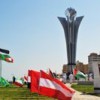
MIDEAST: Undefeated, Freedom Flotillas Expand
A gleaming new memorial towers in the centre of Gaza City's battered port. Flanked by flags of various nations whose citizens have sailed to the Gaza Strip to highlight the all-out siege on Gaza, the memorial's inscription bears the names of the Turkish solidarity activists who died one year ago when Israeli commandoes firing machine guns air-dropped onto the Freedom Flotilla, killing nine and injuring over 50 of the civilians on board.U.S. Uses Peace Talks to Divide Taliban from Pakistan
The leaked reports over the past two weeks of a series of meetings between U.S. officials and a Taliban figure close to leader Mullah Omar seemed to point to real progress toward a negotiated settlement of the war in Afghanistan.Rifts Appear as Syrian Opposition Struggles to Maintain Momentum
Two months into the uprisings that have shaken the Syrian regime of Bashar al-Assad, the outcome remains largely unclear. The Syrian government's repressive measures, complete with mass arrests, torture, and sizable military deployments, have severely dampen the movement but failed to extinguish the protests altogether.OP-ED: Religion, Out of Place?
Brazil is seen as a country of diverse and profound faith. But though religion is an important reference point in the lives of the population, the extent of religious diversity in this sprawling country is not nearly so pervasive as belief itself.LIBYA: Zuma says Gaddafi Ready for Truce
Muammar Gaddafi is ready for a truce to stop the fighting in his country, Jacob Zuma, the South African president, has said.Arab Spring Wary of Economic Lifelines
Governments and international institutions that once bankrolled the authoritarian regimes of Tunisia’s Zine El-Abidine Ben Ali and Egypt’s Hosni Mubarak have begun floating aid packages to speed up the economic recovery and transition to democracy in these countries. Arab revolutionaries have reason to be wary.« Previous Page — Next Page »





The Week with IPS

NEXT STOP - SDGs
Tracking global progress towards a sustainable world
Tracking global progress towards a sustainable world
