Languages
Tuesday, October 13, 2026



News and Views from the Global South
Southern Africa
MALAWI: Tax on the Poor Is to Compensate for Tariff Revenue Loss
The decision by the Malawian government to introduce value-added tax (VAT) of up to 16.5 percent on products such as bread, meat, milk and dairy products is being blamed for losses incurred by small-scale businesses. The move comes in response to a loss of revenue due to regional trade commitments.ZIMBABWE: Microcredit Operators Target Salaried Workers
Johnson Gama knows life on the poverty line only too well. A qualified teacher, Gama has in the last few years been unable to survive on his salary despite working in a profession which two decades ago was considered middleclass in Zimbabwe.
HEALTH: High Drug Prices Hamper Drug-Resistant TB Treatment
Access to treatment for drug-resistant tuberculosis (DR-TB) remains compromised, especially in developing countries, because too few pharmaceutical companies manufacture quality-assured drugs. Lack of competition has led to skyrocketing prices and this means that public health budgets are quickly spent.
Q&A: “When They Find Out You’re a Lesbian They Refuse to Help”
With homophobia on the rise, large numbers of South African lesbians are being subjected to discrimination and violent assaults. There has also been an increase in "corrective rape" by men trying to "cure" them of their sexual orientation. More than 30 lesbians have been killed since 2006. But most of these crimes go unrecognised by the state and unpunished by the legal system.
RIGHTS-UGANDA: Government Needs to Prioritise Maternal Health
Just a week after a group of civil society organisations petitioned Uganda’s constitutional court demanding that the government’s non-provision of essential services for pregnant mothers was a violation of the right to life; Margaret Nabirye lost her baby in childbirth.SWAZILAND: Girls Leave School Because of No Sanitary Wear
After a newspaper that Prudence* (16) used as sanitary wear fell from her while she played with friends at school, she left and never returned.SOUTHERN AFRICA: Reforms First, Elections Later
A new constitution, voters’ roll and electoral law, among other things, have to be in place before elections in Zimbabwe can be held but observers doubt if this can be implemented.
ZIMBABWE: Import of Second Hand Japanese Cars to be Banned
For Mathew Marufu, who has a disabled 10-year-old son, owning a second hand Japanese car has been an ‘answer from God’.MALAWI: Village Hands Join to Save Forest for Juice
Seventy kilometres outside Malawi's commercial capital, Blantyre, a profitable cooperative enterprise is providing villagers jobs and preserving forests.
ZIMBABWE: They Live by the Sword, But Should They Die by the Sword?
In her glory days, death-row inmate Rosemary Khumalo (66) lived life dangerously on the edge. She was a sanguinary fortune hunter who would resort to anything, even murder, to land her loot, according to court records of her trial.ZIMBABWE: Beating the Housing Blues
Every month Cynthia Dube and the nine other women from her co-operative make sure they sell enough clothes and appliances to put 100 dollars each in a joint savings. When they have enough money, they will buy each member a plot of land. And eventually they will help each other build their own homes.
SOUTH AFRICA: Sound Policy Key to Renewable Energy
A radical rethink of current energy policy can cut South Africa's greenhouse gas emissions by 80 percent in 2050 compared to 1990 levels. More than that - after an initial spike in investment - South Africans four decades down the line would pay 23 billion dollars per year less for their electricity compared to business as usual.TANZANIA-INDIA: A Rewarding Relationship
The Indian prime minister, Dr Manmohan Singh, concludes a three-day visit to Tanzania on May 28. Singh arrived in Dar es Salaam from the Ethiopian capital, Addis Ababa, where he took part in the Second India-Africa Forum Summit, which began on May 20.
ZAMBIA: Hope for Women Politicians
Mirriam Kauseni is on a quest to become her town’s first ever female parliamentarian. She has yet to be elected to run for the post by her party, the Patriotic Front (PF), but Kauseni has already been conducting door-to-door campaigns, telling people to vote for her in the country’s national elections.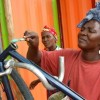
AFRICA: ‘Bicycles Are For Good’
"Politicians may tell us that bicycles are a sign that we are not advancing," says Patrick Kayemba, managing director of the First African Bicycle Information Organization in Uganda, "but we ourselves have seen that cycling is a socio-economic tool. It works now - we don’t have to wait for someone to rescue us with better public transport, better this, or better that..."ZIMBABWE: Cross-Border Traders Don’t Trust Banks With Their Money
A newly available electronic banking service has received a lukewarm reception from cross-border traders in Zimbabwe’s second largest city Bulawayo, despite it alleviating the need to move around with large sums of cash.
SOUTH AFRICA : Women Candidates Struggle in Local Government Elections
Political parties should be forced, through changes in legislation, to bring more women into government.
TRADE: Istanbul Conference “a Setback” for Poor Countries
Some of the decisions taken on trade in the Istanbul Plan of Action are likely to disadvantage poor countries while others are so vague as to be meaningless, says Abdoulaye Sanoko, counsellor at the mission of Mali to the World Trade Organisation (WTO) in Geneva.SOUTHERN AFRICA: Little ‘Extraordinary’ About Latest SADC Summit
Inaction marked the Extraordinary Summit of Southern African Development Community heads of state in Windhoek this weekend, despite an agenda covering Zimbabwe elections, political deadlock in Madagascar, the suspension of the regional court and allegations of corruption within SADC itself.HEALTH: Money Needed for ART Funding
Fixed targets for universal access to AIDS treatment and funding to make it achievable are what HIV and AIDS organisations want from the upcoming United Nations General Assembly Special Session due to be held in New York next month.
Illegal Logging Spreading in Madagascar
The transitional authorities in Madagascar are struggling to overcome the problem of illegal logging of precious wood. In spite of an April 2010 decree that prohibits the logging, transporting, trading and export of precious woods, felling in the forests is still continuing.« Previous Page — Next Page »





The Week with IPS

NEXT STOP - SDGs
Tracking global progress towards a sustainable world
Tracking global progress towards a sustainable world
