
Sunday, October 18, 2026



News and Views from the Global South
POLITICS-SIERRA LEONE: Whose Quota, Exactly?
Mohamed Fofana
- A campaign to bring about greater gender balance in Sierra Leone's government has sparked debate on issues of class, with some fearing that a proposed quota for women could be monopolised by candidates who are unrepresentative of Sierra Leonean women overall.
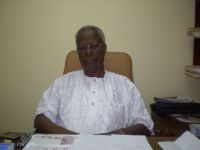
Law Reform Commission Chairman Peter Tucker. Credit: Mohamed Fofana
"The committee expressed reservations, pointing out that the 30 percent quota push is only a crusade by elite women who would be the direct beneficiaries of the quota system if the constitution makes (provision) for it," said Harriet Turay, president of the 50/50 Group – this after a recent submission of arguments in favour of the quota to the committee.
The 50/50 Group is a non-governmental organisation (NGO) that is at the forefront of efforts to have quotas enshrined in the constitution. The body aims to ensure that women's participation in politics reflects the fact that they make up about half – 52 percent – of the population in Sierra Leone.
However, Peter Tucker, chairman of the Law Reform Commission – which oversees the Constitutional Review Committee – told IPS that arguments about the potential elitism of quotas were immaterial to the body, and the concerns were those of certain women who feared quotas would only benefit a select few.
Instead, the committee had faced questions such as "…whether, when we would have agreed to give the 30 percent quota to the women, we (would) decide on giving them a special constituency where the 30 percent quota will come from…or demand the 30 percent quota for women from the political parties."
A vicious, 11-year civil war that ended in 2002 brought devastation to this West African country. The latest United Nations Human Development Report notes that 57 percent of people here live on less than a dollar a day, and 74.5 percent on less than two dollars daily.
Those lobbying for the quota say they have consulted a cross-section of women during their campaign, and that there is broad agreement about the need to reserve posts for women.
Nonetheless, there are signs of dissent about whether quotas are the best way of achieving gender balance in government. Some apparently view this step as discriminatory – even though "No one wants to stand against the campaign now because you will be hounded, and the push for equality is the vogue now," noted a member of LAWYERS, a local NGO that provides legal aid to women.
The president of LAWYERS, Melinda Davies, says the group supports the proposed quota overall: "Individual members hold contrary views, but as an organisation we support the move for a 30 percent quota for women."
According to Nemata Eshun-Baiden, founder of the 50/50 Group, efforts to introduce quotas date back to 2004, when a coalition of women's organisations co-ordinated by 50/50 started the campaign.
The alliance includes the Mano River Women's Peace Network, Accord 97, the Young Women's Christian Organisation and the National Organisation of Women.
"Our strongest argument would be…the fact that Sierra Leone participated so actively at the Beijing Conference…so it stands to reason that Sierra Leone should implement what it had agreed to do, and also to respond to the recommendations of the CEDAW convention," said Nana Pratt of the Mano River Women's Peace Network – this in reference to the Fourth World Conference on Women, held in the Chinese capital of Beijing in 1995, and the Convention on the Elimination of All Forms of Discrimination Against Women (CEDAW).
Sierra Leone is a signatory to the Beijing Declaration and Platform of Action, which commit countries to establishing specific targets for women's representation in government as well as to measures for achieving these goals, with the aim of having equal numbers of men and women in government.
Freetown is also a signatory to CEDAW, which requires states to eradicate discrimination against women in the political and public spheres.
In addition, Sierra Leone's Truth and Reconciliation Commission (TRC) recommended that 30 percent of government posts be reserved for women. The TRC was set up to probe rights violations during the war. It began work in 2002, and submitted its final report in 2004.
In response to claims that quotas could be considered discriminatory towards men, Pratt noted that there is already precedent for affirmative action by officials.
"Government used affirmative action administratively when they recognised that in the north and in the east of the country girls' education lags behind that of boys," she said. "So, they have gone on to award scholarships and made other provisions only for the girls – which we will not call discriminatory, but trying to bridge the gap."
The chairwoman of the Human Rights Commission of Sierra Leone, Jamesina King, voiced similar sentiments: "It (the proposed quota) is positive affirmative action which discriminates to ensure fairness, ensure justice and redress an imbalance that has taken place in our society."
The commission has made recommendations to the Constitutional Review Committee in favour of the quota. It is widely held that for women to begin exercising substantial influence over the work of parliament, they need to control at least 30 percent of seats.
The constitution is being overhauled to bring it in line with social and economic trends, and conventions relating to rights and other issues that have been ratified by government. The Constitutional Review Committee is expected to meet President Ernest Bai Koroma to report on its recommendations by early next year.
Politics has traditionally been viewed as the preserve of men in Sierra Leone, and social and economic factors continue to place women at the margins of public life (see 'SIERRA LEONE: Caught Between Leaving the Kitchen and Putting Food on the Table').
 Print
|
Print
|




