Languages
Monday, September 21, 2026



News and Views from the Global South
Active Citizens

Native Communities in Mexico Demand to be Consulted on Wind Farms
“It hurts us that our land is affected, and the environmental impacts are not even measured. Wind farm projects affect streams and hurt the flora,” said Zapotec Indian Isabel Jiménez, who is taking part in the struggle against the installation of a wind park in southern Mexico.
The Neglected Street Vendors of India
For the past nine years, 27-year-old Jignesh has been hawking bed sheets on the bustling pavements of Janpath, a major throughway in India’s capital, New Delhi, as kamikaze traffic swirls around him.
Growing Mobilisation Against Introduction of Fracking in Spain
Thousands of people in Spain have organised to protest the introduction of “fracking” – a controversial technique that involves pumping water, chemicals and sand at high pressure into shale rock to release gas and oil.
Thousands Rally to Demand Freedom for Puerto Rican Activist
Children in strollers held placards. Those unable to make it into the streets leaned out of high-rise apartment building windows, shouting support to the river of protestors below. For hours, several city blocks became a mass of red and blue, as scores of people waved the national flag of Puerto Rico. One name was on everyone’s lips, but the cause was broader than a single man.
Garment Sweatshops in Argentina an Open Secret
The death of two Bolivian boys in a fire and the mistreatment and sexual abuse of a young Bolivian woman put the problem of slave-like labour conditions in clandestine sweatshops back in the headlines in Argentina.
Latin America’s Relative Success in Fighting Hunger
The Latin American and Caribbean region is the first in the world to reach the two global targets for reducing hunger. Nevertheless, more than 34 million people still go hungry.
Scores of Sri Lankan Tamils Still Living Under the ‘Long Shadow of War’
In many ways, Jayakumari Balendran epitomizes the plight of the Tamil people in Sri Lanka’s northern and eastern provinces, both during and after the island nation’s 26-year-long civil conflict.
U.N. Security Council Takes “Historic” Stand on Killings of Journalists
When war breaks out, most non-combatants run the other way. But a handful of courageous reporters see it as their duty to tell the world what's happening on the ground. And many pay a high price.
Opinion: Internet Should be Common Heritage of Humankind – Part II
The Internet – and the applications that it has spawned – is the single most important technological innovation that has brought together and interlinked humankind in a real, tangible and interactive way.
Laissez Faire Water Laws Threaten Family Farming in Chile
Family farmers in Chile are pushing for the reinstatement of water as a public good, to at least partially solve the shortages caused by the privatisation of water rights by the military dictatorship in 1981.
Pineapple Industry Leaves Costa Rican Communities High and Dry
Twelve years after finding the first traces of pesticides used by the pineapple industry, in the rural water supply, around 7,000 people from four communities in Costa Rica’s Caribbean region are still unable to consume their tap water.
Q&A: Papua New Guinea Reckons With Unmet Development Goals
As Papua New Guinea celebrates 40 years of independence, 2015 marks a defining year for the largest Pacific Island nation, set to record 15 percent GDP growth this year.
Failure of Review Conference Brings World Close to Nuclear Cataclysm, Warn Activists
After nearly four weeks of negotiations, the Nuclear Non-Proliferation Treaty (NPT) Review Conference ended in a predictable outcome: a text overwhelmingly reflecting the views and interests of the nuclear-armed states and some of their nuclear-dependent allies.
School Gardens Combat Hunger in Argentina
In Argentina, where millions of families have unmet dietary needs despite the country’s vast expanse of fertile land, the Huerta Niño project promotes organic gardens in rural primary schools, to teach children healthy eating habits and show them that they can grow their own food to fight hunger.
Bougainville: Former War-Torn Territory Still Wary of Mining
From Arawa, once the capital city of Bougainville, an autonomous region in eastern Papua New Guinea in the southwest Pacific Ocean, a long, winding road leads high up into the Crown Prince Ranges in the centre of the island through impenetrable rainforest.
Opinion: Voice of Civil Society Muffled in Post-2015 Negotiations for Better Future
In September, the United Nations will agree on new Sustainable Development Goals (SDGs) which will set development priorities for the next 15 years. The draft goals that have been developed are ambitious – they seek to end poverty and ensure no one is left behind.
Opinion: New World Information Order, Internet and the Global South – Part I
More than four decades ago, the Non-Aligned Movement (NAM) launched the concept of a New International Information Order (NIIO).
Climate Change: Some Companies Reject ‘Business as Usual’
When it comes to climate change, business as usual is simply “not an option”.
Pakistan’s Streets Kids Drop the Begging Bowl, Opt for Pencils Instead
Khalil Ahmed's life story sounds like it could have come straight out of the plot of a Bollywood flick, but it didn’t. And that makes it all the more inspiring.
Opinion: Bangladesh’s Persecuted Indigenous People
The August 2014 killing of Timir Baran Chakma, an indigenous Jumma activist, allegedly in Bangladeshi military custody, was protested by his supporters. His death, and the failure of justice, like the plight of his people across the Chittagong Hills region, received little international notice.
Development Threatens Antigua’s Protected Guiana Island
In June 2014, Gaston Browne led his Antigua and Barbuda Labour Party to a resounding victory at the polls with a pledge to transform the country into an economic powerhouse in the Caribbean.« Previous Page — Next Page »


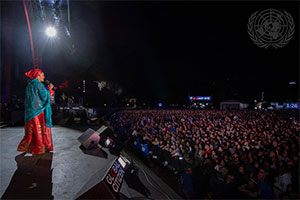 Global Citizen Festival in New York. Credit: UN Photo/Eskinder Debebe
Active citizens are committed to social change because they know that it is achievable. However, major political challenges face active citizens across the world. For example, in authoritarian regimes in Latin America where the hegemonic party has been in power for decades on end, protestors and human rights activists face enormous repression and struggle to materialize their advocacy into concrete results. The same can be said for Africans, where a shift towards elected government in recent decades has yet to translate into an effective voice in decision-making. Now, the Strengthening Citizen Demand for Good Governance, which uses evidence-based approaches – funded by DFID's Governance and Transparency Fund – seeks to raise their voices.
In 2025, the CIVICUS Monitor’s People Power Under Attack report revealed that civic freedoms are severely limited in 122 of 198 countries and territories, and only 7.2% of the global population now lives in countries where civic space is open. Through partnership with the Overseas Development Institute (ODI) and CIVICUS, IPS reporters across the continent will seek to define the extent and limits of state capability, government accountability and the responsiveness of leaders to the needs of citizens.

The Week with IPS

NEXT STOP - SDGs
Tracking global progress towards a sustainable world
Tracking global progress towards a sustainable world
