Languages
Tuesday, September 22, 2026



News and Views from the Global South
Active Citizens

U.N. Urged to Put Global Citizenship at Centre of Post-2015 Development Agenda
When Denmark hosted the World Summit on Social Development (WSSD) in March 1995, one of the conclusions of that international gathering in Copenhagen was to create a new social contract with “people at the centre of development.”
Small Victories at Bonn Climate Talks
As climate talks wind down in Bonn, Germany, observers of the negotiations say that despite some progress on a draft text, key issues remain unresolved and will carry over at least until the next round in August.
Opinion: Cli-Fi Film from Philippines Packs a Punch
I live on a crowded, subtropical island nation in the Western Pacific, on the opposite side of the "Pacific Pond" from North America. And just south of Taiwan is the many-splendored island nation of the Philippines. We are neighbours. You can fly there in one hour, it's that close.
Rights Abuses Still Rampant in Bangladesh’s Garment Sector
 Some say they were beaten with iron bars. Others confess their families have been threatened with death. One pregnant woman was assaulted with metal curtain rods.

Compensation Fund for Victims of Bangladesh Factory Collapse Reaches 30-Million-Dollar Target
Two years after a massive garments factory collapsed in a suburb of Bangladesh’s capital, Dhaka, killing over 1,100 people and leaving more than 2,500 injured, a major international fund has met its target of raising 30 million dollars to be paid out in compensation to the victims and their families.
Chinese Public Most Worried About Climate Change
A new survey finds that China leads the world in public support for government action on climate change.
India Erupts Over Loopholes in Child Labour Law
In a bid to overhaul the country's child labour laws, the Indian government has banned the employment of children below 14 years of age in various commercial ventures, while permitting them to work in family enterprises and on farmlands after school hours and during vacations.
Israel, Hamas Escape U.N.’s List of Shame on Attacks on Children
Secretary-General Ban Ki-moon, reportedly under heavy pressure from the United States and Israel, has decided not to blacklist the Jewish state in an annex to a new U.N. report on children victimised in armed conflicts.
India’s Four Million Sex Workers Demand Equal Labour Rights
 Although forced prostitution and trafficking of women remains a huge challenge in India, health experts, policy-makers and legal advocates say that most of the country’s estimated four million commercial sex workers join the trade of their own free will.

Call for Disability Rights to Be Mainstreamed in Post-2015 Development Agenda
“We should remove the ‘dis’ and focus on ‘abilities,’” Daniela Bas, director of the Division for Social Policy and Development at the U.N. Department of Economic and Social Affairs, said at a media event on the rights of persons with disabilities on Friday.
Ni Una Menos – The Cry Against ‘Femicides’ Finally Heard in Argentina
In the wake of the massive response to their call to protest violence against women in Argentina, the organisers of this week’s demonstrations are starting to plan the steps to be taken to get results for their demand “Ni Una Menos” (not one less), taking advantage of the strength in numbers shown to obtain political support for public policies aimed at protecting women.Governments Must Do More to Support Volunteers, Says U.N.
Volunteers are increasingly essential to ensuring government accountability and effectiveness - but their vast potential is untapped and undervalued, a new United Nations report has found.
Journalists, Gov’ts Square Off in Game of Drones
For some, the word "drone" immediately conjures up ominous phrases like "targeted assassination" and "precision strike."
8.2 Million Iraqis In Need of Emergency Humanitarian Assistance
As fighting drags on between Iraqi armed forces and the Islamic State in Iraq and the Levant (ISIL), millions of refugees caught between the warring groups are in dire need of humanitarian assistance.
Opinion: For a New Generation of Climate Activists, It’s Too Late to Wait
I remember pretending not to be so excited. There was this nervous energy that kicked up my heels as I prowled through the U.N. negotiations that afternoon. You could feel it all around. Circling our meeting point like sharks quietly rounding our prey. If you knew what to look for, you would know exactly what was about to happen.
‘Legal Friends’ Fight Gender Violence in Rural India
Mamta Bai, 36, distinctly remembers the first time the police came to her village: it was December 2014 and her neighbour, Purva Bai, had just been beaten unconscious by her alcoholic husband, prompting Mamta to make a distress call to the nearest station.
As Jamaica’s Prime Forests Decline, Row Erupts Over Protection
For Jamaica, planting more trees as a way to build resilience is one of the highest priorities of the government's climate change action plan. So when Cockpit Country residents woke up to bulldozers in the protected area, they rallied to get answers from the authorities.
Pacific Civil Society Swings Out Against Free Trade Agreement
Fourteen Pacific Island Forum countries are currently locked in negotiations with their two largest economic neighbours, Australia and New Zealand, to forge a new regional free trade agreement called ‘PACER Plus’, which supporters believe will boost economic growth in the region.
U.N. Sets Up Independent Panel to Probe Sexual Abuses in CAR
The United Nations, which came under heavy fire for its failure to act swiftly on charges of sexual abuse by French troops in the Central African Republic (CAR) last year, has decided to set up an External Independent Review (EIR) to probe these allegations.
Climate Fund Rolls Out Amid Hopes It Stays “Green”
After a difficult infancy, the Green Climate Fund is finally getting some legs. The big question now is what direction it will toddle off in.
Zimbabwean Women Weave Their Own, Beautiful Future
Seventy-seven-year-old Grace Ngwenya has an eye for detail. You will never catch her squinting as she effortlessly weaves ilala palm fronds into beautiful baskets.
« Previous Page — Next Page »


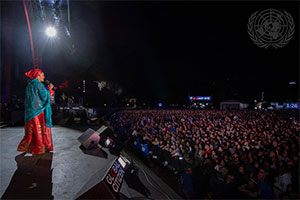 Global Citizen Festival in New York. Credit: UN Photo/Eskinder Debebe
Active citizens are committed to social change because they know that it is achievable. However, major political challenges face active citizens across the world. For example, in authoritarian regimes in Latin America where the hegemonic party has been in power for decades on end, protestors and human rights activists face enormous repression and struggle to materialize their advocacy into concrete results. The same can be said for Africans, where a shift towards elected government in recent decades has yet to translate into an effective voice in decision-making. Now, the Strengthening Citizen Demand for Good Governance, which uses evidence-based approaches – funded by DFID's Governance and Transparency Fund – seeks to raise their voices.
In 2025, the CIVICUS Monitor’s People Power Under Attack report revealed that civic freedoms are severely limited in 122 of 198 countries and territories, and only 7.2% of the global population now lives in countries where civic space is open. Through partnership with the Overseas Development Institute (ODI) and CIVICUS, IPS reporters across the continent will seek to define the extent and limits of state capability, government accountability and the responsiveness of leaders to the needs of citizens.

The Week with IPS

NEXT STOP - SDGs
Tracking global progress towards a sustainable world
Tracking global progress towards a sustainable world
