Languages
Sunday, October 4, 2026



News and Views from the Global South
Active Citizens

Palestinian Grassroots Resistance to Occupation Growing
As soon as the truck carrying Israeli dairy products entered Ramallah’s city centre it was surrounded by Palestinian activists who proceeded to remove and trash almost 20,000 dollars’ worth of mainly milk and yoghurt.
Socioenvironmental Catastrophe Emerges from the Ashes of Patagonia’s Forests
In the wake of the fire that destroyed more than 34,000 hectares of forests, some of them ancient, in Argentina’s southern Patagonia region, the authorities will have to put out flames that are no less serious: the new socio-environmental catastrophe that will emerge from the ashes.
Contradictions Beset U.N. Response to Sexual Abuse by Peacekeepers
An internal United Nations expert report released Monday by the non-governmental organisation AIDS-Free World reveals serious contradictions in the U.N.’s reporting of sexual exploitation and abuse by U.N. peacekeepers.
Sendai Conference Stresses Importance of Women’s Leadership
Women play a critical role in reducing disaster risk and planning and decision-making during and after disasters strike, according to senior United Nations, government and civil society representatives.
Four Ways Women Bring Lasting Peace to the Table
2015 marks anniversaries for two significant commitments made to increasing women’s participation at peace tables.
Indonesia’s Palm Oil Industry in Need of a Makeover
Over the past three decades, 50 percent of the 544,150 square kilometres that comprise Kalimantan, the Indonesian portion of the island of Borneo, has been taken over by the palm oil industry.
Opinion: Gender Equality, the Last Big Poverty Challenge
It is estimated that women account for two-thirds of the 1.4 billion people currently living in extreme poverty. They also make up 60 per cent of the world’s 572 million working poor.
Canada’s Waste Still Rotting in a Philippine Port
Filipino Catholic priest and activist Reverend Father Robert Reyes, dubbed by media as the “running priest”, joined a protest of environmental and public health activists last week by running along the streets of the Makati Business District, the Philippines’ financial capital, to urge the government to immediately re-export the 50 Canadian containers filled with hazardous wastes that have been in the Port of Manila for 600 days now.
Meet the 10 Women Who Will Stop at Nothing
On Apr. 6, 2013, Nadia Sharmeen, a crime reporter, was assigned to cover a rally organised by Hefazat-e-Islam, an association of fundamentalist Islamic groups in Bangladesh whose demands included a call to revoke the proposed National Women Development Policy.Anger Seethes in Gabon after Wood Company Sacks Protesting Workers
There is rising anger among trade unionists, environmentalists and civil society groups in Gabon after a wood company, Rain Forest Management (RFM), sacked 38 fixed-term workers last month in Mbomao, Ogooué-Ivindo province.
Sendai Conference to Move From Managing Disasters to Risk Prevention
As the world inched towards a crucial United Nations Conference in Sendai, Japan, Margareta Wahlström, head of the U.N. Office for Disaster Risk Reduction (UNISDR), assured that there was “general agreement” on the need to “move from managing disasters to managing disaster risk”.
Opinion: A Radical Approach to Global Citizenship Education
Although global citizenship education has now received the recognition it deserves, much of the literature recycles old agendas under another name - 'education to promote peace and justice', 'sustainability', 'care for the environment', 'multi-faith' and 'multi-cultural understanding' - and so forth.
Jailed Journalist’s Family Looks to Iran’s New Year with Hope
The lawyer for Jason Rezaian, the Iranian-American Washington Post reporter detained in Tehran since Jul. 22, 2014, has officially requested temporary bail for her client during Nowruz, the beginning of the Persian calendar year when some prisoners have customarily been granted furlough requests.
Eighty-Three Percent of Lights Have Gone Out in Syria
A single image can be more powerful, more descriptive and more potent than an entire essay – ‘ a picture says a thousand words,’ as the cliché goes.
Coal: Burning Up Australia’s Future
With less than a year to go before the United Nation’s annual climate change meeting scheduled to take place in Paris in November 2015, citizens and civil society groups are pushing their elected leaders to take stock of national commitments to lower carbon emissions in a bid to cap runaway global warming.
Women Make Progress in Politics, But Glass Ceiling Remains Unbreakable
Secretary-General Ban Ki-moon, a creature of the U.N.’s 193 member states and who serves at their will and pleasure, did not hesitate to fault 13 countries that kept women out of their national parliaments and governments in power.
Brazil – from the Droughts of the Northeast to São Paulo’s Thirst
Six million people in Brazil’s biggest city, São Paulo, may at some point find themselves without water. The February rains did not ward off the risk and could even aggravate it by postponing rationing measures which hydrologists have been demanding for the last six months.
‘Cli-Fi’ Reaches into Literature Classrooms Worldwide
From Columbia University in New York to the University of Cambridge in Britain, college classrooms are picking up on the "cli-fi" genre of fiction, and cinema and academia is right behind them.Bridging the Gender Inequality Gap in the Media
Despite the vast number of media outlets and news sources worldwide, women and girls are still not getting enough attention in the news.
From the Mountains to the Sea, Timorese Women Fight for More
In Timor-Leste, the gap between rich and poor is most keenly felt by rural women and children. But while women are working hard to help rebuild Timor-Leste, their contributions are not always recognised, in a country where men’s narratives still heavily dominate.
The 15 Journalists Putting Women’s Rights on the Front Page
Media coverage of maternal, sexual and reproductive health rights is crucial to achieving international development goals, yet journalists covering these issues often face significant challenges.« Previous Page — Next Page »


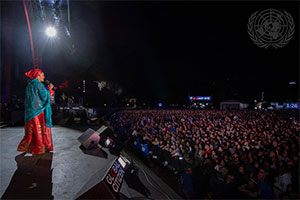 Global Citizen Festival in New York. Credit: UN Photo/Eskinder Debebe
Active citizens are committed to social change because they know that it is achievable. However, major political challenges face active citizens across the world. For example, in authoritarian regimes in Latin America where the hegemonic party has been in power for decades on end, protestors and human rights activists face enormous repression and struggle to materialize their advocacy into concrete results. The same can be said for Africans, where a shift towards elected government in recent decades has yet to translate into an effective voice in decision-making. Now, the Strengthening Citizen Demand for Good Governance, which uses evidence-based approaches – funded by DFID's Governance and Transparency Fund – seeks to raise their voices.
In 2025, the CIVICUS Monitor’s People Power Under Attack report revealed that civic freedoms are severely limited in 122 of 198 countries and territories, and only 7.2% of the global population now lives in countries where civic space is open. Through partnership with the Overseas Development Institute (ODI) and CIVICUS, IPS reporters across the continent will seek to define the extent and limits of state capability, government accountability and the responsiveness of leaders to the needs of citizens.

The Week with IPS

NEXT STOP - SDGs
Tracking global progress towards a sustainable world
Tracking global progress towards a sustainable world
