Languages
Tuesday, October 20, 2026



News and Views from the Global South
Active Citizens

OPINION: Women Must Be Partners and Drivers of Climate Change Decision-Making
As leaders from around the world gather in Lima, Peru this week to discuss global cooperation in addressing climate change, a woman in Guatemala will struggle to feed her family from a farm plot that produces less each season.
Climate Neutrality – the Lifeboat Launched by Lima
Packed into stifling meeting rooms in the Peruvian capital, delegates from 195 countries are trying to find a path that would make it possible for the planet to reach climate neutrality in the second half of this century – the only way to avoid irreversible damage, scientists warn.
“Indigenous Peoples Are the Owners of the Land” Say Activists at COP20
The clamor of indigenous peoples for recognition of their ancestral lands resounded among the delegates of 195 countries at the climate summit taking place in the Peruvian capital. “I want my land…that’s where I live and eat, and it’s where my saintly grandparents lie,” Diana Ríos shouted with rage.
Chilean Activists Change the Rules of the Game
In 2011, students in Chile made headlines when they launched a nationwide strike lasting almost eight months.
“What’s Good for Island States Is Good for the Planet”
The lead negotiator for an inter-governmental organisation of low-lying coastal and small island countries doesn't mince words. She says the new international climate change treaty being drafted here at the ongoing U.N. Climate Change Conference “is to ensure our survival".
Indonesia’s New President Promises to Put Peat Before Palm Oil
Last week, Indonesia's new president, Joko Widodo, ordered the country’s Ministry of Environment and Forestry to review the licenses of all companies that have converted peatlands to oil palm plantations.
OPINION: The Suicide of Europe
The fact that in a referendum Switzerland has taken a path that goes in the opposite direction from that of Europe is an unusual fact which calls for reflection, especially because Switzerland has taken a much more progressive path, while we all were accustomed to see it as a very conservative country.
Climate and Post-2015 Development Agenda Talks Share the Same Path
The international community’s post-2015 development agenda will depend, in key aspects, on whether the delegates of 195 countries meeting now at the climate summit in the Peruvian capital reach an agreement to reduce global warming, since climate change affects all human activity.
Climate Finance Flowing, But for Many, the Well Remains Dry
For more than 10 years, Mildred Crawford has been “a voice in the wilderness” crying out on behalf of rural women in agriculture.
OPINION: Japan’s Misuse of Climate Funds for Dirty Coal Plants Exposed
World governments gathered in Lima, Peru for the latest round of U.N. climate negotiations should have finance on their mind.
Mubarak Acquitted as Egypt’s Counterrevolution Thrives
The acquittal of former Egyptian President Muhammad Hosni Mubarak is not a legal or political surprise. Yet it carries serious ramifications for Arab autocrats who are leading the counterrevolutionary charge, as well as the United States.
Native Villagers in Honduras Bet on Food Security – and Win
The town’s dynamic mayor, Sandro Martínez, assumed the commitment of turning the Honduran municipality of Victoria into a model of food and nutritional security and environmental protection by means of municipal public policies based on broad social and community participation and international development aid.
Dushanbe Considering Bill to Restrict NGO Funding
It looks like Tajikistan is following a regional trend by drafting legislation that may sharply restrict the activities of foreign-funded non-governmental organisations. Activists say the bill threatens to hinder the operations of hundreds of organisations working on everything from human rights to public health.
OPINION: Stand in Solidarity with Courageous Women’s Human Rights Defenders
Almost two decades ago, in Beijing, 189 countries made a commitment to achieve equality for women, in practice and in law, so that all women could at last fully enjoy their rights and freedoms as equal human beings.
U.N. Chief, Under Fire, Moves Closer to Gender Parity
When Secretary-General Ban Ki-moon named an international panel to review peacekeeping operations last October, the announcement was greeted with bitter criticism because it lacked even a semblance of gender balance: only three out of 14 members were women.
The South Demands Clarity in Financing and Adaptation at COP20
At the 12-day climate summit that began Monday in the Peruvian capital, representatives of 195 countries and hundreds of members of civil society are trying to agree on the key points of a new international treaty aimed at curbing global warming.
Kyrgyzstan Debates Russian-Style “Foreign Agents” Law
Kyrgyzstan must protect itself from Arab Islamists and gay-loving Americans; so say supporters of a sweeping draft law that could shutter many non-governmental organisations and, like a Russian bill adopted in 2012, label foreign-funded activists as “foreign agents.”
OPINION: Climate Justice Is the Only Way to Solve Our Climate Crisis
In November, the world's top climate scientists issued their latest warning that the climate crisis is rapidly worsening on a number of fronts, and that we must stop our climate-polluting way of producing energy if we are to stand a chance of avoiding the worst impacts of climate change.
Only a Few Drops of Water at the Lima Climate Summit
Although it is one of the victims of global warming, water will not be given a place of importance at the COP20 climate change conference to be held Dec. 1-12 in Lima, Peru.
Citizens of the World, Unite!
As politics, economies, conflicts and cultures become increasingly intertwined, will individual identities also begin to transcend national boundaries?
Led by INTERPOL, U.N. Tracks Environmental Criminals
A coalition of international organisations, led by INTERPOL and backed by the United Nations, is pursuing a growing new brand of criminals - primarily accused of serious environmental crimes - who have mostly escaped the long arm of the law.« Previous Page — Next Page »





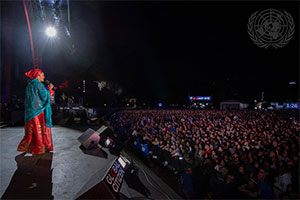 Global Citizen Festival in New York. Credit: UN Photo/Eskinder Debebe
Active citizens are committed to social change because they know that it is achievable. However, major political challenges face active citizens across the world. For example, in authoritarian regimes in Latin America where the hegemonic party has been in power for decades on end, protestors and human rights activists face enormous repression and struggle to materialize their advocacy into concrete results. The same can be said for Africans, where a shift towards elected government in recent decades has yet to translate into an effective voice in decision-making. Now, the Strengthening Citizen Demand for Good Governance, which uses evidence-based approaches – funded by DFID's Governance and Transparency Fund – seeks to raise their voices.
In 2025, the CIVICUS Monitor’s People Power Under Attack report revealed that civic freedoms are severely limited in 122 of 198 countries and territories, and only 7.2% of the global population now lives in countries where civic space is open. Through partnership with the Overseas Development Institute (ODI) and CIVICUS, IPS reporters across the continent will seek to define the extent and limits of state capability, government accountability and the responsiveness of leaders to the needs of citizens.

The Week with IPS

NEXT STOP - SDGs
Tracking global progress towards a sustainable world
Tracking global progress towards a sustainable world
