Languages
Tuesday, October 27, 2026



News and Views from the Global South
Active Citizens

OPINION: Climate Justice Is the Only Way to Solve Our Climate Crisis
In November, the world's top climate scientists issued their latest warning that the climate crisis is rapidly worsening on a number of fronts, and that we must stop our climate-polluting way of producing energy if we are to stand a chance of avoiding the worst impacts of climate change.
Only a Few Drops of Water at the Lima Climate Summit
Although it is one of the victims of global warming, water will not be given a place of importance at the COP20 climate change conference to be held Dec. 1-12 in Lima, Peru.
Citizens of the World, Unite!
As politics, economies, conflicts and cultures become increasingly intertwined, will individual identities also begin to transcend national boundaries?
Led by INTERPOL, U.N. Tracks Environmental Criminals
A coalition of international organisations, led by INTERPOL and backed by the United Nations, is pursuing a growing new brand of criminals - primarily accused of serious environmental crimes - who have mostly escaped the long arm of the law.
Elections Offer Little Solace to Sri Lanka’s Poor
Priyantha Wakvitta is used to seeing his adopted city, Colombo, transform into a landscape of bright sparkling lights and window dressing towards the end of the year.
Indigenous Community Beats Drought and Malnutrition in Honduras
In the heart of the Pijol mountains in the northern Honduran province of Yoro, the Tolupan indigenous community of Pueblo Nuevo has a lot to celebrate: famine is no longer a problem for them, and their youngest children were rescued from the grip of child malnutrition.
Democratising the Fight against Malnutrition
There is a new dimension to the issue of malnutrition – governments, civil society and the private sector have started to come together around a common nutrition agenda.
Rich Countries Pony Up (Some) for Climate Justice
It’s one of the oldest tricks in politics: Talk down expectations to the point that you can meet them.
Filipino Farmers Protest Government Research on Genetically Modified Rice
Jon Sarmiento, a farmer in the Cavite province in southern Manila, plants a variety of fruits and vegetables, but his main crop, rice, is under threat. He claims that approval by the Philippine government of the genetically modified ‘golden rice’ that is fortified with beta-carotene, which the body converts into vitamin A, could ruin his livelihood.
Laying the Foundations of a World Citizens Movement
Has organised civil society, bound up in internal bureaucracy, in slow, tired processes and donor accountability, become simply another layer of a global system that perpetuates injustice and inequality?
Survivors of Sexual Violence Face Increased Risks
“A recurring nightmare for me is I’m trying to tell someone something and they are not listening. I’m yelling at the top of my lungs and it feels like there is a glass wall between us.”
Central American Civil Society Calls for Protection of Local Agriculture at COP20
Worried about the effects of global warming on agriculture, water and food security in their communities, social organisations in Central America are demanding that their governments put a priority on these issues in the COP20 climate summit.
Civil Society Freedoms Merit Role in Post-2015 Development Agenda
Nabeel Rajab, president of the Bahrain Centre for Human Rights, an advocacy NGO, is facing criminal charges for sending a tweet that said: “many Bahrain men who joined terrorism and ISIS have come from the security institutions and those institutions were the first ideological incubator”.
Jewellery Industry Takes Steps to Eliminate “Conflict Gold”
Major U.S. jewellery companies and retailers have started to take substantive steps to eliminate the presence of “conflict gold” from their supply chains, according to the results of a year-long investigation published Monday.
OPINION: A Plea for Banning Nuke Tests and Nuclear Weapons
December 1938 was a decisive month in human history: In Germany, the scientists Otto Hahn and Fritz Strassmann discovered that when bombarded with neutrons, the atomic nucleus of uranium would split.Azerbaijan’s Rights Activists on the Brink
When Azerbaijan served as chair of the Council of Europe’s Committee of Ministers, it scoffed at the spirit and purpose of the organisation and moved vigorously to squash all forms of free speech at home.
OPINION: Humanitarian Impact of Nukes Calls For Concerted Action
As we approach the 70th anniversary next year of the atomic bombings of Hiroshima and Nagasaki, there are growing calls to place the humanitarian consequences of their use at the heart of deliberations about nuclear weapons.
Will Myanmar’s ‘Triple Transition’ Help Eradicate Crushing Poverty?
Myanmar is never out of the news for long. This has been the case since a popular uprising challenged military rule in 1988. For over two decades, the country was featured in mainstream media primarily as one unable to cope with its own internal contradictions, a nation crippled by violence.
To Fight Inequality, Latin America Needs Transparency…and More
As public policy, political transparency and open data need an active ingredient to bring about social change that would reduce inequality in Latin America: citizen participation, said regional experts consulted by IPS.Proposal for International Anti-Corruption Court Seeing “Significant” Momentum
The key U.S. advocate of a proposal to create a multilateral body mandated to investigate allegations of political corruption says the idea is receiving significant interest from civil society, politicians and major business leaders.
Mexico’s Undead Rise Up
“Alive they were taken, and alive we want them back!”« Previous Page — Next Page »





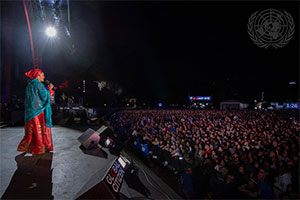 Global Citizen Festival in New York. Credit: UN Photo/Eskinder Debebe
Active citizens are committed to social change because they know that it is achievable. However, major political challenges face active citizens across the world. For example, in authoritarian regimes in Latin America where the hegemonic party has been in power for decades on end, protestors and human rights activists face enormous repression and struggle to materialize their advocacy into concrete results. The same can be said for Africans, where a shift towards elected government in recent decades has yet to translate into an effective voice in decision-making. Now, the Strengthening Citizen Demand for Good Governance, which uses evidence-based approaches – funded by DFID's Governance and Transparency Fund – seeks to raise their voices.
In 2025, the CIVICUS Monitor’s People Power Under Attack report revealed that civic freedoms are severely limited in 122 of 198 countries and territories, and only 7.2% of the global population now lives in countries where civic space is open. Through partnership with the Overseas Development Institute (ODI) and CIVICUS, IPS reporters across the continent will seek to define the extent and limits of state capability, government accountability and the responsiveness of leaders to the needs of citizens.

The Week with IPS

NEXT STOP - SDGs
Tracking global progress towards a sustainable world
Tracking global progress towards a sustainable world
