Languages
Thursday, October 8, 2026



News and Views from the Global South
Aid
U.S. Dangerously Short-Sighted on Yemen, Experts Warn
As President Barack Obama's administration becomes further enmeshed in what many are calling an undeclared war in Yemen, observers here are urging the government to broaden its policy approach to the country beyond counterterrorism.
Green, Cyclone-Resistant Schools for Madagascar
This year, the cyclone season's heavy rains did not mean the usual days off school for children in Marolondo, a village in the Fénérive-Est district, 450 kilometres northeast of Antananarivo, the capital of Madagascar.Biofuels and Hunger, Two Sides of the Same Coin
Despite growing evidence that biofuel production is causing food insecurity around the world, the new European Union policy blueprint on renewable energy ignores the social effects of biofuels. Last week, Guatemalan victims of the food crisis came to Brussels to make European policy makers aware of the problem.
Bringing People “Back to Life” in Uganda’s Slums
As soon as Sanyu Nagia sits down outside Barbara Namirimu’s home, she asks to see her patient’s bag of medicine. It is too heavy for the ill Namirimu to carry, so her mother, Efrance Namakula, brings it out and hands it over.
Bangladesh on the Green Brick Road
Bangladesh, a country highly vulnerable to climate change, is doing its bit to reduce greenhouse gas (GhG) emissions and glacier-melting soot by switching to ‘smokeless’ brick-making technology.
Mauritian Farmers Hooked on Fair Trade
In finding a way to survive a 36 percent cut in sugar prices, Mauritian farmers are not only exporting a variety of fruit and vegetables to the European Union, but they have also begun farming in a more environmentally sustainable way.
In One Haitian Camp, Life Offers Hardship and Little Hope
In the remote, dusty and barren area of northern Port-au-Prince, Cannon Camp houses nearly 6,000 displaced Haitians in tiny and cramped spaces. Nestled among the smattering of tents is the home of a 50-something-year-old mother of 12.
Earth Summits Fail Biodiversity in India
Heads of state and governments are meeting in Rio de Janeiro this week to decide how to renew their pledges made during the first Earth Summit held in Rio in 1992.
Food Crisis Empties Niger Schools
Since December 2011, the food crisis in Niger has displaced large numbers of people from areas of scarcity to parts of the country that enjoyed better harvests. The social impacts for these internal migrants are serious, not least in terms of disruption of education.
Refugees in South Sudan Facing “Full-blown Humanitarian Crisis”
Within the next nine days, drinking water at refugee camps in South Sudan's Upper Nile state will run dry, warned the aid agency Doctors Without Borders on Tuesday. Meanwhile, refugees continue to stream into the state, as the few camps set up to house to entrants are stretched even further beyond capacity.
Rio Outcome Bleak With No New Funding*
Amidst recrimination, anger and charges of “strong arm tactics”, negotiators eventually endorsed a global plan of action for sustainable development following marathon sessions lasting over six weary days.
RIO+20: The Two Faces of BRICS Development Aid
The BRICS countries (Brazil, Russia, India, China and South Africa) face a key choice: to opt for "good" development aid, based on sustainable development, or for the "bad" old traditional model, which they criticised when they were its recipients.
Europe and Former Colonies Urge Action at Rio+20
Europe and 79 of its former colonies have sent a strong message to the U.N. Conference on Sustainable Development in Brazil next week that it should use the opportunity to both fulfill past promises and deal with "new and emerging challenges".G20 to See Showdown on IMF Reforms
The head of the International Monetary Fund (IMF), Christine Lagarde, on Wednesday urged countries to act on a suite of reform measures that would significantly increase the voices of developing countries within the agency.
Activists Aren’t Mourning Obama’s Absence at Rio Summit
When a reluctant George H.W. Bush, Sr., then U.S. president, changed his mind and decided at the eleventh hour to address the 1992 Earth Summit in Rio, he sounded defensive in his strong response to charges that the United States was one of the major powers responsible for the some of the world's worst environmental ills - from greenhouse gases to conspicuous consumption.
Former Girl Soldiers Trade One Nightmare for Another
"When I was still at school I was abducted by the Lord's Resistance Army, along with 139 other girls," says Grace Akallo. "I spent seven months in captivity, but I survived, I escaped and I went back home."
OP-ED: Repealing Malawi’s LGBT Laws: An Example for Africa?
At a news conference shortly after she was sworn in as Malawi’s president, Joyce Banda announced her government’s intention to decriminalise homosexuality. It is unclear how she will achieve this, but the move is in stark contrast to the approach of her predecessor, Bingu wa Mutharika, who openly condemned it.
Sudanese Refugees Dying of Thirst
Sudanese refugees have started dying as a camp in South Sudan ran out of water four days ago after a massive influx of people fled across the border to escape war and hunger.
Q&A: Volunteer Spirit Alive in Rio
When the Rio+20 summit gets underway in Brazil next week, the estimated 50,000 to 60,000 participants will not only include world leaders, government delegates and U.N. staffers but also a staggering array of activists from the far corners of the world.
Malawi Businesses Lose Out after AU Summit Cancelled
Small and large businesses in Malawi are counting their losses following the cabinet’s decision not to host the African Union summit in July.
Trade Pact with Europe Still a Tough Sell to Africa, Pacific Bloc
Caught between a proverbial rock and a hard place, African and Pacific countries are still unsure whether they should follow the lead of their Caribbean counterparts and sign a wide-ranging Economic Partnership Agreement (EPA) with Europe.« Previous Page — Next Page »





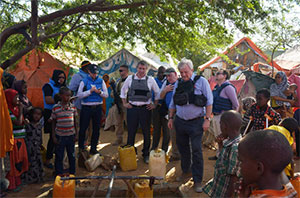 UN Emergency Relief Coordinator Visits Somalia. Credit: UN Photo/Tobin Jones
In recent years, conflicts have broken out across the world with no sign of slowing down or stopping. In times like this, millions of people globally are in dire need of humanitarian aid. Famine, warfare, natural disasters, and economic decline plague a host of nations, including Palestine, Sudan, Chad, Lebanon, and Haiti, to name a few. Humanitarian aid provides millions of people with critical services including healthcare, food, clean drinking water, psychosocial support, housing, and access to education. UN agencies such as the UNDP, UNICEF, the World Food Programme (WFP), UNHCR, UNRWA, and UNEP work with the UN Office for the Coordination of Humanitarian Aid (OCHA) and local organizations to come up with the best possible strategies to support affected communities. At the same time, humanitarian aid and those working on the frontlines are consistently threatened by both actors directly involved in conflict as well as those who are meant to contribute to the international humanitarian regime at large. The near-collapse of United States international aid structures in 2025, including the termination of 83% of USAID’s 6,300 global initiatives, has left millions of people without access to vital humanitarian assistance. 98 million people in 2025, only 65% of people targeted for humanitarian assistance, received the help they needed. In contrast, 123 million people received some form of humanitarian assistance in 2024, and OCHA’s 2026 Global Humanitarian Overview estimates that 239 million people are in need of assistance in 2026. IPS is well-positioned to discuss current initiatives to provide aid and relief through in-depth reporting and opinion content.

The Week with IPS

NEXT STOP - SDGs
Tracking global progress towards a sustainable world
Tracking global progress towards a sustainable world
