Languages
Thursday, October 8, 2026



News and Views from the Global South
Aid
Defining Green Economy May Stymie Rio Summit
The thematic battle at the U.N. Conference on Sustainable Development (UNCSD) in Brazil next week will be primarily around the new concept of a "green economy" - and how best to define it.
Rio+20: Transforming Political Platitudes into Economic Realities
When world leaders endorse the final plan of action, titled "The Future We Want, at the Rio+20 summit in Brazil next week, a lingering question may remain unanswered: how best can the United Nations transform political platitudes into economic realities?
Q&A: “Today’s Food System Is Failing Small Farmers”
With heads of state from more than 120 nations and tens of thousands of civil society and international development experts gathering for the U.N. Summit on Sustainable Development next week, it is accepted wisdom that rethinking agriculture is one of most critical issues facing this and future generations.
Will Water Dry Up at Summit on Sustainable Development?
The headline in a New York newspaper last March captured the essence of a future potential threat to political stability the world over: "U.S. Report Sees Tensions Over Water."World Bank Lauded for Publishing Sanctions Decisions
This week, for the first time, the World Bank began publishing decisions by the institution's sanctions board on cases involving fraud or corruption.
Rio+20 – a Call to Responsibility, a Call to Action
We are all going through a period of great confusion and uncertainty.Billions of Development Dollars in Private Hands
With governments and international institutions focusing increasingly on a stronger role for the private sector in development aid, a new report by the European Network on Debt and Development (Eurodad) released yesterday suggests there is good reason to doubt this approach.
After War, Economic Crisis Hits South Sudan
The United Nations has warned that despite the austerity measures put in place by South Sudan to deal with its economic woes, humanitarian agencies will have to increase relief efforts in order to keep the country’s poor alive as the financial situation worsens.

Q&A: The World Must Learn From Smallholder Farmers
As Africa's Sahel region faces a new food crisis, smallholder famers hold the key to making future development policies sustainable.
Climate Change and Family Planning – Twin Issues for LDCs
The reproductive rights agenda, from improving women’s access to education to systematic family planning to reducing birth rates and combating poverty, has become a cornerstone of most industrialised nations’ development policies toward the least developed countries (LDCs), comprised primarily of sub-Saharan African states.
MALI: Food Aid Taking Too Long to Reach Needy
Her neat, bright yellow headscarf matches the rest of her outfit, but contrasts with her weary expression. Sokona Soumounou sits a little apart from the crowd queueing for assistance from the World Food Programme in the southern Mali town of Ségou.
HAITI: Partners in Deforestation and “Slumification”
More than 100 Haitian families now have new housing, thanks to the support of two non-governmental organisations working on reconstruction following the country's devastating 2010 earthquake.
EU Summit Ends with Warning for Greece
A European Union summit has ended with a warning to Greece that it will have to stick to its bailout terms if it wants to stay in the eurozone, but failed to resolve Franco-German differences over the issue of eurobonds.
G8 Report Offers Worrying Look at Aid Accountability
Observers here on Tuesday lauded the newly released Group of Eight (G8) Camp David Accountability Report as a noteworthy step towards transparency and accountability, but warned that the data included suggest a looming shortfall in international agriculture-related foreign aid.
“Africa – a Place Where You Will Make Money, Not Lose Money”
Africa needs to reduce its dependency on foreign aid and get to the point of financing its own development, some of the continent’s key development experts say. Timing is optimal now that Africa is experiencing an economic boom with annual growth rates of up to eight percent.Caribbean Courts Mexico as Ally in the G20
The Caribbean Community bloc (Caricom) is lobbying Mexico to use its influence as chair of the G20, which controls 90 percent of world trade, to promote the interests of the Caribbean and other small island developing states when it meets in June.
G8 Turns to Private Sector for Food Crisis Solutions
On the eve of the Group of Eight (G8) summit near Washington, President Barack Obama on Friday unveiled a major new initiative aimed at shoring up food security and combating global hunger.
Funding Dries Up Even as Rains Worsen Cholera Deaths
As predicted, the beginning of the rainy season in Haiti brought exponential increases in the numbers of people sickened and killed by cholera.
Q&A: How Sex Education Programs Can Shape a Better Future
In Latin American countries and in the Caribbean, where income disparities are among the greatest in the world, too many people often lack access to comprehensive health services and information needed to live healthy lives.
World Bank Accused of Ignoring Lessons on Mega Infrastructure
In a renewed funding focus on large-scale infrastructure, the World Bank, Group of 20 (G20) countries and other multilateral groups are wilfully overlooking lessons learned decades ago, a new report by International Rivers warns.EU Feels Force of Israeli Demolitions
All 27 foreign ministers of the European Union have strongly spoken out against Israeli demolitions in Area C of the West Bank. Since the beginning of 2011 not less than 60 EU-funded projects have been demolished while 110 others are currently at risk. Several analysts claim the Israeli authorities are specifically targeting EU-funded projects.« Previous Page — Next Page »





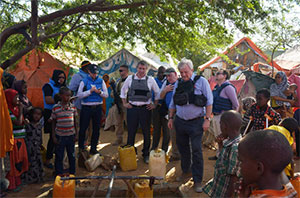 UN Emergency Relief Coordinator Visits Somalia. Credit: UN Photo/Tobin Jones
In recent years, conflicts have broken out across the world with no sign of slowing down or stopping. In times like this, millions of people globally are in dire need of humanitarian aid. Famine, warfare, natural disasters, and economic decline plague a host of nations, including Palestine, Sudan, Chad, Lebanon, and Haiti, to name a few. Humanitarian aid provides millions of people with critical services including healthcare, food, clean drinking water, psychosocial support, housing, and access to education. UN agencies such as the UNDP, UNICEF, the World Food Programme (WFP), UNHCR, UNRWA, and UNEP work with the UN Office for the Coordination of Humanitarian Aid (OCHA) and local organizations to come up with the best possible strategies to support affected communities. At the same time, humanitarian aid and those working on the frontlines are consistently threatened by both actors directly involved in conflict as well as those who are meant to contribute to the international humanitarian regime at large. The near-collapse of United States international aid structures in 2025, including the termination of 83% of USAID’s 6,300 global initiatives, has left millions of people without access to vital humanitarian assistance. 98 million people in 2025, only 65% of people targeted for humanitarian assistance, received the help they needed. In contrast, 123 million people received some form of humanitarian assistance in 2024, and OCHA’s 2026 Global Humanitarian Overview estimates that 239 million people are in need of assistance in 2026. IPS is well-positioned to discuss current initiatives to provide aid and relief through in-depth reporting and opinion content.

The Week with IPS

NEXT STOP - SDGs
Tracking global progress towards a sustainable world
Tracking global progress towards a sustainable world
