Languages
Tuesday, October 6, 2026



News and Views from the Global South
Aid

To Aid Afghanistan, Offer Less Aid
It is customary to focus on the amount of money the international community offers Afghanistan: the higher the sum and the longer the commitment, the lower the risk of further destabilisation. And so the 16 billion dollars pledged by the donors for the next four years at the Tokyo conference earlier this month has been widely welcomed. But such aid may not be quite the virtue it seems.
U.S. Commits 10 Million for Mali Refugees as Intervention Talk Builds
President Barack Obama on Thursday authorised the release of 10 million dollars in emergency funding to help with the refugee crisis stemming from continued violence in northern Mali, in response to warnings that international aid efforts were in danger of drying up in coming months.
U.N. Showcases South-South Successes
Knowledge-sharing has become a cornerstone of successful cooperation among developing countries, in areas ranging from agriculture to health and renewable energies.Mauritania’s Emergency Food Programme Under Fire
The sun is beating down on Nouakchott, the Mauritanian capital, and Habi Amadou Tidjane Diop is a tired and frustrated woman. Seated on an empty upturned bucket, the mother of nine is waiting in a long queue to buy food.U.S. Urged to Increase Bomb-Clearing Aid for Laos
Disarmament activists and former U.S. ambassadors are urging Secretary of State Hillary Clinton to increase U.S. aid to Laos to clear millions of tonnes of unexploded ordinance (UXO) left by U.S. bombers on its territory during the Indochina War during her brief visit to the country Wednesday.
New Afghanistan Aid Policy Turns Away from U.S. Model
For the first time, international donors gathered in Tokyo over the weekend explicitly tied ongoing financial aid for Afghanistan to progress made in the country’s economy and governance.Amid Stormy Waters, Caribbean Tacks South
The Eurozone crisis and growing influence of countries like China and Brazil are leading the Caribbean to reassess its dependence on traditional trade and aid partners.
South Sudan Celebrates a Troubled First Birthday
The streets have been swept clean and lined with flags to mark the first anniversary of South Sudan’s independence. But cosmetic changes in the capital, Juba, mask deep concerns about the future of the world’s newest nation.
South Sudan’s Women Await Independence From Poverty
One year after the formation of South Sudan, the country’s women say that independence has not resulted in the positive political, economic and social changes that they had hoped for.
To Aid Afghans, Not Just Afghanistan
Afghanistan’s international donors will gather on Sunday in Tokyo for a conference at which they are expected to pledge economic aid, and ensure their assistance level will be maintained after withdrawal of ISAF-NATO troops, in 2014. But Afghan people and civil society groups working in the country say much of the aid is being directed the wrong way.
Anxiety as Donors Chart Aid for Afghanistan Beyond 2014
A key United Nations official on Friday urged the international community to match security funding for Afghanistan with economic and development funding after 2014, when most international – particularly U.S. – forces will leave the country.New U.S.-Pakistani Supply Accord Seen as Tenuous
As NATO supply convoys began crossing from Pakistan into Afghanistan for the first time in more than seven months Thursday, analysts here warned that the reopening of the key route does not necessarily signal a new dawn in the fraught relations between Washington and Islamabad.U.N. Calls for Tax on Ultrarich to Boost Development
What if billionaires the world over are asked to shell out at least one percent of their wealth as an international tax for development?Caribbean Weighs Allegiance to Taiwan vs. China
As Caribbean leaders meet in St. Lucia this week, they are focusing on a series of routine issues affecting the region, including problems with the smooth operation of the single trading market.
Overpopulation on Uganda’s Mount Elgon Kills Hundreds
The Ugandan government says it will forcibly remove people settling on the steep slopes of Mount Elgon in eastern Uganda’s Bududa District, as the growing population has resulted in increased landslides in recent years.New World Bank Chief Backs Defunding Bangladesh Bridge Project
On Monday, his first day in office, new World Bank President Jim Yong Kim said he sees the institution's recent decision to pull out of a massive bridge project in Bangladesh as "appropriate".
Kim Assumes World Bank Presidency Amidst Uncertainty
Incoming World Bank President Jim Yong Kim reported to work on Monday for the first time, telling those gathered at the bank's headquarters here in Washington that he was "humbled and inspired to take over today as president".
Community Volunteers Convince Ugandan Families to Have Fewer Children
It is midmorning at the Kanungu Health Centre IV and the queue of patients grows as more people start to arrive for treatment at this rural facility more than 400 kilometres outside the Ugandan capital of Kampala.Drugs and Violence Underscore U.S. Influence in Honduras
A rise in drug trafficking in Honduras has resulted in a sharp increase in violence, leading some to question the United States' influence in the country.
U.S. Aid Policies in Pakistan Resulting in Anti-U.S. Sentiment
Despite President Barack Obama's stated policy of using foreign aid to improve public perception of the United States in Pakistan, two major new reports suggest that U.S. policies are exacerbating an already soured relationship.U.S. Dangerously Short-Sighted on Yemen, Experts Warn
As President Barack Obama's administration becomes further enmeshed in what many are calling an undeclared war in Yemen, observers here are urging the government to broaden its policy approach to the country beyond counterterrorism.« Previous Page — Next Page »





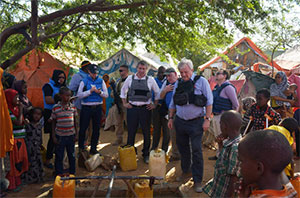 UN Emergency Relief Coordinator Visits Somalia. Credit: UN Photo/Tobin Jones
In recent years, conflicts have broken out across the world with no sign of slowing down or stopping. In times like this, millions of people globally are in dire need of humanitarian aid. Famine, warfare, natural disasters, and economic decline plague a host of nations, including Palestine, Sudan, Chad, Lebanon, and Haiti, to name a few. Humanitarian aid provides millions of people with critical services including healthcare, food, clean drinking water, psychosocial support, housing, and access to education. UN agencies such as the UNDP, UNICEF, the World Food Programme (WFP), UNHCR, UNRWA, and UNEP work with the UN Office for the Coordination of Humanitarian Aid (OCHA) and local organizations to come up with the best possible strategies to support affected communities. At the same time, humanitarian aid and those working on the frontlines are consistently threatened by both actors directly involved in conflict as well as those who are meant to contribute to the international humanitarian regime at large. The near-collapse of United States international aid structures in 2025, including the termination of 83% of USAID’s 6,300 global initiatives, has left millions of people without access to vital humanitarian assistance. 98 million people in 2025, only 65% of people targeted for humanitarian assistance, received the help they needed. In contrast, 123 million people received some form of humanitarian assistance in 2024, and OCHA’s 2026 Global Humanitarian Overview estimates that 239 million people are in need of assistance in 2026. IPS is well-positioned to discuss current initiatives to provide aid and relief through in-depth reporting and opinion content.

The Week with IPS

NEXT STOP - SDGs
Tracking global progress towards a sustainable world
Tracking global progress towards a sustainable world
