Languages
Sunday, October 4, 2026



News and Views from the Global South
Aid

Operating in Rural Tanzania “To Save a Life”
At the Kakonko Health Centre, about 250 kilometres from the nearest hospital in Kigoma Region, Western Tanzania, assistant medical officer Abdu Mapinduzi prepares to operate on Joanitha, a young pregnant mother.South Korea Showcases Role as Donor at Expo 2012
When South Korea took the initiative to integrate a development cooperation programme into this year’s World Expo, it stepped up its efforts to gain credibility as a donor on the international stage.
Human Right to Water and Sanitation Remains a Political Mirage
When the 193-member General Assembly, the U.N.'s highest policy-making body, declared water and sanitation a basic human right back in July 2010, the adoption of that divisive resolution was hailed by many as a "historic" achievement.Caribbean Sees Progress on HIV/AIDS, Fears Funding Cuts
Ian McKnight, executive director of the Caribbean Vulnerable Communities Coalition (CVCC), used one word - “tokenistic” - to sum up his perspective on the 19th International AIDS Conference that ended here over the weekend.
Private Sector Debt Gnawing at Developing Countries
Twelve years after a global campaign successfully advocated the cancellation of some of the world’s poorest countries’ public debt, developing economies are again facing unsustainable debt burdens. Only this time, it is the private sector’s debt in developing economies that is inflating dangerously.AIDS Meet Ends with Talk of Cure, But Realities of Scourge Persist
As the International AIDS Conference ended in Washington on Friday, organisers unveiled groundbreaking new research on the promise of early anti-retroviral (ARV) drug therapy.
Govts Boost Nukes While Cutting Aid, Social Services
As U.N.-led talks on disarmament resume in Geneva Monday, calls are growing for nuclear-armed nations to cut spending on their stockpiles and instead divert resources to development.
Africa Must Earn Its Climate Change Adaptation Finance
With the United Nations Climate Change Conference less than four months away, African countries need to present convincing arguments and successful adaptation projects to attract competitive funding for adjusting to changes in global weather patterns, climate finance experts say.Banksters Hijack Microfinance
For several decades, microcredit presented itself as a magical and benign financial tool for the poorest people in the world, who were otherwise completely excluded from conventional commercial banking services, to secure easy access to loans in order to set up their own businesses and live a dignified life.
Papua New Guinea Casts Wide Net Against Malaria
In Papua New Guinea, a Pacific Island nation located south of the equator, 90 percent of the population is at risk of malaria and 1.9 million cases are reported every year. But, according to a recent medical study, a programme to distribute long-lasting insecticide treated mosquito nets to every district in the country has dramatically reduced malaria infections.
Record Aid Shortfall Abandons Millions to Their Fate
Global funding for humanitarian aid interventions saw the biggest shortfalls in 10 years in 2011, according to a new report, raising questions about the international community’s ability to meet a 20-percent greater need for 2012 driven by drought and conflict.Mexican Official: CIA ‘Manages’ Drug Trade
The U.S. Central Intelligence Agency and other international security forces "don't fight drug traffickers", a spokesman for the Chihuahua state government in northern Mexico has told Al Jazeera, instead "they try to manage the drug trade".
U.S. Aims for AIDS-Free Generation Amid Funding Cuts
As more than 20,000 health workers, scholars and activists from around the world gather here this week for a major biannual AIDS conference, observers are warning that U.S. government proposals to cut HIV/AIDS-related funding could undermine the significant potential to deal a decisive blow to the disease in the near future.
U.N. Urged to Take Lead in Aiding Cholera-Stricken Haiti
U.S. legislators are appealing to the United Nations to take a greater role in addressing Haiti's cholera outbreak, now in its third year and which has has left thousands dead.
“Famine May Have Ended, But For Us Hunger Has Not”
One-year-old Miriam Jama is a symbol of life in Somalia after the famine. Born just as the United Nations World Food Programme declared famine in this Horn of Africa nation a year ago on Jul. 20, Miriam has known no other life than the one in the Badbaado refugee camp, situated 10 kilometres outside the country’s capital, Mogadishu.
Officials Decry “Appalling Gaps” in Global Data on Women
The World Bank and U.S. government on Thursday each announced major new initiatives aimed at expanding knowledge on the experience of women around the world, while acknowledging that much remains to be done on filling the global “data gap” on women.
Look to Developing World for Solutions, Says New World Bank Chief
Speaking on Wednesday at his first major public address, new World Bank President Jim Yong Kim said the institution needs to be more flexible and responsive, as well as more open to innovations coming from the developing world.
Family Planning Essential for Development
Improving family planning to avoid unwanted pregnancies in developing countries, as well as assuring girls’ access to education, and women’s participation in the economy, are essential components of a sound development policy, according to Western experts and African activists.
U.N. Warns of Impending Humanitarian Crisis in Somalia
The United Nations has called for sustained aid efforts in Somalia to prevent the war-torn country from experiencing another humanitarian crisis as more than three million people remain in need of urgent aid.Rights Groups, U.S. Denounce Sentences of Ethiopian Journalists
Human rights groups, press watchdogs, and even the U.S. government have strongly denounced recent prison sentences meted out against journalists and opposition activists accused of violating Ethiopia's anti-terrorism laws.
Teaching Madagascar’s Mothers to Combat Malnutrition
Every Friday, mothers and their children gather at the community nutrition centre in the little village of Rantolava, 450 kilometres north east of Antananarivo, the Malagasy capital, to learn more about a healthy diet.« Previous Page — Next Page »


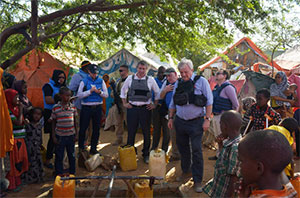 UN Emergency Relief Coordinator Visits Somalia. Credit: UN Photo/Tobin Jones
In recent years, conflicts have broken out across the world with no sign of slowing down or stopping. In times like this, millions of people globally are in dire need of humanitarian aid. Famine, warfare, natural disasters, and economic decline plague a host of nations, including Palestine, Sudan, Chad, Lebanon, and Haiti, to name a few. Humanitarian aid provides millions of people with critical services including healthcare, food, clean drinking water, psychosocial support, housing, and access to education. UN agencies such as the UNDP, UNICEF, the World Food Programme (WFP), UNHCR, UNRWA, and UNEP work with the UN Office for the Coordination of Humanitarian Aid (OCHA) and local organizations to come up with the best possible strategies to support affected communities. At the same time, humanitarian aid and those working on the frontlines are consistently threatened by both actors directly involved in conflict as well as those who are meant to contribute to the international humanitarian regime at large. The near-collapse of United States international aid structures in 2025, including the termination of 83% of USAID’s 6,300 global initiatives, has left millions of people without access to vital humanitarian assistance. 98 million people in 2025, only 65% of people targeted for humanitarian assistance, received the help they needed. In contrast, 123 million people received some form of humanitarian assistance in 2024, and OCHA’s 2026 Global Humanitarian Overview estimates that 239 million people are in need of assistance in 2026. IPS is well-positioned to discuss current initiatives to provide aid and relief through in-depth reporting and opinion content.

The Week with IPS

NEXT STOP - SDGs
Tracking global progress towards a sustainable world
Tracking global progress towards a sustainable world
