Languages
Tuesday, October 6, 2026



News and Views from the Global South
Aid

Child Labour: A Hidden Atrocity of the Syrian Crisis
In a conflict that has claimed over 220,000 lives and injured a further 840,000 people as of January 2015, it is sometimes hard to see beyond the death toll.
Funding For Desperate Palestinian Refugees Under Threat
The U.N. Relief and Works Agency (UNRWA) faces a severe financial crisis which could see core services to desperate Palestinian refugees in Syria, Lebanon, Gaza and the West Bank halted unless donors step in before the end of September.
Syrian Refugees Face Hunger Amidst Humanitarian Funding Crisis
The United Nations’ food aid organisation, the World Food Programme (WFP), said on Jul. 1 that up to 440,000 refugees from war-torn Syria might have to go hungry if no additional funds are received by August.
Union Islanders Wonder if Their Home Will Be the Next Atlantis
Fifteen years ago, Stephanie Browne, a former Member of Parliament in St. Vincent and the Grenadines, needed only to look at the beach outside her house to know why her community in Union Island was called “Big Sand”.
Poor Bear the Brunt of Corruption in India’s Food Distribution System
Chottey Lal, 43, a daily wage labourer at a construction site in NOIDA, a township in the northern Indian state of Uttar Pradesh, is a beleaguered man. After a gruelling 12-hour daily shift at the dusty location, he and his wife Subha make barely enough to feed a family of seven.
Toilets with Piped Music for Rich, Open Defecation on Rail Tracks for Poor
As most developing nations fall short of meeting their goals on sanitation, the world’s poorest countries have been lagging far behind, according to a new U.N. report released here.
U.S. Urged to Ramp up Aid for Agent Orange Clean-Up Efforts in Vietnam
A key senator and a D.C.-based think tank are calling for Washington to step up its aid in cleaning up toxic herbicides sprayed by the United States in Vietnam during the war that ended 40 years ago.
Opinion: The ACP at 40 – Repositioning as a Global Player
In his memoirs, Glimpses of a Global Life, Sir Shridath Ramphal, then-Foreign Minister of the Republic of Guyana, who played a leading role in the evolution of the Lomé negotiations that lead to the birth of the African, Caribbean and Pacific (ACP) Group of States, pointed to the significant lessons of that engagement of developed and developing countries some 40 years ago and had this to say:
Donors Pledge Over 4.4 Billion Dollars to Nepal – But With a Caveat
Blessed with more than 4.4 billion dollars in pledges at an international donor conference in Kathmandu on Thursday, the government of Nepal is expected to launch a massive reconstruction project to rebuild the earthquake-devastated South Asian nation.
Ghosts Of War Give Way to Development in Sri Lanka
It is an oasis from the scorching heat outside. The three-storey, centrally air-conditioned Cargills Square, a major mall in Sri Lanka’s northern Jaffna town, is the latest hangout spot in the former warzone, where everyone from teenagers to families to off-duty military officers converge.Billions Pledged for Nepal Reconstruction – But Still No Debt Relief
A major donor conference in Nepal’s capital, Kathmandu, came to a close on Jun. 25 with foreign governments and aid agencies pledging three billion dollars in post-reconstruction funds to the struggling South Asian nation.
Journalists Pay the Price in Egypt’s Crackdown on Dissent
The Egyptian government is holding a record number of journalists in jail, a press freedom group said Thursday, despite promises to improve media freedoms in the country.
Ghosts Of War Give Way to Development in Sri Lanka
 It is an oasis from the scorching heat outside. The three-storey, centrally air-conditioned Cargills Square, a major mall in Sri Lanka’s northern Jaffna town, is the latest hangout spot in the former warzone, where everyone from teenagers to families to off-duty military officers converge.

Grenada Rebuilds Barrier Reefs
The Eastern Caribbean nation of Grenada is following the example of its bigger neighbours Belize and Jamaica in taking action to restore coral reefs, which serve as frontline barriers against storm waves.
Opinion: Sub-Saharan Africa, Addis and Paris
After the turn of the century, growth in sub-Saharan Africa (SSA) picked up again after a quarter century of near stagnation for most, mainly due to increased world demand for minerals and other natural resources.
Critics of World Bank-Funded Projects in the Line of Fire
For an entire month beginning in February 2015, a group of between 40 and 50 residents of the Durgapur Village in the northern Indian state of Uttarakhand would gather at the site of a hydroelectric power project being carried out by the state-owned Tehri Hydro Development Corporation (THDC).
Take Good News on Afghanistan’s Reconstruction With a ‘Grain of Salt’
Since 2002, a year after it invaded Afghanistan, the United States has poured over 100 billion dollars into developing and rebuilding this country of just over 30 million people. This sum is in addition to the trillions spent on U.S. military operations, to say nothing of the deaths of 2,000 service personnel in the space of a single decade.
Opinion: 2015 and Beyond, Young Voices, Loud Demands
As a young person interested in development, my heart beats a little faster when I look at the potential of 2015. There has never been so much at stake as this year for the future of our planet.
Farmers Find their Voice Through Radio in the Badlands of India
Eighty-year-old Chenabai Kushwaha sits on a charpoy under a neem tree in the village of Chitawar, located in the Tikamgarh district in the central Indian state of Madhya Pradesh, staring intently at a dictaphone.
Worldwide Displacement at the Highest Level Ever Recorded
A horrific year of war, humanitarian crises, human rights violations and persecution has caused a sharp rise in global forced displacement.
New Approaches to Managing Disaster Focus on Resilience
Natural disasters have become a fact of life for millions around the world, and the future forecast is only getting worse.« Previous Page — Next Page »





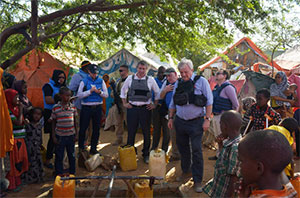 UN Emergency Relief Coordinator Visits Somalia. Credit: UN Photo/Tobin Jones
In recent years, conflicts have broken out across the world with no sign of slowing down or stopping. In times like this, millions of people globally are in dire need of humanitarian aid. Famine, warfare, natural disasters, and economic decline plague a host of nations, including Palestine, Sudan, Chad, Lebanon, and Haiti, to name a few. Humanitarian aid provides millions of people with critical services including healthcare, food, clean drinking water, psychosocial support, housing, and access to education. UN agencies such as the UNDP, UNICEF, the World Food Programme (WFP), UNHCR, UNRWA, and UNEP work with the UN Office for the Coordination of Humanitarian Aid (OCHA) and local organizations to come up with the best possible strategies to support affected communities. At the same time, humanitarian aid and those working on the frontlines are consistently threatened by both actors directly involved in conflict as well as those who are meant to contribute to the international humanitarian regime at large. The near-collapse of United States international aid structures in 2025, including the termination of 83% of USAID’s 6,300 global initiatives, has left millions of people without access to vital humanitarian assistance. 98 million people in 2025, only 65% of people targeted for humanitarian assistance, received the help they needed. In contrast, 123 million people received some form of humanitarian assistance in 2024, and OCHA’s 2026 Global Humanitarian Overview estimates that 239 million people are in need of assistance in 2026. IPS is well-positioned to discuss current initiatives to provide aid and relief through in-depth reporting and opinion content.

The Week with IPS

NEXT STOP - SDGs
Tracking global progress towards a sustainable world
Tracking global progress towards a sustainable world
