Languages
Wednesday, October 7, 2026



News and Views from the Global South
Aid

Opinion: No Place to Hide in Addis
My colleagues just got back from Munich, where we held a summit bringing together over 250 young volunteers from across Europe. These youngsters campaigned in the run-up to and at the doorstep of the G7 Summit in Schloss Elmau, as one of the key moments in a year brimming with opportunities to tackle extreme poverty.
Donor Conference to Tackle Nepal Reconstruction
The 7.8 magnitude earthquake that shook Nepal in April, and the numerous aftershocks that followed, left the country with losses amounting to a third of its economy.
From Residents to Rangers: Local Communities Take Lead on Mangrove Conservation in Sri Lanka
Weekends and public holidays are deadly for one of Sri Lanka’s most delicate ecosystems – that is when the island’s 8,815 hectares of mangroves come under threat.
Cities Will Be Decisive in Fight for Sustainable Development
With cities increasingly in the spotlight on the international stage, urban planning and development has become a critical issue in the Sustainable Development Goals (SDGs).
Opinion: What the Philippines Can Learn from Morocco, Peru and Ethiopia
(Last week, Australian Climate Activist offered an apology to the Philippines for his country’s lack of action. Today, he partners up with climate tracker from the Philippines Jed Alegado to talk about what the Philippines can do to show its leadership in tackling climate change.)
Climate Justice: Trial by Public Opinion for World’s Polluters
The United Nations, which is tasked with the protection of the global environment, has asserted that climate change affects people everywhere - with no exceptions.
From Residents to Rangers: Local Communities Take Lead on Mangrove Conservation in Sri Lanka
 Weekends and public holidays are deadly for one of Sri Lanka’s most delicate ecosystems – that is when the island’s 8,815 hectares of mangroves come under threat.

When a Kid With Low Self-Esteem Dreams of Becoming the President
You may have heard of Global Citizenship Education (GCED), but unless you move in international development circles, chances are you’re not entirely sure what the acronym means.
Adaptation Funding a Key Issue for Caribbean at Climate Talks
With less than six months to go before the next full United Nations Conference of the Parties also known as COP 21 – widely regarded as a make-or-break moment for an agreement on global action on climate change – Caribbean nations are still hammering out the best approach to the talks.
Q&A: Better Students, Better Citizens, Better World: Education Is the Key to Peace
In a world where high levels of social and religious intolerance, conflicts, violent extremism and environmental degradation are threatening justice and peace, the United Nations is trying to find ways to maintain world order and promote sustainable development.
U.N. Urged to Put Global Citizenship at Centre of Post-2015 Development Agenda
When Denmark hosted the World Summit on Social Development (WSSD) in March 1995, one of the conclusions of that international gathering in Copenhagen was to create a new social contract with “people at the centre of development.”
Peru a Shining Example for South America’s Climate Action Plans
This week, Peru became the first South American nation to publicly announce its Climate Action Plan, or INDC. In doing so, it may have set the scene for a new wave of highly transparent and ambitious INDC submissions from the continent.
Opinion: Journey Towards an African Taxation Renaissance
Africa is known as the ‘paradox of plenty’. How can a continent so rich in natural resources be so poor?
Small Victories at Bonn Climate Talks
As climate talks wind down in Bonn, Germany, observers of the negotiations say that despite some progress on a draft text, key issues remain unresolved and will carry over at least until the next round in August.
Opinion: Cli-Fi Film from Philippines Packs a Punch
I live on a crowded, subtropical island nation in the Western Pacific, on the opposite side of the "Pacific Pond" from North America. And just south of Taiwan is the many-splendored island nation of the Philippines. We are neighbours. You can fly there in one hour, it's that close.
A Regional Foodbasket Plans for the Worst
Despite its highly variable climate, Guyana is the only Caribbean Community (CARICOM) country that enjoys food security. But rapid climate change could pose a challenge not only for Guyana, but for its Caribbean neigbours who depend on the South American country for much of their produce.
Compensation Fund for Victims of Bangladesh Factory Collapse Reaches 30-Million-Dollar Target
Two years after a massive garments factory collapsed in a suburb of Bangladesh’s capital, Dhaka, killing over 1,100 people and leaving more than 2,500 injured, a major international fund has met its target of raising 30 million dollars to be paid out in compensation to the victims and their families.
U.N. Chief Backs New Int’l Decade for Water for Sustainable Development
As the United Nations continues its negotiations to both define and refine a new set of Sustainable Development Goals (SDGs) before a summit meeting of world leaders in September, Secretary-General Ban Ki-moon has expressed support for a new “International Decade for Water for Sustainable Development.”
Why ACP Countries Matter for the EU Post-2015 Development Agenda
We are witnessing a shift in the original rationale behind the unique relationship between the European Union and the African, Caribbean and Pacific countries of the ACP group, which goes beyond the logic of “unilateral aid transfer”, “donor-recipient approach” and “North-South dialogue”.
Opinion: Greece – A Sad Story of the European Establishment
Only 50 years of Cold War (and the fact that German Chancellor Angela Merkel grew up in East Germany) can possibly explain the strange political power of the United States over Europe.Opinion: Minsk Agreements, the Only Path to Peace in Ukraine
The “U.N. Report on the human rights situation in Ukraine”, which was referred to in an Inter Press Service (IPS) article of Jun. 2, does not, in my view, reflect many salient points.« Previous Page — Next Page »





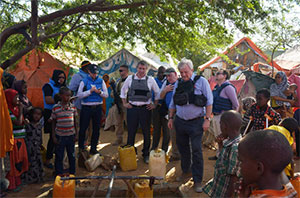 UN Emergency Relief Coordinator Visits Somalia. Credit: UN Photo/Tobin Jones
In recent years, conflicts have broken out across the world with no sign of slowing down or stopping. In times like this, millions of people globally are in dire need of humanitarian aid. Famine, warfare, natural disasters, and economic decline plague a host of nations, including Palestine, Sudan, Chad, Lebanon, and Haiti, to name a few. Humanitarian aid provides millions of people with critical services including healthcare, food, clean drinking water, psychosocial support, housing, and access to education. UN agencies such as the UNDP, UNICEF, the World Food Programme (WFP), UNHCR, UNRWA, and UNEP work with the UN Office for the Coordination of Humanitarian Aid (OCHA) and local organizations to come up with the best possible strategies to support affected communities. At the same time, humanitarian aid and those working on the frontlines are consistently threatened by both actors directly involved in conflict as well as those who are meant to contribute to the international humanitarian regime at large. The near-collapse of United States international aid structures in 2025, including the termination of 83% of USAID’s 6,300 global initiatives, has left millions of people without access to vital humanitarian assistance. 98 million people in 2025, only 65% of people targeted for humanitarian assistance, received the help they needed. In contrast, 123 million people received some form of humanitarian assistance in 2024, and OCHA’s 2026 Global Humanitarian Overview estimates that 239 million people are in need of assistance in 2026. IPS is well-positioned to discuss current initiatives to provide aid and relief through in-depth reporting and opinion content.

The Week with IPS

NEXT STOP - SDGs
Tracking global progress towards a sustainable world
Tracking global progress towards a sustainable world
