Languages
Monday, October 12, 2026



News and Views from the Global South
Aid

Why ACP Countries Matter for the EU Post-2015 Development Agenda
We are witnessing a shift in the original rationale behind the unique relationship between the European Union and the African, Caribbean and Pacific countries of the ACP group, which goes beyond the logic of “unilateral aid transfer”, “donor-recipient approach” and “North-South dialogue”.
Opinion: Greece – A Sad Story of the European Establishment
Only 50 years of Cold War (and the fact that German Chancellor Angela Merkel grew up in East Germany) can possibly explain the strange political power of the United States over Europe.Opinion: Minsk Agreements, the Only Path to Peace in Ukraine
The “U.N. Report on the human rights situation in Ukraine”, which was referred to in an Inter Press Service (IPS) article of Jun. 2, does not, in my view, reflect many salient points.
Fishing and Farming in Gaza is a Deadly Business
Three Palestinian fishermen were injured last week after Israeli naval forces opened fire on fishing boats off the coast of al-Sudaniyya in the northern Gaza Strip, bringing to 15 the number of farmers and fishermen shot and injured by Israeli security forces recently as they attempted to earn a living.
G7’s Coal Addiction Behind Hunger
As heads of state and government of the G7 states prepare for their Jun. 7-8 summit in Germany, Oxfam has released a new report titled Let Them Eat Coal which they may find hard to digest.
Exodus in the Bay of Bengal
For a while it went unnoticed: a boatload of migrants here, a vessel full of refugees there. But since 2012, the complex and unregulated movement of human beings through South and Southeast Asia– and the fate of those who put their lives in the hands of smugglers and at the mercy of the high seas – is becoming bleaker with each passing day.
The U.N. at 70: A Time for Reflection and Reform
Seventy years since its inception, the United Nations remains at the core of the multilateral system. The world body, together with the Bretton Woods institutions, was conceived in the mid-1940s by the architects of the postwar order with the central aim of saving succeeding generations from the scourge of war on the one hand, and the need to reconstruct and revive the global economy on the other.
8.2 Million Iraqis In Need of Emergency Humanitarian Assistance
As fighting drags on between Iraqi armed forces and the Islamic State in Iraq and the Levant (ISIL), millions of refugees caught between the warring groups are in dire need of humanitarian assistance.
Pacific Civil Society Swings Out Against Free Trade Agreement
Fourteen Pacific Island Forum countries are currently locked in negotiations with their two largest economic neighbours, Australia and New Zealand, to forge a new regional free trade agreement called ‘PACER Plus’, which supporters believe will boost economic growth in the region.
U.N. Sets Up Independent Panel to Probe Sexual Abuses in CAR
The United Nations, which came under heavy fire for its failure to act swiftly on charges of sexual abuse by French troops in the Central African Republic (CAR) last year, has decided to set up an External Independent Review (EIR) to probe these allegations.
Climate Fund Rolls Out Amid Hopes It Stays “Green”
After a difficult infancy, the Green Climate Fund is finally getting some legs. The big question now is what direction it will toddle off in.
Zimbabwean Women Weave Their Own, Beautiful Future
 Seventy-seven-year-old Grace Ngwenya has an eye for detail. You will never catch her squinting as she effortlessly weaves ilala palm fronds into beautiful baskets.

Despite Setbacks, Global Sanitation Makes Progress, Says Fund
When the United Nations hosted a panel discussion last year urging its partners to “break their silence” on open defecation, Singapore’s deputy permanent representative Mark Neo was outspoken in his characterisation: “Open defecation is a euphemism. What we are talking about is shitting in the open.”
Prolonged Drought Leaves Caribbean Farmers Broke and Worried
St. Lucian farmer Anthony Herman was hoping that next year he’d manage to recoup some of the losses he sustained after 70 per cent of his cashew crop withered and died in the heat of the scorching southern Caribbean sun.Indigenous Voices Ignored in Financing Panamanian Dam Project
Indigenous people who would be directly affected by the impact of a hydroelectric project in Panama were not consulted despite national and international human rights obligations to obtain their free, prior and informed consent, according to a just-released report.
Bahamas Builds Resilience Against a Surging Sea
Small Island Developing States (SIDS) have championed the phrase “1.5 to stay alive” in demanding that global temperature increases be kept as far below 1.5 degrees C as possible to limit the anticipated devastating effects of climate change on the world’s most vulnerable countries.
Relief Organisation Urges Mandatory Funding for Humanitarian Appeals
The United Nations is not only overwhelmed by a spreading humanitarian crisis, largely in Africa and the Middle East, but also remains hamstrung by a severe shortfall in funds, mostly from Western donors.
Humanitarian Crisis in South Sudan Continues to Worsen
After peace talks failed earlier this month, the ongoing conflict in South Sudan between government forces and opposition forces that began at the end of 2013 is having a severe impact on the country’s food security and civilian safety.
Opinion: Let’s End Chronic Hunger
At the 1996 World Food Summit (WFS), heads of government and the international community committed to reducing the number of hungry people in the world by half. Five years later, the Millennium Development Goals (MDGs) lowered this level of ambition by only seeking to halve the proportion of the hungry.
Q&A: Papua New Guinea Reckons With Unmet Development Goals
As Papua New Guinea celebrates 40 years of independence, 2015 marks a defining year for the largest Pacific Island nation, set to record 15 percent GDP growth this year.
Caribbean Looks to France as Key Partner in Climate Financing
By the time leaders of the international community sit down in Paris later this year to discuss climate change, at least two Caribbean leaders are hoping that France can demonstrate its commitment to assisting their adaptation efforts by re-joining the Barbados-based Caribbean Development Bank (CDB).« Previous Page — Next Page »





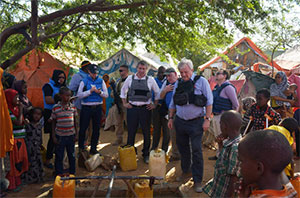 UN Emergency Relief Coordinator Visits Somalia. Credit: UN Photo/Tobin Jones
In recent years, conflicts have broken out across the world with no sign of slowing down or stopping. In times like this, millions of people globally are in dire need of humanitarian aid. Famine, warfare, natural disasters, and economic decline plague a host of nations, including Palestine, Sudan, Chad, Lebanon, and Haiti, to name a few. Humanitarian aid provides millions of people with critical services including healthcare, food, clean drinking water, psychosocial support, housing, and access to education. UN agencies such as the UNDP, UNICEF, the World Food Programme (WFP), UNHCR, UNRWA, and UNEP work with the UN Office for the Coordination of Humanitarian Aid (OCHA) and local organizations to come up with the best possible strategies to support affected communities. At the same time, humanitarian aid and those working on the frontlines are consistently threatened by both actors directly involved in conflict as well as those who are meant to contribute to the international humanitarian regime at large. The near-collapse of United States international aid structures in 2025, including the termination of 83% of USAID’s 6,300 global initiatives, has left millions of people without access to vital humanitarian assistance. 98 million people in 2025, only 65% of people targeted for humanitarian assistance, received the help they needed. In contrast, 123 million people received some form of humanitarian assistance in 2024, and OCHA’s 2026 Global Humanitarian Overview estimates that 239 million people are in need of assistance in 2026. IPS is well-positioned to discuss current initiatives to provide aid and relief through in-depth reporting and opinion content.

The Week with IPS

NEXT STOP - SDGs
Tracking global progress towards a sustainable world
Tracking global progress towards a sustainable world
