Languages
Saturday, October 17, 2026



News and Views from the Global South
Aid

Dushanbe Considering Bill to Restrict NGO Funding
It looks like Tajikistan is following a regional trend by drafting legislation that may sharply restrict the activities of foreign-funded non-governmental organisations. Activists say the bill threatens to hinder the operations of hundreds of organisations working on everything from human rights to public health.
Will Rollout of Green Technologies Get a Boost at Lima Climate Summit?
The road towards a green economy is paved with both reward and risk, and policymakers must seek to balance these out if the transition to low-carbon energy sources is to succeed on the required scale, climate experts say.
Women on the Edge of Land and Life
November is the cruelest month for landless families in the Indian Sundarbans, the largest single block of tidal mangrove forest in the world lying primarily in the eastern Indian state of West Bengal.
Rich Countries Pony Up (Some) for Climate Justice
It’s one of the oldest tricks in politics: Talk down expectations to the point that you can meet them.
Filipino Farmers Protest Government Research on Genetically Modified Rice
Jon Sarmiento, a farmer in the Cavite province in southern Manila, plants a variety of fruits and vegetables, but his main crop, rice, is under threat. He claims that approval by the Philippine government of the genetically modified ‘golden rice’ that is fortified with beta-carotene, which the body converts into vitamin A, could ruin his livelihood.
Water and Sanitation Report Card: Slow Progress, Inadequate Funding
The Ebola crisis has thrown into sharp relief the issue of water, sanitation and hygiene in treating and caring for the sick. Dying patients are being taken to hospitals which never had enough water to maintain hygiene, and the epidemic has pushed the system to the breaking point.
OPINION: How Ebola Could End the Cuban Embargo
When was the last time in recent memory a top U.S. official praised Cuba publicly? And since when has Cuba’s leadership offered to cooperate with Americans?
Pakistan’s Paraplegics Learning to Stand on their Own Feet
When a stray bullet fired by Taliban militants became lodged in her spine last August, 22-year-old Shakira Bibi gave up all hopes of ever leading a normal life.
Will Myanmar’s ‘Triple Transition’ Help Eradicate Crushing Poverty?
Myanmar is never out of the news for long. This has been the case since a popular uprising challenged military rule in 1988. For over two decades, the country was featured in mainstream media primarily as one unable to cope with its own internal contradictions, a nation crippled by violence.
Pakistani Sikhs Back in the ‘Dark Ages’ of Religious Persecution
Balwan Singh, an 84-year-old shopkeeper living in Pakistan’s northern Khyber Pakhtunkhwa province, is well past retirement age, but any illusions he may have had about living out his golden years in peace and security have long since been dashed.
Building Disaster Resilience Amidst Rampant Poverty
Of the thousands of landslide-prone villages he has visited and worked with, R M S Bandara, a high-ranking official from Sri Lanka’s National Building Resources Organisation (NBRO), says only one has made him sit up and take note.
Ebola Outbreak Affects Key Development Areas in Sierra Leone
The outbreak of the deadly Ebola epidemic in Sierra Leone has badly affected the West African country’s move towards meeting key development goals.
War-ravaged South Sudan Struggles to Contain AIDS
Dressed in a flowered African print kitenge and a blue head scarf, Sabur Samson, 27, sits pensively at the HIV centre at Maridi Civil Hospital in South Sudan’s Western Equatoria state.
U.S. Proposes Major Debt Relief for Ebola-Hit Countries
The United States proposed Tuesday that the international community write off 100 million dollars in debt owed by West African countries hit hardest by the current Ebola outbreak. The money would be re-invested in health and other public programming.
Ebola and ISIS: A Learning Exchange Between U.N. and Faith-based Organisations
The simultaneity presented by the outbreak of the deadly Ebola virus on one hand and militant barbarism ostensibly in the name of Islam on the other present the international development community - particularly the United Nations and international NGOs – with challenges, as well as opportunities.
How a Small Tribe Turned Tragedy into Opportunity
When the Asian tsunami washed over several Indian Ocean Rim countries on Boxing Day 2004, it left a trail of destruction in its wake, including a death toll that touched 230,000.
Braving Dust storms, Women Plant Seeds of Hope
In the world’s largest refugee complex – the sprawling Dadaab settlement in Kenya’s North Eastern Province – women listen attentively during a business management workshop held at a hospital in one of its newest camps, Ifo 2.
OPINION: Obstacles to Development Arising from the International System
As the international community wades into the political discussions regarding the alternatives to the Millennium Development Goals (MDGs) after 2015 and the design of the Sustainable Development Goals (SDGs) as mandated by the Rio+20 conference, it is timely to consider the question of whether development is a matter mostly of individual effort on the part of nation-states or whether there are elements in the international economic system that could serve as significant obstacles to national development efforts.
U.N. Chief Eyes Upcoming Summits to Resolve Development Crisis
The continued widespread economic recession - aggravated by the recent Ebola outbreak in West Africa - is threatening to undermine the U.N.'s highly-touted post-2015 development agenda.
A Fair Climate Treaty or None at All, Jamaica Warns
As the clock counts down to the last major climate change meeting of the year, before countries must agree on a definitive new treaty in 2015, a senior United Nations official says members of the Alliance of Small Island Developing States (AOSIS) “need to be innovative and think outside the box” if they hope to make progress on key issues.
Filipinos Take to the Streets One Year After Typhoon Haiyan
People covered their bodies with mud to protest against government ineptitude and abandonment; others lighted paper lanterns and candles and released white doves and balloons to remember the dead, offer thanks and pray for more strength to move on; while many trooped to a vast grave site with white crosses to lay flowers for those who died, and to cry one more time.« Previous Page — Next Page »





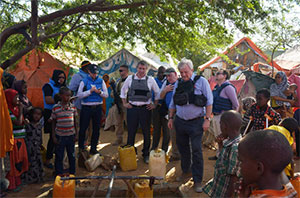 UN Emergency Relief Coordinator Visits Somalia. Credit: UN Photo/Tobin Jones
In recent years, conflicts have broken out across the world with no sign of slowing down or stopping. In times like this, millions of people globally are in dire need of humanitarian aid. Famine, warfare, natural disasters, and economic decline plague a host of nations, including Palestine, Sudan, Chad, Lebanon, and Haiti, to name a few. Humanitarian aid provides millions of people with critical services including healthcare, food, clean drinking water, psychosocial support, housing, and access to education. UN agencies such as the UNDP, UNICEF, the World Food Programme (WFP), UNHCR, UNRWA, and UNEP work with the UN Office for the Coordination of Humanitarian Aid (OCHA) and local organizations to come up with the best possible strategies to support affected communities. At the same time, humanitarian aid and those working on the frontlines are consistently threatened by both actors directly involved in conflict as well as those who are meant to contribute to the international humanitarian regime at large. The near-collapse of United States international aid structures in 2025, including the termination of 83% of USAID’s 6,300 global initiatives, has left millions of people without access to vital humanitarian assistance. 98 million people in 2025, only 65% of people targeted for humanitarian assistance, received the help they needed. In contrast, 123 million people received some form of humanitarian assistance in 2024, and OCHA’s 2026 Global Humanitarian Overview estimates that 239 million people are in need of assistance in 2026. IPS is well-positioned to discuss current initiatives to provide aid and relief through in-depth reporting and opinion content.

The Week with IPS

NEXT STOP - SDGs
Tracking global progress towards a sustainable world
Tracking global progress towards a sustainable world
