Languages
Friday, October 16, 2026



News and Views from the Global South
Aid

Children Starving to Death in Pakistan’s Drought-Struck Tharparkar District
The main entrance to the Civil Hospital in Mithi, headquarters of the Tharparkar district in Pakistan’s southern Sindh Province, is blocked by a couple of men clad in traditional dress and turbans. They are trying to console a woman who is sobbing so heavily she has to gasp for breath.
Sri Lanka Still in Search of a Comprehensive Disaster Management Plan
About six months after a massive tsunami slammed the island nation of Sri Lanka on Dec. 26, 2004, large plumes of smoke could be frequently seen snaking skywards from the beach near the village of Sainathimaruthu, just east of Kalmunai town, about 300 km from the capital, Colombo.
Small Grants for Big Solutions in Northeast Argentina
Summers in northeast Argentina are hot and humid. At siesta time, the people of this rural municipality like to drink “tereré” (cold yerba mate), which until now they had problems preparing because of lack of clean water or electricity. But sometimes small donations can make a big dent in inequality.
Poverty and Fear Still Rankle, Ten Years After the Tsunami
It took just 30 minutes for the killer waves to leave 350,000 dead and half a million displaced. Less than one hour for 100,000 houses to be destroyed and 200,000 people to be stripped of their livelihoods.
For Zimbabweans, Universal Education May be an Unattainable Goal
Zimbabwe boasts of one of the highest rates of literacy across Africa but, but without free primary education, achieving universal primary education here may remain a pipe dream, educationists say.
‘Cyclone College’ Raises Hopes, Dreams of India’s Vulnerable Fisherfolk
Ten years have now passed, but Raghu Raja, a 27-year-old fisherman from the coastal village of Nemmeli in southern India’s Kanchipuram district, still clearly remembers the day he escaped the tsunami.Changes to World Bank Safeguards Risk “Race to the Bottom”, U.N. Experts Warn
An unprecedented number of United Nations special rapporteurs and independent experts are raising pointed concerns over the World Bank’s ongoing review of its pioneering environmental and social safeguards, particularly around the role that human rights will play in these revamped policies.
UNIDO Development Initiative Gains Momentum in ACP Nations
The inclusive and sustainable industrial development (ISID) initiative of the U.N. Industrial Development Organisation to promote industrial development for poverty reduction, inclusive globalisation and environmental sustainability is gaining momentum in the countries of the African, Caribbean and Pacific (ACP) group.
OPINION: Give Peace a Chance – Run with Youth
Rambang “Raymond” Tot Deng was 18 and attending his final year of school when fighting erupted in South Sudan’s capital Juba, one year ago. In the ensuing violence, as Raymond’s schoolbooks burned, thousands of South Sudanese were killed, including two of his cousins.
OPINION: How Shifting to the Cloud Can Unlock Innovation for Food and Farming
The digital revolution that is continuing to develop at lightening speed is an exciting new ally in our fight for global food security in the face of climate change.
What Future for the ACP-EU Partnership Post-2015?
“There are still prospects for a meaningful ACP-EU partnership, capable of contributing and responding concretely and effectively to the objectives of promoting and attaining peace, security, poverty eradication and sustainable development,” according to the top official of the African, Caribbean and Pacific Group of States (ACP).
Afghan Concern Over Western Disengagement
The U.S./NATO International Security Assistance Force Joint Command lowered its flag for the last time in Afghanistan on Dec. 8, after 13 years. The ISAF mission officially ends on Dec. 31, and will be replaced on Jan. 1, 2015 by “Resolute Support”, a new, narrow-mandate mission to train, advise and assist the Afghan National Security Forces.
Mangrove Conservation Paves the Way to a Sustainable Future
 When the Asian tsunami washed over several Indian Ocean Rim countries on Boxing Day 2004, it left a trail of destruction in its wake, including a death toll that touched 230,000.

Groups Push Obama to Clarify U.S. Abortion Funding for Wartime Rape
Nearly two dozen health, advocacy and faith groups are calling on President Barack Obama to take executive action clarifying that U.S. assistance can be used to fund abortion services for women and girls raped in the context of war and conflict.
Starvation Strikes Zimbabwe’s Urban Dwellers
As unemployment deepens across this Southern African nation and as the country battles to achieve the United Nations Millennium Development Goals (MDGs) ahead of the December 2015 deadline, thousands of urban Zimbabweans here are facing starvation.World Bank Calls for Development Policy “Redesign” around Human Behaviour
The World Bank has taken an unusual but highly visible step away from traditional economics, encouraging policymakers and development implementers to place far more emphasis on research into local human behaviour when drawing up plans and projects.
U.N.’s 17 Sustainable Development Goals Remain Intact
Secretary-General Ban Ki-moon has refused to jettison any of the 17 Sustainable Development Goals (SDGs) proposed by an Open Working Group of member states: goals aimed at launching the U.N.'s new post-2015 development agenda through 2030.
Climate Finance Flowing, But for Many, the Well Remains Dry
For more than 10 years, Mildred Crawford has been “a voice in the wilderness” crying out on behalf of rural women in agriculture.
OPINION: Japan’s Misuse of Climate Funds for Dirty Coal Plants Exposed
World governments gathered in Lima, Peru for the latest round of U.N. climate negotiations should have finance on their mind.
Football Stars Join ‘Africa United’ Campaign to Stop Spread of Ebola
The Confederation of African Football (CAF) has joined a number of football stars, celebrities, international health organisations and corporations in the ‘Africa United’ global health communications campaign aimed at preventing the spread of Ebola in West Africa.
Mubarak Acquitted as Egypt’s Counterrevolution Thrives
The acquittal of former Egyptian President Muhammad Hosni Mubarak is not a legal or political surprise. Yet it carries serious ramifications for Arab autocrats who are leading the counterrevolutionary charge, as well as the United States.« Previous Page — Next Page »





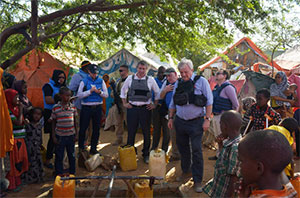 UN Emergency Relief Coordinator Visits Somalia. Credit: UN Photo/Tobin Jones
In recent years, conflicts have broken out across the world with no sign of slowing down or stopping. In times like this, millions of people globally are in dire need of humanitarian aid. Famine, warfare, natural disasters, and economic decline plague a host of nations, including Palestine, Sudan, Chad, Lebanon, and Haiti, to name a few. Humanitarian aid provides millions of people with critical services including healthcare, food, clean drinking water, psychosocial support, housing, and access to education. UN agencies such as the UNDP, UNICEF, the World Food Programme (WFP), UNHCR, UNRWA, and UNEP work with the UN Office for the Coordination of Humanitarian Aid (OCHA) and local organizations to come up with the best possible strategies to support affected communities. At the same time, humanitarian aid and those working on the frontlines are consistently threatened by both actors directly involved in conflict as well as those who are meant to contribute to the international humanitarian regime at large. The near-collapse of United States international aid structures in 2025, including the termination of 83% of USAID’s 6,300 global initiatives, has left millions of people without access to vital humanitarian assistance. 98 million people in 2025, only 65% of people targeted for humanitarian assistance, received the help they needed. In contrast, 123 million people received some form of humanitarian assistance in 2024, and OCHA’s 2026 Global Humanitarian Overview estimates that 239 million people are in need of assistance in 2026. IPS is well-positioned to discuss current initiatives to provide aid and relief through in-depth reporting and opinion content.

The Week with IPS

NEXT STOP - SDGs
Tracking global progress towards a sustainable world
Tracking global progress towards a sustainable world
