Languages
Wednesday, October 14, 2026



News and Views from the Global South
Aid

Pacific Islands Call for New Thinking to Implement Post-2015 Development Goals
As the Millennium Development Goals (MDGs), a set of poverty-alleviation targets set by the United Nations, come to a close this year, countries around the world are taking stock of their successes and failures in tackling key developmental issues.
Aid Freeze Over Energy Controversy a Blow to Tanzanian Economy
As foreign donors drag their feet on injecting badly needed cash into the government’s coffers, local analysts are increasingly worried that this will affect implementation of key development projects that require donor funding.
Children Starving to Death in Pakistan’s Drought-Struck Tharparkar District
 The main entrance to the Civil Hospital in Mithi, headquarters of the Tharparkar district in Pakistan’s southern Sindh Province, is blocked by a couple of men clad in traditional dress and turbans. They are trying to console a woman who is sobbing so heavily she has to gasp for breath.

Papal Visit Rekindles Hopes in Former War Zone
Jessi Jogeswaran, a 20-year-old woman from Sri Lanka’s northern Jaffna district, waited over six hours with 18 friends in the sweltering heat just to get a glimpse of Pope Francis on Jan. 14.
In the Shadow of Glacial Lakes, Pakistan’s Mountain Communities Look to Climate Adaptation
Khaliq-ul-Zaman, a farmer from the remote Bindo Gol valley in northern Pakistan’s Khyber Pakhtunkhwa province, has long lived under the shadow of disaster.
Island States Throw Off the Heavy Yoke of Fossil Fuels
The Caribbean nation of St. Kitts and Nevis, on a quest to become the world’s first sustainable island state, has taken a giant leap in its programme to cut energy costs.
European Citizens Call for Increased Aid to Developing World
An overwhelming majority of citizens in the 28-member European Union (EU) - which has been hamstrung by a spreading economic recession, a fall in oil prices and a decline of its common currency, the Euro - has expressed strong support for development cooperation and increased aid to developing nations.
Women ‘Sewing’ a Bright Future in Northern Pakistan
At 46, Naseema Nashad is starting her life over, not out of choice but out of necessity. The Afghan woman was just 25 years old when Taliban militants stormed Kabul and her family was forced to flee to neighbouring Pakistan to escape what they knew would be a brutal regime.
Bhopal Cloud Hovers Over Industrial Safety in India
Three decades after 40 tons of deadly methyl isocyanate gas leaked from the Union Carbide India Limited plant in the central Indian city of Bhopal on Dec. 3, 1984 – killing an estimated 4,000 almost instantly and maiming and blinding hundreds of thousands of others – the world's worst industrial disaster remains a sharp lesson on the need for greater safety regulations in Asia’s third-largest economy.
OPINION: No Nation Wants to Be Labeled “Least Developed”
Since 1971, Maldives is one of only three countries that have graduated from the ranks of the world’s “least developed countries” (LDCs) – the other two being Botswana and Cape Verde.
Sri Lanka’s Minorities Choose “Unknown Angel” Over “Known Devil”
When the initial results started trickling in a little after midnight on Jan. 9, it still wasn’t clear exactly which way the country would swing: had Sri Lanka’s 15 million eligible voters thrown in their lot with incumbent President Mahinda Rajapaksa for a third term? Or would the desire for change put common opposition candidate Maithripala Sirisena at the helm?U.N. Chief Leads the Way on the ‘Road to Dignity’
Addressing the 193 member states of the General Assembly on Thursday, United Nations Secretary-General Ban Ki-moon called for sweeping changes that would set the world on the path of sustainable development.
Integrated Farming: The Only Way to Survive a Rising Sea
When the gentle clucking grows louder, 50-year-old Sukomal Mandal calls out to his wife, who is busy grinding ingredients for a fish curry. She gets up to thrust leafy green stalks through the netting of a coop and two-dozen shiny hens rush forward for lunch.
Organic Farming in India Points the Way to Sustainable Agriculture
Standing amidst his lush green paddy fields in Nagapatnam, a coastal district in the southern Indian state of Tamil Nadu, a farmer named Ramajayam remembers how a single wave changed his entire life.
The Rise and Fall of the World’s Poorest Nations
The world's 48 Least Developed Countries (LDCs) - a special category of developing nations created by the General Assembly in 1971 but refused recognition by the World Bank - have long been described as "poorest of the poor" in need of special international assistance for their economic survival.
OPINION: Political Islam and U.S. Policy in 2015
This year, Arab political Islam will be greatly influenced by U.S. regional policy, as it has been since the Obama administration came into office six years ago. Indeed, as the U.S. standing in the region rose with Obama’s presidency beginning in January 2009, so did the fortunes of Arab political Islam.
Spectre of Violence Hangs Over Sri Lanka Polls
As 14.5 million Sri Lankans prepare to select their next leader, there is growing fear that violence could mar the Jan. 8 elections, billed as the closest electoral contest in the island’s history.
OPINION: Doubling Down on Dictatorship in the Middle East
For a moment, four years ago, it seemed that dictators in the Middle East would soon be a thing of the past.
Children Starving to Death in Pakistan’s Drought-Struck Tharparkar District
The main entrance to the Civil Hospital in Mithi, headquarters of the Tharparkar district in Pakistan’s southern Sindh Province, is blocked by a couple of men clad in traditional dress and turbans. They are trying to console a woman who is sobbing so heavily she has to gasp for breath.
Sri Lanka Still in Search of a Comprehensive Disaster Management Plan
About six months after a massive tsunami slammed the island nation of Sri Lanka on Dec. 26, 2004, large plumes of smoke could be frequently seen snaking skywards from the beach near the village of Sainathimaruthu, just east of Kalmunai town, about 300 km from the capital, Colombo.
Small Grants for Big Solutions in Northeast Argentina
Summers in northeast Argentina are hot and humid. At siesta time, the people of this rural municipality like to drink “tereré” (cold yerba mate), which until now they had problems preparing because of lack of clean water or electricity. But sometimes small donations can make a big dent in inequality.« Previous Page — Next Page »





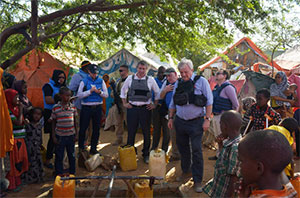 UN Emergency Relief Coordinator Visits Somalia. Credit: UN Photo/Tobin Jones
In recent years, conflicts have broken out across the world with no sign of slowing down or stopping. In times like this, millions of people globally are in dire need of humanitarian aid. Famine, warfare, natural disasters, and economic decline plague a host of nations, including Palestine, Sudan, Chad, Lebanon, and Haiti, to name a few. Humanitarian aid provides millions of people with critical services including healthcare, food, clean drinking water, psychosocial support, housing, and access to education. UN agencies such as the UNDP, UNICEF, the World Food Programme (WFP), UNHCR, UNRWA, and UNEP work with the UN Office for the Coordination of Humanitarian Aid (OCHA) and local organizations to come up with the best possible strategies to support affected communities. At the same time, humanitarian aid and those working on the frontlines are consistently threatened by both actors directly involved in conflict as well as those who are meant to contribute to the international humanitarian regime at large. The near-collapse of United States international aid structures in 2025, including the termination of 83% of USAID’s 6,300 global initiatives, has left millions of people without access to vital humanitarian assistance. 98 million people in 2025, only 65% of people targeted for humanitarian assistance, received the help they needed. In contrast, 123 million people received some form of humanitarian assistance in 2024, and OCHA’s 2026 Global Humanitarian Overview estimates that 239 million people are in need of assistance in 2026. IPS is well-positioned to discuss current initiatives to provide aid and relief through in-depth reporting and opinion content.

The Week with IPS

NEXT STOP - SDGs
Tracking global progress towards a sustainable world
Tracking global progress towards a sustainable world
