Languages
Wednesday, October 14, 2026



News and Views from the Global South
Aid

Analysis: Economic Growth Is Not Enough
Recent new data show a worrying picture of Latin America and the Caribbean. Income poverty reduction has stagnated and the number of poor has risen — for the first time in a decade — according to recent figures from the Economic Commission for Latin America and the Caribbean.
The Two Koreas: Between Economic Success and Nuclear Threat
The two Koreas are an odd match – both are talking about possible dialogue but both have different ideas of the conditions, and that difference comes from the 62-year-old division following the 1950-53 Korean War.
Maimed by Conflict, Forgotten by Peace: Life Through the Eyes of the War-Disabled
It is a hot, steamy day in Sri Lanka’s northwestern Mannar District. Mid-day temperatures are reaching 34 degrees Celsius, and the tarred road is practically melting under the sun.
Millennium Development Goals: A Mixed Report Card for India
Despite being one of the world's fastest expanding economies, projected to clock seven-percent GDP growth in 2017, India – a nation of 1.2 billion – is trailing behind on many vital social development indices while also hosting one-fourth of the world's poor.
Getting Bang for the Buck on New Development Goals
Right now, the United Nations is negotiating one of the world’s potentially most powerful policy documents. It can influence trillions of dollars, pull hundreds of millions out of poverty and hunger, reduce violence and improve education — essentially make the world a better place. But much depends on this being done well.
Warming, Wildfires and Worries
World leaders from government, finance, business, science and civil society are attempting to negotiate a legally binding and universal agreement on climate change at the upcoming 21st United Nations Climate Change Conference being convened in Paris in December.
U.N. Climate Talks Advance Link Between Gender and Climate Change
A week of climate negotiations in Geneva, Switzerland Feb. 8-13 are setting the stage for what promises to be a busy year. In order to reach an agreement in Paris by December, negotiators will have to climb a mountain of contentious issues which continue to overshadow the talks.
Women Pick Up the Slack as Fishing Declines on India’s Southern Coasts
Geeta Selvaraj and a few other women take turns to prepare meals with just one large gas cooker in a tiny shop.
U.N. Touts 2015 as Milestone Year for World Body
The United Nations, in a sustained political hype, is touting 2015 as a likely breakthrough year for several key issues on its agenda - primarily development financing, climate change, sustainable development, disaster risk-reduction and nuclear non-proliferation.
Youth Unemployment, Income Inequality Keep Rising
Global youth unemployment may be “six or seven times” what the International Labor Organisation’s (ILO) latest figures state, due to what a youth advocacy group calls a flawed system of assessment.
Bangladesh Fighting Inequality at the Preschool Level
Shanta* is only four years old, but already she loves school. Every morning, her mother walks her to the small pre-primary facility in Mohonpur village, about 140 km away from Bangladesh’s capital Dhaka, and leaves her in the care of a young female teacher, who oversees the day’s activities: storytelling, drama, reciting poetry.
Conflict-Related Displacement: A Huge Development Challenge for India
 The tarpaulin sheet, when stretched and tied to bamboo poles, is about the length and breadth of a large SUV. Yet, about 25 women and children have been sleeping beneath these makeshift shelters at several relief camps across Kokrajhar, a district in the north-eastern Indian state of Assam.

From Bullets to Ballots: The Face of Sri Lanka’s Former War Zone
In four months’ time, Sri Lanka will mark the sixth anniversary of the end of its bloody civil conflict. Ever since government armed forces declared victory over the Liberation Tigers of Tamil Eelam (LTTE) on May 19, 2009, the country has savored peace after a generation of war.

OPINION: The Plight of Women and Girls in Zambezi’s Floods
The flooding of the Zambezi River has had devastating consequences for three countries in Southern Africa. The three worst affected countries are Malawi, Mozambique and Zimbabwe.
Conflict-Related Displacement: A Huge Development Challenge for India
The tarpaulin sheet, when stretched and tied to bamboo poles, is about the length and breadth of a large SUV. Yet, about 25 women and children have been sleeping beneath these makeshift shelters at several relief camps across Kokrajhar, a district in the north-eastern Indian state of Assam.OPINION: Russia’s Friendship University, Educating the Developing World for 55 Years
People’s Friendship University of Russia (PFUR), which celebrates its 55th anniversary on Feb. 5, is known worldwide as a major academic and research centre. During the last five decades, PFUR has educated 80,000 students from 145 countries.
Antiguan Shanty Dwellers Ask if Poverty Will Be the Death of Them
It was early on a Saturday morning and there was no sign of life in the community. The shacks erected on both sides of the old, narrow road that winds through the area are all surrounded by zinc sheets which rise so high, it’s impossible to see what lies on the other side.
Developing Nations Write Hopeful New Chapters in a Toxic Legacy
The village of Dong Mai in Vietnam's agricultural heartland had a serious problem.
OPINION: The Corporate Takeover of Ukrainian Agriculture
At the same time as the United States, Canada and the European Union announced a set of new sanctions against Russia in mid-December last year, Ukraine received 350 million dollars in U.S. military aid, coming on top of a one billion dollar aid package approved by the U.S. Congress in March 2014.
Aboriginal Businesses Stimulate Positive Change in Australia
Roy Roger Gibson, an indigenous Kuku Yalanji elder, would watch thousands of tourists and vehicles trampling his pristine land while working on the sugarcane fields in Far North Queensland. His people were suffering and their culture was being eroded. The native wildlife was disappearing. He dreamt of turning this around.
From Bullets to Ballots: The Face of Sri Lanka’s Former War Zone
In four months’ time, Sri Lanka will mark the sixth anniversary of the end of its bloody civil conflict. Ever since government armed forces declared victory over the Liberation Tigers of Tamil Eelam (LTTE) on May 19, 2009, the country has savored peace after a generation of war.« Previous Page — Next Page »





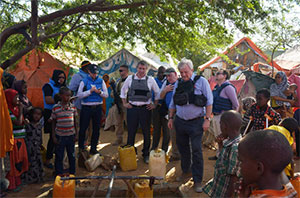 UN Emergency Relief Coordinator Visits Somalia. Credit: UN Photo/Tobin Jones
In recent years, conflicts have broken out across the world with no sign of slowing down or stopping. In times like this, millions of people globally are in dire need of humanitarian aid. Famine, warfare, natural disasters, and economic decline plague a host of nations, including Palestine, Sudan, Chad, Lebanon, and Haiti, to name a few. Humanitarian aid provides millions of people with critical services including healthcare, food, clean drinking water, psychosocial support, housing, and access to education. UN agencies such as the UNDP, UNICEF, the World Food Programme (WFP), UNHCR, UNRWA, and UNEP work with the UN Office for the Coordination of Humanitarian Aid (OCHA) and local organizations to come up with the best possible strategies to support affected communities. At the same time, humanitarian aid and those working on the frontlines are consistently threatened by both actors directly involved in conflict as well as those who are meant to contribute to the international humanitarian regime at large. The near-collapse of United States international aid structures in 2025, including the termination of 83% of USAID’s 6,300 global initiatives, has left millions of people without access to vital humanitarian assistance. 98 million people in 2025, only 65% of people targeted for humanitarian assistance, received the help they needed. In contrast, 123 million people received some form of humanitarian assistance in 2024, and OCHA’s 2026 Global Humanitarian Overview estimates that 239 million people are in need of assistance in 2026. IPS is well-positioned to discuss current initiatives to provide aid and relief through in-depth reporting and opinion content.

The Week with IPS

NEXT STOP - SDGs
Tracking global progress towards a sustainable world
Tracking global progress towards a sustainable world
