Languages
Saturday, October 17, 2026



News and Views from the Global South
Aid

The Young, Female Face of HIV in East and Southern Africa
Experts are raising alarm that years of HIV interventions throughout Africa have failed to stop infection among young women 15 to 24 years old.
Hopes of Controlling Sierra Leone’s Ebola Outbreak Remain Grim
The fight against the deadly Ebola epidemic ravaging West Africa seems to be hanging in the balance as Sierra Leone’s Minister of Health and Sanitation Dr Abubakar Fofana told IPS that the government is overwhelmed by the outbreak.
Learning, Dating and Hooking Up: Sex Education Goes Online in Cambodia
The transition to puberty can be an awkward experience for youth to navigate. In Cambodia, sex education is moving increasingly into the virtual realm, with the Internet and mobile phones providing welcome spaces for young people to learn, seek help and stay safe.
Middle-Income Kenya Still in Need of Aid
Coffee farmer Gabriel Kimwaki from Nyeri County, in central Kenya, is considering “giving up farming altogether”.
U.N. Favours Changeover from Landlocked to ‘Land-linked’
Some 440 million people are living in 32 countries that are among the world’s poorest, most of them least developed, and geographically isolated from world markets not only because they have very few commodities to export, but also because they have no direct territorial access to the sea.
Lacklustre Early Warning System Brings Tragedy to a Languid Mountainside
When early warning systems fail, death comes quickly to unsuspecting victims of natural disasters. It is a reality that millions of Sri Lankans have experienced repeatedly in the last decade, and yet those responsible for preventing human fatalities continue to make the same mistakes.
Iraqi Christians Seek Shelter in Jordan after IS Threats
Watching videos and pictures on social media of the advance of the Islamic State (IS) inside Syria made it all seem far from reality to Iraqi Marvin Nafee.
They Say the Land is ‘Uninhabited’ but Indigenous Communities Disagree
Disregarding the rights of indigenous people to their traditional lands is costing companies millions of dollars each year, and costing communities themselves their lives.
Bangladeshi ‘Char Dwellers’ in Search of Higher Ground
Jahanara Begum, a 35-year-old housewife, is surrounded by thatched-roof homes, all of which are partially submerged by floodwater.
OPINION: Ebola, Human Rights and Poverty – Making the Links
The catastrophic Ebola crisis unfolding in West Africa offers many lessons, not least for global anti-poverty efforts. These will culminate in a set of targets, to be agreed by the United Nations in 2015, known as the Sustainable Development Goals (SDGs).
Asia: So Close and Yet So Far From Polio Eradication
The goal is an ambitious one – to deliver a polio-free world by 2018. Towards this end, the multi-sector Global Polio Eradication Initiative (GPEI) is bringing out the big guns, sparing no expense to ensure that “every last child” is immunised against the crippling disease.Global South Brings United Front to Green Climate Fund
The United Nations’ key mechanism for funding climate change-related mitigation and adaptation in developing countries is now ready to receive funds, following a series of agreements between rich and poor economies.
Kashmir Flood Carries Away Humble Dreams
Rafiqa Kazim and her husband Kazim Ali had a simple dream – to live a modest life, educate their four children and repay the bank-loan that the couple took out to sustain their small business.
The Nagoya Protocol: A Treaty Waiting to Happen
For over 20 years, Mote Bahadur Pun of Nepal’s western Myagdi district has been growing ‘Paris polyphylla’ - a Himalayan herb used to cure pain, burns and fevers.
Panama’s Indigenous People Want to Harness the Riches of Their Forests
For indigenous people in Panama, the rainforest where they live is not only their habitat but also their spiritual home, and their link to nature and their ancestors. The forest holds part of their essence and their identity.
Belize Fights to Save a Crucial Barrier Reef
Home to the second longest barrier reef in the world and the largest in the Western Hemisphere, which provides jobs in fishing, tourism and other industries which feed the lifeblood of the economy, Belize has long been acutely aware of the need to protect its marine resources from both human and natural activities.
OPINION: Innovation Needed to Help Family Farms Thrive
Family farms have been contributing to food security and nutrition for centuries, if not millennia. But with changing demand for food as well as increasingly scarce natural resources and growing demographic pressures, family farms will need to innovate rapidly to thrive.
Africa Can Be its Own ‘Switzerland’
Africa has the capacity to access at least 200 billion dollars for sustainable development investment but it will remain a slave to foreign aid unless it improves the climate for investment and trade and plugs illicit financial flows, development experts say.
Cycle of Death, Destruction and Rebuilding Continues in Gaza
When the international pledging conference to rebuild a devastated Gaza ended in Cairo over the weekend - the third such conference in less than six years - the lingering question among donors was: is this the last of it or are there more assaults to come?
New Trains, New Hopes, Old Anguish
The kids of Kodikaman, a dusty village straddling the newly laid railway line in Sri Lanka’s northern Jaffna District, enjoy a special treat these days.
New Trains, New Hopes, Old Anguish
 The kids of Kodikaman, a dusty village straddling the newly laid railway line in Sri Lanka’s northern Jaffna District, enjoy a special treat these days.
« Previous Page — Next Page »





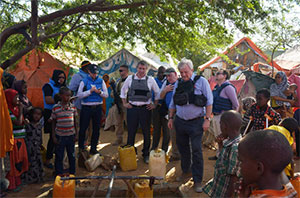 UN Emergency Relief Coordinator Visits Somalia. Credit: UN Photo/Tobin Jones
In recent years, conflicts have broken out across the world with no sign of slowing down or stopping. In times like this, millions of people globally are in dire need of humanitarian aid. Famine, warfare, natural disasters, and economic decline plague a host of nations, including Palestine, Sudan, Chad, Lebanon, and Haiti, to name a few. Humanitarian aid provides millions of people with critical services including healthcare, food, clean drinking water, psychosocial support, housing, and access to education. UN agencies such as the UNDP, UNICEF, the World Food Programme (WFP), UNHCR, UNRWA, and UNEP work with the UN Office for the Coordination of Humanitarian Aid (OCHA) and local organizations to come up with the best possible strategies to support affected communities. At the same time, humanitarian aid and those working on the frontlines are consistently threatened by both actors directly involved in conflict as well as those who are meant to contribute to the international humanitarian regime at large. The near-collapse of United States international aid structures in 2025, including the termination of 83% of USAID’s 6,300 global initiatives, has left millions of people without access to vital humanitarian assistance. 98 million people in 2025, only 65% of people targeted for humanitarian assistance, received the help they needed. In contrast, 123 million people received some form of humanitarian assistance in 2024, and OCHA’s 2026 Global Humanitarian Overview estimates that 239 million people are in need of assistance in 2026. IPS is well-positioned to discuss current initiatives to provide aid and relief through in-depth reporting and opinion content.

The Week with IPS

NEXT STOP - SDGs
Tracking global progress towards a sustainable world
Tracking global progress towards a sustainable world
