Languages
Monday, October 26, 2026



News and Views from the Global South
Education
The “Shocking” Reality of Child Marriage in the U.S.
While stories of child marriage are commonly associated with the Global South, lesser known are the cases closer to home: in the United States.
Renewing Commitment to SDGs: Private Sector Gets Active
Just last month business representatives from around the world joined the United Nations Sustainable Development Goals Fund commemorate their work as part of the Private Sector Advisory Group (PSAG).
AIDS Pandemic Far From Over: 37 Million Living with HIV Globally
During the process of developing the Sustainable Development Goals it was clear to me how relevant and innovative the approach to ending AIDS had been and how important it would continue to be.
Brazil Drives New School Feeding Model in the Region
“I am going back to Panama with many ideas,” said Gilda Montenegro, a nutritionist with the Panamanian Education Ministry, after getting to know the school feeding system in the city of Vitoria, in central-eastern Brazil.
Menstrual Health and Vitality: Breaking the Silence, Stemming the Flood
Menstruation matters to everyone, everywhere. But it still matters so much more to women and girls, who have historically been asked to bleed in stoic silence so that no one even knows they have their period.
No One is Left Behind
In the context of global development, ‘no one is left behind’ brings with it a powerful message. It emphasizes progress- one that is inclusive, fair, integrated and empowering. The phrase ‘No one is left behind’ is mentioned some five times in the 2030 Agenda for Sustainable Development that was adopted by all governments at the United Nations in 2015. The Agenda is a plan of action for people, planet, peace and prosperity. It has globally agreed 17 Sustainable Development Goals and 169 ambitious targets, and should be achieved within the next decade ‘to end poverty and hunger everywhere; to combat inequalities within and among countries; to build peaceful, just and inclusive societies; to protect human rights and promote gender equality and the empowerment of women and girls; and to ensure the lasting protection of the planet and its natural resources.’
New Education Model Can “Achieve Much More,” Says Education Envoy
UN’s education envoy has unveiled a new model that could provide every child with access to education by 2030. Citing concerns about the neglect of children’s rights, the Special Envoy for Global Education Gordon Brown urged for more and better finance to ensure every child is in school and learning.
Malala Yousafzai Becomes UN’s Youngest Messenger of Peace
Pakistani education activist Malala Yousafzai has become the youngest UN Messenger of Peace with a special focus on girls’ education.
How a Devastating Hurricane Led to St. Vincent’s First Sustainability School
In the 1980s, an institution for troubled Danish youth and a vocational school for Vincentians was built in Richmond Vale, an agricultural district on the northwestern tip of St. Vincent.A Special Learning Journey Cut Short
When building a house, it’s critical to lay a strong foundation. The same applies to education, with studies showing that children who attend early learning centers perform better in school than those who do not.
France Hosts Major Exhibition on Jamaican Music
It’s one of those movie-like spring days in Paris, where blue skies and brilliant sunshine lift spirits after a long, wet, grey winter. Many people are outdoors trying to catch the rays, but Jamaican artist Danny Coxson is not among them. He’s inside a museum in a northeastern neighbourhood of the French capital, with a brush in his hand and tubs of vivid paint beside him, focusing on finishing a portrait of a deejay named Big Youth.
Free Education Helps Combat Child Labour in Fiji
In the South Pacific nation of Fiji, free and compulsory education, introduced three years ago, in association with better awareness and child protection measures, is helping to reduce children’s vulnerability to harmful and hazardous forms of work.
New Recipe for School Meals Programmes in Latin America
Sunita Daniel remembers what the school lunch programmes were like in her Caribbean island nation, Saint Lucía, until a couple of years ago: meals made of processed foods and imported products, and little integration with the surrounding communities.
Menstrual Hygiene Project Keeps Girls in School
Breaking taboos surrounding menstruation, a project to distribute sanitary napkins to girls in one district of Bangladesh has had a positive impact on school dropout rates – and should be replicated in other parts of the country, experts say.
370 Million Children Eat Healthy Food at School, Every Day
Every day some 370 million children around the world are fed at school, while learning about healthy food and nutrition through school meals programmes that also help boost attendance, the United Nations reports.
Barefoot Solar Warriors Take On Gender Injustice and Climate Change
On a summer morning in 2008, Magan Kawar decided to leave her village for a job. The very next day, her parents-in-law excommunicated her.
These Women Cannot Celebrate Their Day
This is a story that one would wish to never have to write—the story of hundreds of millions of life-givers whose production and productivity have systematically been ‘quantified’ in much detailed statistics, but whose abnegation, human suffering and denial of rights are subject to just words.
No Hidden Figures: Success Stories Can Help Girls’ STEM Careers
What makes a young girl believe she is less intelligent and capable than a boy? And what happens when those children face the ‘hard’ subjects like science, technology, engineering and mathematics (STEM)? A recent study, ‘Gender stereotypes about intellectual ability emerge early and influence children’s interests’ showed that by the age of 6, girls were already less likely than boys to describe their own gender as ‘brilliant’, and less likely to join an activity labelled for ‘very, very smart’ kids.
Stop worrying about ‘Doing Business’ ranking
Without any hint of irony, the World Bank’s most recent Doing Business Report 2017 promises ‘Equal Opportunity for All’. Bangladesh ranked 176th among 190 economies, below civil war-ravaged Iraq and Syria! Bangladesh even slipped two places from 174 in the 2016 ranking and is three places below its 2015 ranking.
More of the Same: World Bank Doing Business Report Continues to Mislead
The World Bank’s Doing Business Report 2017, subtitled ‘Equal Opportunity for All’, continues to mislead despite the many criticisms, including from within, levelled against the Bank’s most widely read publication, and Bank management promises of reform for many years.
Why Achieving Sdg Goal 8 on Decent Work and Economic Growth Is Critical for Kenya
In Kenya the Gini coefficient of inequality is at around 0.45%. Therefore, the economic growth statistics present an unequivocal picture of a highly unequal society, whose development strategy is largely leading to accumulation of wealth by a few and worsening the poverty of the majority.« Previous Page — Next Page »





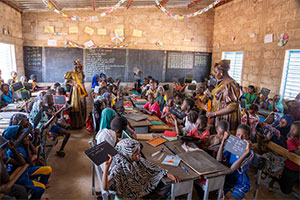 Two teachers work in a classroom in Forces Vives School in Dori, Burkina Faso. Credit: UNICEF/UNI978361
Safe and uninterrupted education is a fundamental right for all children. Education is paramount to global development, as it has been proven that investing in education – especially for girls and children – contributes significantly to economic growth and prosperity. Although more than 1 billion children go to school, many are subjected to conditions that are not conducive to a proper learning environment, including makeshift facilities, a lack of supplies, violence in classrooms, inadequate sanitation, untrained instructors, and widespread school closures. Since 2015, there have been immense gains in education with an increase of 109 million children in school. However, as of 2023, 272 million children are still out of school.
High poverty levels in developing countries also impede children’s access to a proper education. For example, from the early to mid 2000s, Sub-Saharan African nations witnessed a dramatic decline in trained teachers due to inadequate funding in the education sector. Furthermore, major cuts to United States international aid threaten an estimated 23 million additional children's access to education, as USAID‑funded school programmes across Africa and Asia face closure.
Various other factors contribute to the decline of education, notably hunger, which has increased as conflict and climate change interfere with global food production and dissemination. Meanwhile, certain social and cultural practices also impede children’s access to education, with gender inequality, discrimination, child labour, and child marriages preventing millions of children from attending school. Economic conditions such as the inaccessibility of higher education also affect disenfranchised communities across the world. In extreme situations, such as warfare where educational facilities are destroyed in their totality, notably in Gaza and Sudan, entire generations of children might grow up without access to education. Rebuilding educational infrastructure is a long and arduous process, especially when violence persists across generations, and this significantly stunts the development of societal prosperity and stability.
IPS is dedicated to telling the shocking truths about worldwide education through impassioned opinion pieces and comprehensive articles, highlighting global issues that impede worldwide education and the courses of action being taken by organizations such as UNICEF and Education Cannot Wait.

The Week with IPS

NEXT STOP - SDGs
Tracking global progress towards a sustainable world
Tracking global progress towards a sustainable world
