Languages
Monday, October 26, 2026



News and Views from the Global South
Education

The United Nations Volunteer: From Global To Local
Today 05 December is International Volunteer Day, and every year we recognize the invaluable contributions of volunteers to peace and development.
Unleashing Africa Full Potential
Africa, the cradle of mankind and home to the youngest population in the world, has a historic opportunity to realise its full potential, in sharing our potential prosperity, by enhancing economic growth, promoting and entrenching democratic ideals. That is why I am so passionate to be running for the coveted African Union Commission (AUC) Chairperson.
Students Under Siege as Schools Burn in India’s Troubled Kashmir
In the fading light of a November afternoon, 12-year-old Mariya Sareer bends over a textbook, trying to read as much as she can before it gets dark. It's been nearly five months since the seventh grader from Shurat, a village 70 kms south of Srinagar city, last went to school, thanks to a raging political conflict.
Children of the ‘Others’, Sons of Minor Gods
In December 1946, “faced with the reality of millions of children suffering daily deprivation in Europe after World War II,” the General Assembly of the United Nations created the UN International Children’s Emergency Fund (UNICEF), to mount urgent relief programmes.
Beyond Calais: A Perspective on Migration, Agriculture and Rural Development
Migration is part of the process of development. It is not a problem in itself, and could, in fact, offer a solution to a number of matters. Migrants can make a positive and profound contribution to the economic and social development of their countries of origin, transit and destination alike. To quote the New York Declaration, adopted at the UN Summit on Refugees and Migrants on 19 September, “migrants can help to respond to demographic trends, labour shortages and other challenges in host societies, and add fresh skills and dynamism to the latter’s economies”.
Q&A: Bangladesh’s ‘Higher Trajectory of Development’ Not Easy but Achievable
Bangladesh, a country of 160 million people, has made significant progress in its efforts to accelerate economic growth, reduce poverty and promote social development, but it now faces certain challenges in consolidating these achievements and marching forward on the higher trajectory of development, says one of its leading economists.
Student Struggle in South Africa Gains Momentum
When #FeesMustFall began to trend on social media platforms in South Africa in October 2015, government shrugged it off as an example of isolated hotheads, while political pundits predicted the student campaign wouldn’t last.
Making Policy out of Scientific Bricks, not Straw
Given the enormity of the challenges confronting humanity, the world’s investment in science, technology and innovation is woefully inadequate.
Community Conversations in Ethiopia Prevents Exploitative Migration
Five years ago, when Meliya Gumi’s two daughters, Gifty* and Chaltu,* aged 16 and 18, migrated to Dubai and Qatar respectively, as domestic workers, everyone thought they were moving towards a better future. As a widowed mother of eight with little resources, living in the village of Haro Kunta in the Oromia region of Ethiopia, Gumi had a difficult time making ends meet.
Jobs Are Crucial for Peace, Stem Radicalization and Violent Extremism in Kenya
Today 21 September 2016 is the International Day of Peace. Kenya has the largest number of jobless youth in East Africa, putting a strain on the economy’s growth and also threatening peace and security when hopeless youth gravitate towards violent extremist groups.
Argentina at Risk of an Educational System Serving the Market
In Argentina, teachers, students and trade unionists are protesting against mass redundancies in education, which they say are part of a process of undermining public education and a move towards a new model based on market needs.
Muslims in Europe: Can There Be Social Harmony ?
Although 20 million Muslims reside in Western Europe, establishing social harmony between the Muslim community and their European counterparts has proved exceedingly challenging.Much to the dismay of international humanitarian agencies and anti-racism activists,the language of exclusion and prejudice persists.
Global Citizenship Education Aims to Break Down Artificial Barriers
The importance of education in the promotion of peace, sustainable development and human dignity, and the prevention of violent extremism, was the focus of a Global Citizenship Education Seminar at UN headquarters in New York on Friday September 9.
Smart Technologies Key to Youth Involvement in Agriculture
She is only 24 and already running her father’s farm with 110 milking cows. Cornelia Flatten sees herself as a farmer for the rest of her life.
Youth Key to the Success of the SDGs in Kenya
Consider this: in 1956 Sweden and Kenya’s population was roughly at 7 million. Today Sweden has about 9.8 million, while there are about 44 million Kenyans. Fertility levels are declining gradually and Kenyans are living longer. It is estimated that there will be 85 million people in Kenya by 2050, with three quarters of these being below 35 years. While Kenya’s median age is 19, Sweden’s is 42.
Youth Employment: Turning Workplace Partnerships into Opportunity
Many of us can remember the difficulties of getting our first job – the searching, the frustration of rejection, the nervous wait for an interview or the first day of work. Today’s staggering unemployment rates in many countries make it an especially difficult time for young job-seekers.
The UN Steps up Efforts to End Child Marriage
Barely 17 years old and from the Gajapati district in Odisha, India, Susmita has never gone to school. She rears the few animals her family owns, and this is her primary duty besides attending to household chores.
Education: An Elusive Dream for Cameroon’s Indigenous Peoples
It is a sunny afternoon in Boui, a small village in the Boumba and Ngoko Division of Cameroon’s South East Region. A primary school teacher is drawing some wild animals on the blackboard. Then she turns to the class of fifteen pupils.
The Floating Schools of Chalan Beel
 They don't go to schools, schools come to them.
Currently, some 2,000 underprivileged children are attending classes in 22 floating schools that move across the Chalan Beel in Pabna, Natore and Sirajganj districts.
They don't go to schools, schools come to them.
Currently, some 2,000 underprivileged children are attending classes in 22 floating schools that move across the Chalan Beel in Pabna, Natore and Sirajganj districts.

Indigenous Communities Risk Lives in Struggle for Self-determination in Education
Indigenous peoples around the world continue to struggle for self-determination over their education, as highlighted by recent protests against proposed education reforms in Oaxaca, Mexico, which have left at least six people dead.
Right to Education Still Elusive for Native People in Latin America
Education, the most powerful instrument in the struggle against exclusion and discrimination, is still elusive for indigenous people in Latin America who remain the most disadvantaged segment of the population despite their wide presence in the region.« Previous Page — Next Page »





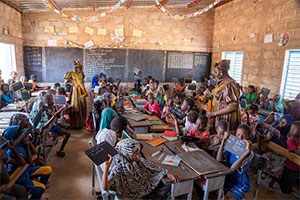 Two teachers work in a classroom in Forces Vives School in Dori, Burkina Faso. Credit: UNICEF/UNI978361
Safe and uninterrupted education is a fundamental right for all children. Education is paramount to global development, as it has been proven that investing in education – especially for girls and children – contributes significantly to economic growth and prosperity. Although more than 1 billion children go to school, many are subjected to conditions that are not conducive to a proper learning environment, including makeshift facilities, a lack of supplies, violence in classrooms, inadequate sanitation, untrained instructors, and widespread school closures. Since 2015, there have been immense gains in education with an increase of 109 million children in school. However, as of 2023, 272 million children are still out of school.
High poverty levels in developing countries also impede children’s access to a proper education. For example, from the early to mid 2000s, Sub-Saharan African nations witnessed a dramatic decline in trained teachers due to inadequate funding in the education sector. Furthermore, major cuts to United States international aid threaten an estimated 23 million additional children's access to education, as USAID‑funded school programmes across Africa and Asia face closure.
Various other factors contribute to the decline of education, notably hunger, which has increased as conflict and climate change interfere with global food production and dissemination. Meanwhile, certain social and cultural practices also impede children’s access to education, with gender inequality, discrimination, child labour, and child marriages preventing millions of children from attending school. Economic conditions such as the inaccessibility of higher education also affect disenfranchised communities across the world. In extreme situations, such as warfare where educational facilities are destroyed in their totality, notably in Gaza and Sudan, entire generations of children might grow up without access to education. Rebuilding educational infrastructure is a long and arduous process, especially when violence persists across generations, and this significantly stunts the development of societal prosperity and stability.
IPS is dedicated to telling the shocking truths about worldwide education through impassioned opinion pieces and comprehensive articles, highlighting global issues that impede worldwide education and the courses of action being taken by organizations such as UNICEF and Education Cannot Wait.

The Week with IPS

NEXT STOP - SDGs
Tracking global progress towards a sustainable world
Tracking global progress towards a sustainable world
