Languages
Wednesday, October 21, 2026



News and Views from the Global South
Energy

Mexican Village Wants to Turn Thermoelectric Plant into Solar Panel Factory
Social organisations in the central Mexican municipality of Yecapixtla managed to halt the construction of a large thermoelectric plant in the town and are now designing a project to convert the installation into a solar panel factory, which would bring the area socioeconomic and environmental dividends.
Solar Energy Begins to Light Up Favelas in Rio de Janeiro
 “We can’t work just to pay the electric bill,” complained José Hilario dos Santos, president of the Residents Association of Morro de Santa Marta, a favela or shantytown embedded in Botafogo, a traditional middle-class neighborhood in Rio de Janeiro.
Q&A: ‘There’s a Lot More Climate Finance Available than People Think’
While growth in the green economy looks promising, government regulation and a business-as-usual approach are among the hurdles inhibiting cleaner energy production.
A Closer Look at the World Bank’s Sizable China Portfolio
China continues to borrow an average of $2 billion a year from the World Bank, making it one of the Bank’s top borrowers—despite being the world’s second-largest economy and itself a major global lender, according to our study released today.
Local Innovation Facilitates Solidarity-Based Biogas Networks in Cuba
Black plastic pipes, readily available on the mainly empty shelves of Cuba’s shops, distribute biogas to homes in the rural town of La Macuca, buried under the ground or running through the grass and stones in people’s yards.
Solar Energy Crowns Social Housing Programme in Brazil
"Solar energy makes my happiness complete," said Divina Cardoso dos Santos, owner of one of 740 houses with photovoltaic panels on the rooftops in a settlement on the outskirts of this central Brazilian city.
Getting Sustainable Development Back on Track in Asia & the Pacific
2019 will be a landmark year for the United Nations 2030 Agenda for Sustainable Development. Four years will have passed since world leaders adopted the Sustainable Development Goals (SDGs). Four years since governments recommitted themselves to eradicating extreme poverty, improving universal health care coverage, education and food security, and achieving a sweeping set of economic, social and environmental objectives. Long enough to assess our direction of travel and then refocus work where progress is falling short.Aborted Fuel Tax Initiative in France: Its Ramifications for Green Growth
Emmanuel Macron was voted to French Presidency in 2017 with the mission of strengthening the integration of the European Union and pursuing economic and ecological reforms. So from the outset, he was set to distinguish himself, not just in Europe but on the world stage, especially after President Trump pulled the United States out of the Paris Agreement. So Macron held the summit meeting on `One Planet’ in Paris last December to push for stronger environment and climate policy. He also spoke of the environment when he addressed the Congress in April 2018, stating that “Let us face it: There is no Planet B.”i
What the COP24 Needs: A New Emerging Mindset
An alternative framework of international development and new forms of consumption of good/services are implicit in achieving the goals of UN climate conference recently held in Poland.
Of Cockroaches and Humans
Rita Levi-Montalcini, the Italian Nobel laureate honoured for her work in neurobiology, once gave a splendid conference with the title “The imperfect brain”. There she explained that man has a brain that is not used completely, while the reverse is true for the cockroach.
Investors Turn Kenya’s Troublesome Invasive Water Hyacinth into Cheap Fuel
Currently 30 square kilometres of Lake Victoria, which stretches to approximately 375 kilometres and links Tanzania, Kenya and Uganda, is covered with the evasive water hyacinth that has paralysed transport in the area. But scientists are harvesting and fermenting the weed, and one intrepid chemistry teacher has built a business out of it.
Q&A: Making Green Growth a Success Across the Globe
When the Global Green Growth Institute’s (GGGI) Director General Frank Rijsberman’s son was looking for a job following graduation, he saw that oil companies were paying the highest salaries. But Rijsberman, who has been working in the sustainable development sector for decades, knew better. He told his son that those very same oil companies would soon go broke. And instead advised him to seek employment with renewable energy companies as they would soon be the ones making money.
70 Years since the Universal Declaration on Human Rights – Hope Against Hope
“Save the Children estimates that 84,701 children under five have died in Yemen from untreated cases of severe acute malnutrition between April 2015 and October 2018.” “The grim analysis of United Nations data comes as intense fighting has again erupted in Yemen's strategic port city of Hodeidah.”
The Revolution of Renewable Energy Needs Political Leadership
The cost of renewable energy is low, and at times, less than fossil fuels. What are the barriers to switching to renewables? Where current energy systems exist, they will need to be upgraded to be able to draw power from modern renewables and to exploit storage solutions that they require.
Thermal Houses Keep People Warm in Peru’s Highlands
Thirty families from a rural community more than 4,300 meters above sea level will have warm houses that will protect them from the freezing temperatures that each year cause deaths and diseases among children and older adults in this region of the southeastern Peruvian Andes.
Climate Action Should be a Global Priority for World Leaders
The IPCC report says that it is not impossible to limit climate change to 1.5͒C? Do you think we can realistically achieve that? Politically, what needs to happen? History shows that when the human race decides to pursue a challenging goal, we can achieve great things. From ridding the world of smallpox to prohibiting slavery and other ancient abuses through the Universal Declaration of Human Rights, we have proven that by joining together we can create a better world.
Get Ready for COP24: Transition to a Sustainable Future
COP24 is the time for governments to act and increase their pledges to prevent global warming ensuring a just transition that leaves no one behind.
Limiting Climate Change to 1.5 C is not Impossible, Says IPCC Chair
When governments set a target in December 2015 of limiting global warming to well below 2ºC above pre-industrial levels while pursuing efforts to hold it at 1.5ºC, they invited the IPCC to prepare a report to provide information on this Goal.
Over Half of the World’s Tropical Forests Have been Destroyed, Say Conservationists
Biodiversity conservationists have revealed that at least 10 more percent of land than what is currently being used to grow green crops will be required to successfully replace fossil fuels with alternatives derived from natural sources such as biofuel.
NGOs Call for Disinvestments in Biodiversity Destruction
A discussion held earlier this week at the ongoing Convention of Biodiversity’s (CBD) Conference of Parties in Egypt highlighted that grants to curb deforestation in the Amazon are not enough if they are accompanied with investments that increase the loss of biodiversity.
Solar Energy Drives Social Development in Brazil’s Favelas
"We can't work just to pay the electric bill," complained José Hilario dos Santos, president of the Residents Association of Morro de Santa Marta, a favela or shantytown embedded in Botafogo, a traditional middle-class neighborhood in Rio de Janeiro.« Previous Page — Next Page »





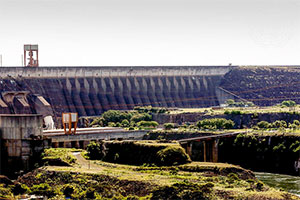 UN Power Plant, Paraguay. Credit: UN Photo/Evan Schneider
Energy has posed a great challenge for economies around the world. As global energy consumption skyrockets throughout the years, so does the need for sustainable solutions. The Sustainable Development Goals are essential in providing people with access to safe, affordable, and sustainable energy sources that minimize harm on the planet. Progress towards these goals opens the door for an advancement in modernization for communities on a global level and allows for a potential mitigation of tensions between nations.
The UN’s Summit of the Future in 2024 offered new initiatives that are being taken to achieve these goals, including a decreased reliance on fossil fuels, a switch to renewable energy sources, and improved climate financing.
IPS is well positioned to provide relevant, insightful, and compelling analysis of recent updates and measures being taken around the world to achieve a cleaner future.

The Week with IPS

NEXT STOP - SDGs
Tracking global progress towards a sustainable world
Tracking global progress towards a sustainable world
